Quranic Answer
My dear friend, this question deeply resonates within many of us and has profound roots in human psychology and social interactions. At first glance, it might seem that the Holy Quran doesn't directly address the modern concept of 'always being myself.' However, with a little contemplation and reflection on the divine verses, we discover that Quranic concepts delve with unparalleled depth into the inner and outer dimensions of human personality, offering solutions for achieving true integrity and authenticity. Indeed, the concern 'Why can't I always be myself?' in the Quranic framework can be understood as a lack of consistency between one's outward actions and inner beliefs, fear of others' judgment, or yielding to the temptations of the lower self (nafs al-ammarah) and Satan, which pull a person away from their divine 'fitra.' The Holy Quran states that humanity has been created with a pure 'fitra.' This fitra is the primordial, unblemished nature with which every human being is born, containing an inherent inclination towards recognizing God, goodness, benevolence, and truth-seeking. In Surah Ar-Rum, verse 30, we read: 'So direct your face toward the religion, inclining to truth. [Adhere to] the fitra of Allah upon which He has created [all] people. No change in the creation of Allah. That is the correct religion, but most of the people do not know.' This verse indicates that our 'true self' is that divine fitra, which guides us towards monotheism and righteous deeds. When we cannot 'be ourselves,' we are essentially distancing ourselves from this authentic nature and falling under the influence of factors that contradict this fitra. One of the most significant reasons a person cannot always be themselves is societal pressure and expectations. Sometimes, for acceptance, to maintain status, or to avoid rejection, we feel compelled to put on a facade and exhibit behavior contrary to what we genuinely feel inside. This phenomenon is strongly condemned in the Quran by the term 'nifaq' (hypocrisy). Hypocrisy precisely means the incongruity between appearance and reality; that is, a person expresses something they do not truly believe in their heart or performs an action with a different underlying intention. Surah An-Nisa, verse 142, describes the state of hypocrites thus: 'Indeed, the hypocrites [think to] deceive Allah, but He is deceiving them. And when they stand for prayer, they stand lazily, showing [themselves to] the people and not remembering Allah except a little.' This verse demonstrates that striving to 'display' oneself to others, instead of genuinely 'being' for God, leads to a state of instability and anxiety, preventing true peace. In addition to external pressures, internal struggles also play a significant role in this lack of integrity. The 'nafs al-ammarah,' or the commanding self that inclines towards evil, constantly strives to push us towards fleeting worldly desires and passions. Following these desires can alienate a person from their fundamental and divine values, leading them to act in ways that contradict their 'true self' and their faith. Furthermore, the whisperings of Satan are another factor that encourages deception and showmanship, leading people astray from the path of truth. In Surah Al-Kahf, verse 28, Allah advises the Prophet to patiently keep company with those who call upon their Lord morning and evening, seeking His countenance, and not to turn his eyes away from them in pursuit of worldly adornments, nor to obey one whose heart Allah has made heedless of His remembrance, one who follows his desires and whose affair has been a loss: 'And keep yourself patient [by being] with those who call upon their Lord in the morning and the evening, desiring His countenance. And let not your eyes pass beyond them, desiring adornments of the worldly life. And do not obey one whose heart We have made heedless of Our remembrance and who follows his desire and whose affair has been [a] loss.' This verse highlights the importance of associating with those who help us adhere to our 'true self' and avoiding those who encourage showmanship and heedlessness. The Quranic solution to overcoming this problem lies in 'steadfastness' (istiqamah) and 'sincerity' (ikhlas). The Quran commands believers to be firm and steadfast on the path of truth and in obedience to divine commands. Surah Hud, verse 112, states: 'So remain on a straight course as you have been commanded, [you] and those who have turned back with you [to Allah], and do not transgress. Indeed, He is Seeing of what you do.' Steadfastness means that a person, under all circumstances, whether alone or in public, adheres to their principles and values, and does not abandon the truth out of fear of others' judgment or the temptations of the self. This steadfastness is what grants a person integrity and authenticity, enabling them to always 'be themselves' – that is, the person God created them to be and invited them towards. Sincerity is another key to 'always being yourself.' Sincerity means purifying one's intention and action solely for God, far from any hypocrisy or self-display. When a person does everything only for Allah's pleasure, they are no longer concerned with people's judgment and see no need to play a role to gain their attention. This liberation from the shackles of others' gazes allows a person to live with complete peace and inner honesty, being truly who they are. Purification of the soul (tazkiyat al-nafs) is also a continuous process wherein, through self-knowledge and struggle against carnal and satanic desires, a person removes layers of impurity from their pure fitra and draws closer to their 'true self.' Ultimately, 'always being yourself' from a Quranic perspective means living with complete honesty, harmony between appearance and inner reality, steadfastness on the path of truth, and purifying intentions for God. This path leads to peace, authenticity, and divine pleasure, freeing a person from the servitude of others' opinions.
Related Verses
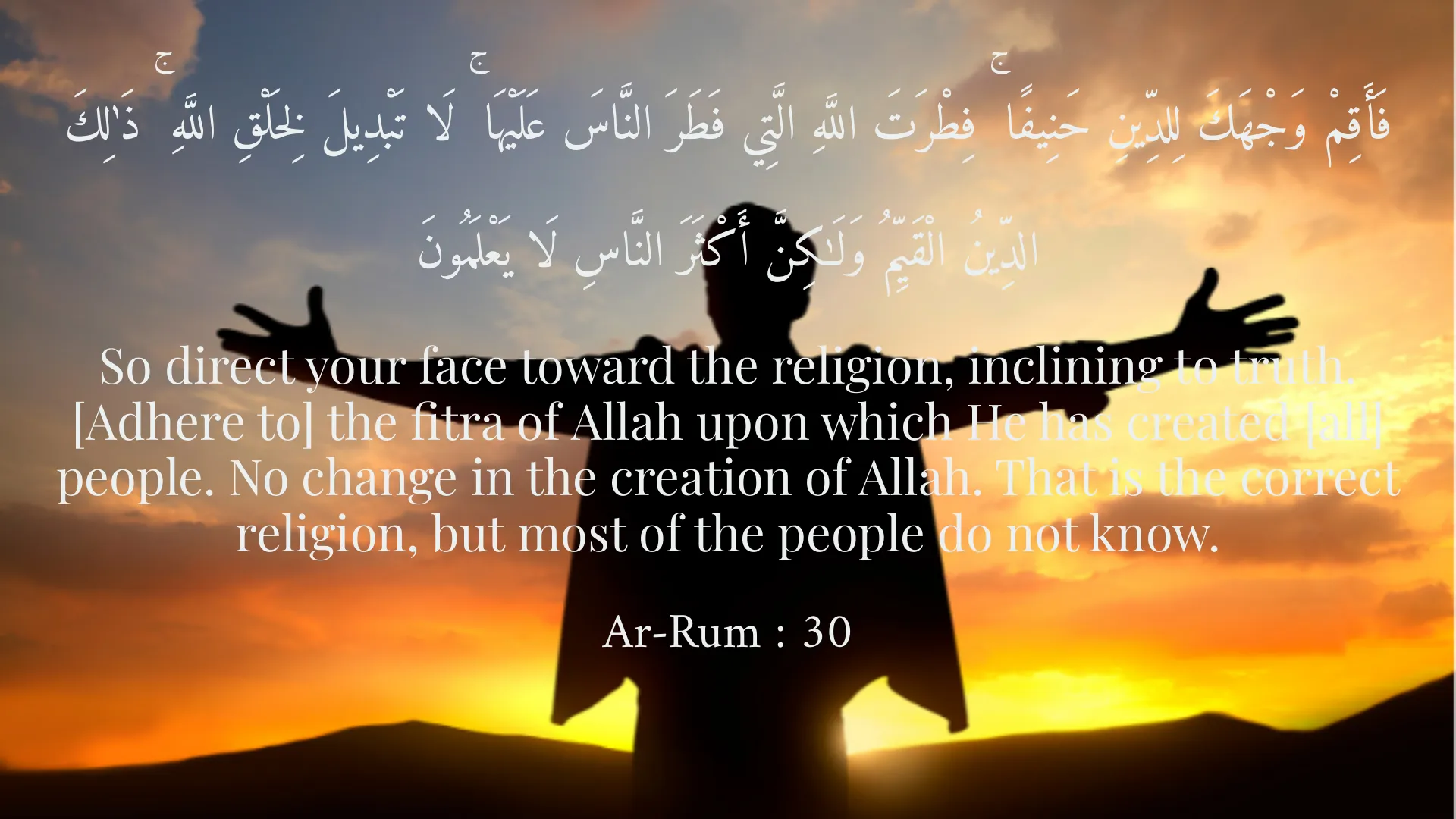
فَأَقِمْ وَجْهَكَ لِلدِّينِ حَنِيفًا ۚ فِطْرَتَ اللَّهِ الَّتِي فَطَرَ النَّاسَ عَلَيْهَا ۚ لَا تَبْدِيلَ لِخَلْقِ اللَّهِ ۚ ذَٰلِكَ الدِّينُ الْقَيِّمُ وَلَٰكِنَّ أَكْثَرَ النَّاسِ لَا يَعْلَمُونَ
So direct your face toward the religion, inclining to truth. [Adhere to] the fitra of Allah upon which He has created [all] people. No change in the creation of Allah. That is the correct religion, but most of the people do not know.
Ar-Rum : 30
إِنَّ الْمُنَافِقِينَ يُخَادِعُونَ اللَّهَ وَهُوَ خَادِعُهُمْ وَإِذَا قَامُوا إِلَى الصَّلَاةِ قَامُوا كُسَالَى يُرَاءُونَ النَّاسَ وَلَا يَذْكُرُونَ اللَّهَ إِلَّا قَلِيلًا
Indeed, the hypocrites [think to] deceive Allah, but He is deceiving them. And when they stand for prayer, they stand lazily, showing [themselves to] the people and not remembering Allah except a little.
An-Nisa : 142
فَاسْتَقِمْ كَمَا أُمِرْتَ وَمَن تَابَ مَعَكَ وَلَا تَطْغَوْا ۚ إِنَّهُ بِمَا تَعْمَلُونَ بَصِيرٌ
So remain on a straight course as you have been commanded, [you] and those who have turned back with you [to Allah], and do not transgress. Indeed, He is Seeing of what you do.
Hud : 112
Short Story
It is said that one day, a pious dervish saw another dervish who spoke differently in the company of nobles than he did among common folk. The pious dervish smiled and said, 'My brother, I invite you to truth. If your heart and tongue are not one, you will never find peace and will constantly suffer the anxiety of your mask falling. But if your inner and outer selves become one, you will no longer need to worry and can always 'be yourself'.' This story teaches us that true peace and authenticity lie in the unity of inside and out, otherwise one will always strive to conceal their true self.