Quranic Answer
The feeling of being left behind and comparing oneself to others is a common human experience that many individuals face throughout their lives. In today's fast-paced world, with constant access to the lives and achievements of others through social media and digital platforms, this feeling can be exacerbated. Successful individuals, luxurious possessions, impressive career advancements, and ideal relationships are easily showcased, unconsciously leading us to comparison. However, from the perspective of the Holy Quran, this feeling is not only unnatural but has deep roots in satanic temptations and worldly attachments that divert a person from their true path: seeking divine pleasure and inner peace. The Holy Quran explicitly clarifies the transient and fleeting nature of worldly life and issues serious warnings about becoming engrossed in it and competing over material achievements. In Surah At-Takathur (102:1-2), Allah says: “Rivalry in worldly increase diverts you until you visit the graveyards (and death overtakes you).” These verses clearly indicate that humanity's inclination to accumulate more and compete with others in material matters can so preoccupy a person that they become oblivious to the primary purpose of creation and their ultimate destiny. This endless competition not only brings no peace but leads to anxiety, regret, and a constant feeling of inadequacy, even if an individual seemingly achieves many successes. The Quran warns us against this endless cycle of worldly competition, as it hinders spiritual and moral elevation and traps us in fleeting appearances. It's a profound reminder that true fulfillment isn't found in outperforming others in a temporary race, but in understanding the deeper purpose of our existence. Furthermore, in Surah Al-Hadid (57:20), Allah Almighty states: “Know that the life of this world is only play and amusement, pomp and mutual boasting in rivalry for wealth and children. [It is] like a rain whose [resulting] plant growth pleases the farmers; then it dries and you see it turned yellow; then it becomes [scattered] debris. And in the Hereafter is severe punishment and forgiveness from Allah and approval. And what is the worldly life except the enjoyment of delusion?” This verse offers a highly accurate depiction of the world's nature: a fleeting show, a purposeless game, and a competition for acquiring things that hold no lasting value. Comparing oneself to others in such a field is like participating in a game where a true winner has no meaning, because everything is unstable and temporary. When we measure ourselves against the material and external standards of others, we essentially become entangled in this deceptive game of the world and neglect true values. This verse reminds us that focusing on worldly achievements and constant comparison is like observing a plant that rapidly grows, turns green, then yellows and dries up, eventually perishing; all these are deceptive and lead nowhere. Another key point in the Quran is prioritizing the Hereafter over this world. In Surah Al-A'la (87:16-17), we read: “But you prefer the worldly life, while the Hereafter is better and more lasting.” These verses caution us that our eyes should not be fixed solely on this transient life. The feeling of being left behind often stems from the perception that we are less successful than others in achieving worldly gains. However, the Quran rejects this criterion and considers true success to be in Allah's pleasure and the rewards of the Hereafter, which are permanent and enduring. Worldly life is merely a field for cultivating for the Hereafter, and what is sown in this world will be reaped in the next. So, whenever you feel you've fallen behind in the worldly caravan, remember that a more important and lasting caravan lies ahead, for which provisions must be gathered. Moreover, the concept of rizq (sustenance) and qadar (divine decree) in Islam plays a significant role in alleviating the feeling of being left behind. The Quran teaches us that everyone has a predetermined provision from Allah, and there is no need for envy or competition over it. This does not mean one should not strive, but rather that the outcome of efforts and what one receives ultimately depends on divine will. This understanding brings peace to a person, knowing that the achievements of others do not diminish their own sustenance, and unnecessary worry about what one lacks does not prevent gratitude for what one has. Trusting in Allah (tawakkul) and His wisdom in managing affairs is the key to escaping the trap of comparisons. Allah has decreed everything for everyone in the best possible way, and it is we who must be content with this divine decree. To overcome this feeling, the Quran offers practical solutions: patience (sabr), prayer (salat), gratitude (shukr), and the remembrance of Allah (dhikr). Patience against the temptations of comparison and gratitude for existing blessings are key practices. Prayer, as a pillar of connection with the Creator, helps a person redefine their priorities and find tranquility in the remembrance of Allah. As stated in Surah Ar-Ra'd (13:28): “Those who have believed and whose hearts are assured by the remembrance of Allah. Unquestionably, by the remembrance of Allah hearts are assured.” When the heart finds tranquility in the remembrance of Allah, it no longer needs external validation or comparison with others, for it has found true richness within itself and in connection to the boundless source of power and mercy. Therefore, focusing on acts of worship, seeking beneficial knowledge, and striving to help Allah's creation can divert the mind from futile comparisons and guide it towards more valuable goals. Ultimately, this feeling of being left behind can be a sign to re-evaluate life's values and goals. Is true happiness found in acquiring more wealth and status, or in inner contentment, peace of mind, and a deeper connection with the Creator? The Quran guides us towards the latter. Instead of looking at what others have or have achieved, it is better to focus on our own possessions, the blessings of Allah in our lives, and our personal progress. Every human being has their unique path and capacities. Someone might progress in one area, and you in another. What is important is striving in the path of truth, fulfilling divine and human duties, and having a tranquil heart content with divine decree. This Quranic perspective not only frees us from regret and anxiety but opens a door to a more fruitful and meaningful life in which real peace and eternal bliss reside. So, whenever this feeling comes over you, instead of sinking into sorrow, pause for a moment and ask yourself: Does this comparison bring me closer to Allah or further away? And the Quran's answer is always the guiding light: distance from worldliness and closeness to the One Creator. This is how, instead of feeling left behind, we will feel true progress and perfection.
Related Verses
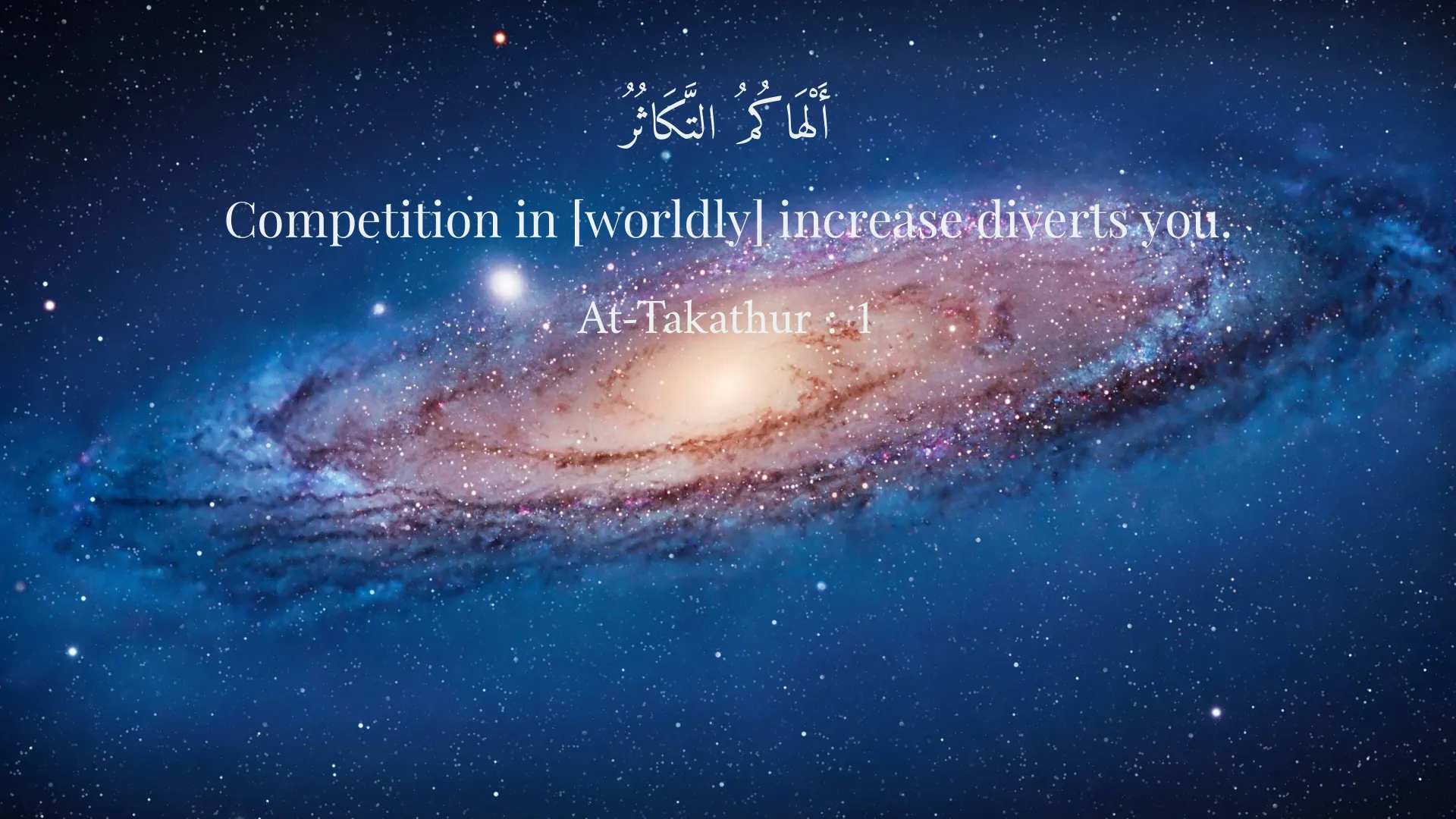
أَلْهَاكُمُ التَّكَاثُرُ
Competition in [worldly] increase diverts you.
At-Takathur : 1
حَتَّىٰ زُرْتُمُ الْمَقَابِرَ
Until you visit the graveyards.
At-Takathur : 2
اعْلَمُوا أَنَّمَا الْحَيَاةُ الدُّنْيَا لَعِبٌ وَلَهْوٌ وَزِينَةٌ وَتَفَاخُرٌ بَيْنَكُمْ وَتَكَاثُرٌ فِي الْأَمْوَالِ وَالْأَوْلَادِ ۖ كَمَثَلِ غَيْثٍ أَعْجَبَ الْكُفَّارَ نَبَاتُهُ ثُمَّ يَهِيجُ فَتَرَاهُ مُصْفَرًّا ثُمَّ يَكُونُ حُطَامًا ۖ وَفِي الْآخِرَةِ عَذَابٌ شَدِيدٌ وَمَغْفِرَةٌ مِّنَ اللَّهِ وَرِضْوَانٌ ۚ وَمَا الْحَيَاةُ الدُّنْيَا إِلَّا مَتَاعُ الْغُرُورِ
Know that the life of this world is only play and amusement, pomp and mutual boasting in rivalry for wealth and children. [It is] like a rain whose [resulting] plant growth pleases the farmers; then it dries and you see it turned yellow; then it becomes [scattered] debris. And in the Hereafter is severe punishment and forgiveness from Allah and approval. And what is the worldly life except the enjoyment of delusion?
Al-Hadid : 20
بَلْ تُؤْثِرُونَ الْحَيَاةَ الدُّنْيَا
But you prefer the worldly life,
Al-A'la : 16
وَالْآخِرَةُ خَيْرٌ وَأَبْقَىٰ
While the Hereafter is better and more lasting.
Al-A'la : 17
Short Story
They say that in ancient times, there were two neighbors: one a wealthy merchant and the other a contented dervish. The merchant daily increased his business, but his eye was always on the trade of others. The more he acquired, the more regret settled in his heart, wondering why he wasn't like such and such a merchant. At night, thoughts of profit and loss, and rivalry with others, stole sleep from his eyes, and by day he was in constant anxiety. But the dervish, with a simple bread, dates, and worn cloak, had a tranquil heart and began each day with gratitude. A smile was on his lips, and peace resided within him. One day, the merchant said to the dervish: 'O friend, how is it that I, with all this wealth and effort, am always in distress, while you, in your poverty, are so at peace?' The dervish replied kindly: 'O companion, you seek something that has no end, and that is competition in this world. But I deem what I have sufficient and have entrusted my heart to the Creator. You measure yourself by what others possess, and I measure myself by what God has given me. He whose eye is on others will never be satisfied; but he whose eye is on the Creator's generosity is always rich.' The merchant heard these words and pondered them for an hour, understanding that peace lies in contentment, not in abundance.