Quranic Answer
The feeling of confusion and a lack of understanding regarding certain life events is a very common human experience that many of us face at different points. This profound and thought-provoking question has Quranic and divine roots, and its answer lies at the heart of believing in the infinite wisdom of God. The Holy Quran repeatedly emphasizes that human knowledge and insight are limited, while Divine knowledge and wisdom are boundless and all-encompassing. What we experience as 'not understanding' is often the result of the vast difference between our limited perception of time and space, and the boundless knowledge of the Almighty, which encompasses all hidden and apparent dimensions, past, present, and future. One of the most significant reasons the Quran provides for our incomplete understanding of life's events is the nature of this world as a 'test.' Allah states in numerous verses that worldly life is a field of trials and tribulations, designed to distinguish the believer from the non-believer, the patient from the impatient, and the grateful from the ungrateful. These tests sometimes manifest as calamities and hardships, and at other times as blessings and ease. In Surah Al-Ankabut, verses 2 and 3, Allah says: "Do people think that they will be left alone because they say, 'We believe,' and will not be tested? But We have certainly tested those before them, and Allah will surely make evident those who are truthful, and He will surely make evident the liars." These verses explicitly state that challenges and unpleasant events are an inseparable part of our spiritual growth and evolution. We may not understand their wisdom at the time of their occurrence, but later, with the passage of time and gained experience, we may realize their profound positive impact on our character and faith. These are mechanisms for purifying the soul, elevating spiritual ranks, and expiating sins, which remain hidden from our immediate perception. Furthermore, the Quran teaches us that the apparent nature of things does not always align with their inner reality. An event that seems undesirable on the surface might contain immense hidden good and benefits for us. Surah Al-Baqarah, verse 216, offers one of the clearest statements on this matter: "But perhaps you hate a thing and it is good for you; and perhaps you love a thing and it is bad for you. And Allah Knows, while you know not." This verse is a fundamental principle in Islamic thought, reminding us that our judgments, based on our limited knowledge, are often incomplete. Sometimes, losing a job leads to finding a better path more suited to our abilities; sometimes, a severe illness provides an opportunity for reflection, a change in lifestyle, and a closer connection to God; and sometimes, not achieving a particular desire saves us from a greater harm of which we were unaware. These hidden wisdoms are only comprehensible from a divine perspective, and as humans, we can only believe in them and trust in God. One of the most astonishing and instructive Quranic stories that vividly illustrates our lack of understanding of Divine wisdom is the account of Prophet Moses and Al-Khidr (in Surah Al-Kahf). Prophet Moses, despite his prophetic status, knowledge, and wisdom, found three events performed by Al-Khidr at God's command (sinking the ship, killing the young boy, and rebuilding the broken wall) to be apparently wrong and illogical, and he could not comprehend them. Each time, Moses protested and questioned, unaware of the inner meaning and hidden wisdom behind these actions. But after Al-Khidr explained the true reasons for each of these seemingly negative events, it became clear that behind each lay a great good and prevention of a greater evil: sinking the ship was to prevent its confiscation by a tyrannical king, killing the boy was to prevent him from leading his righteous parents astray, and rebuilding the wall was to preserve the treasure of two orphan boys underneath it. This story is a powerful symbol demonstrating that many events in our lives may also appear illogical and incomprehensible, but they possess deep wisdom that only God knows. This narrative teaches us that patience and trust in Allah's decree and destiny are the keys to inner peace in the face of adversities. Therefore, when we feel that we do not understand an event, we should remember that this is a deficiency in our perception, not in Divine wisdom. These moments are opportunities to strengthen our reliance and faith in Allah. By accepting the truth that our knowledge is limited and God's knowledge is infinite, we can achieve peace of mind. This peace does not mean indifference but rather acceptance of God's will and wisdom, even when the path is unclear to us. Ultimately, everything is moving towards a higher purpose: the growth and perfection of humanity in sincere servitude to a Lord who desires nothing but the good for His servants, even if that good comes in the guise of hardship or an incomprehensible event. Patience, prayer, and reflection on divine verses can help us gain a deeper perspective on the flow of life, and even if we do not understand the immediate wisdom, to believe in a greater wisdom in the overall journey of life. This perspective not only grants us tranquility but also provides the necessary strength to face challenges, with the certainty that Allah never abandons His servants and always considers their well-being and best interest.
Related Verses
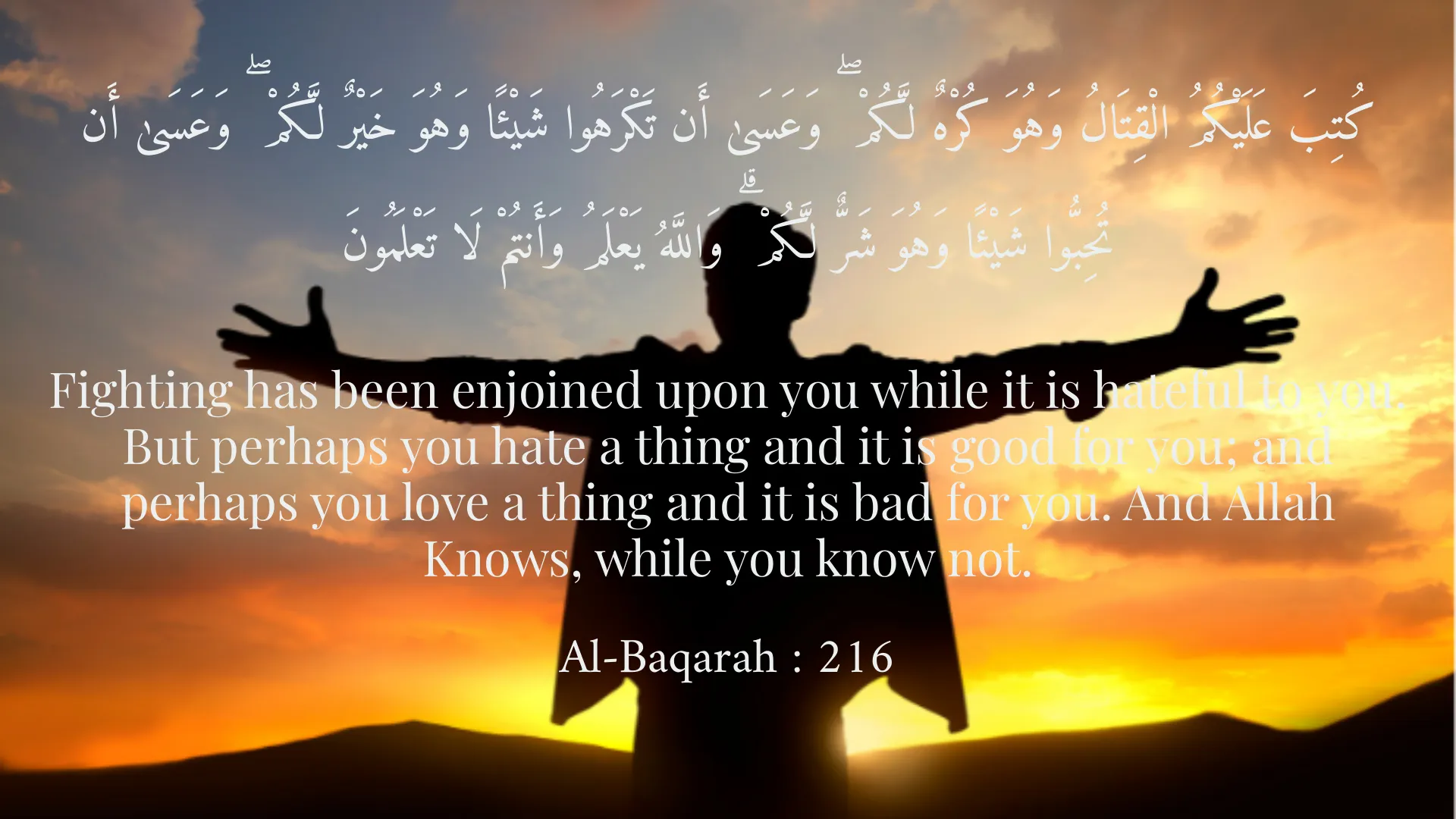
كُتِبَ عَلَيْكُمُ الْقِتَالُ وَهُوَ كُرْهٌ لَّكُمْ ۖ وَعَسَىٰ أَن تَكْرَهُوا شَيْئًا وَهُوَ خَيْرٌ لَّكُمْ ۖ وَعَسَىٰ أَن تُحِبُّوا شَيْئًا وَهُوَ شَرٌّ لَّكُمْ ۗ وَاللَّهُ يَعْلَمُ وَأَنتُمْ لَا تَعْلَمُونَ
Fighting has been enjoined upon you while it is hateful to you. But perhaps you hate a thing and it is good for you; and perhaps you love a thing and it is bad for you. And Allah Knows, while you know not.
Al-Baqarah : 216
أَحَسِبَ النَّاسُ أَن يُتْرَكُوا أَن يَقُولُوا آمَنَّا وَهُمْ لَا يُفْتَنُونَ
Do people think that they will be left alone because they say, 'We believe,' and will not be tested?
Al-Ankabut : 2
وَلَقَدْ فَتَنَّا الَّذِينَ مِن قَبْلِهِمْ ۖ فَلَيَعْلَمَنَّ اللَّهُ الَّذِينَ صَدَقُوا وَلَيَعْلَمَنَّ الْكَاذِبِينَ
But We have certainly tested those before them, and Allah will surely make evident those who are truthful, and He will surely make evident the liars.
Al-Ankabut : 3
وَكَيْفَ تَصْبِرُ عَلَىٰ مَا لَمْ تُحِطْ بِهِ خُبْرًا
And how can you have patience for that which you have not encompassed in knowledge?
Al-Kahf : 68
Short Story
It is narrated that a pious and good-natured man, on his journey to a distant city, was left behind by his caravan due to heavy rain and a storm. He became very sad and said to himself, 'Alas, I have fallen behind the caravan, and perhaps I will be left alone in this desert and perish.' However, as he exercised patience and surrendered to divine wisdom, after an hour, he saw the same caravan in a narrow pass being attacked by robbers. All their possessions were plundered, and they themselves were harmed. When the pious man witnessed this scene, he thanked God and realized that his delay from the caravan had been a great blessing, saving him from a great calamity. Thus, he understood that many hardships and adversities that we do not comprehend at the moment may be a veil for a greater good that God has destined for us.