Quranic Answer
The inclination to seek immediate rewards for good deeds is a deeply ingrained human tendency, rooted in our psychological makeup. Humans are naturally drawn to tangible and swift outcomes, and this applies equally to acts of benevolence. When we perform a good deed, a part of us expects immediate recognition, praise, or to witness its instant impact. While this might seem natural, from a Quranic perspective, it necessitates reflection and a shift in perspective for our actions to attain their true, divine value. The Holy Quran repeatedly emphasizes that good deeds must be performed solely for the pleasure of Almighty Allah, with sincere intention (Ikhlas), not for worldly gains—whether material or spiritual—nor to garner human admiration. The Quran consistently draws a distinction between transient worldly pleasures and the enduring, eternal rewards of the Hereafter. This distinction is key to understanding why we should not seek immediate gratification for our good deeds. Allah, in numerous verses, highlights that what is with Him is better and more lasting. For instance, in Surah An-Nahl, verse 96, it states: "What is with you will be exhausted, and what is with Allah is lasting." This verse clearly indicates that divine rewards, unlike any worldly recompense, will never cease or perish. When a person seeks immediate reward, they are essentially trading the value of their deed for something perishable and limited, whereas Allah has promised boundless and eternal rewards for His sincere servants. One of the most crucial concepts presented in the Quran regarding good deeds is "Ikhlas" (sincerity). Ikhlas means purifying one's intention for Allah, performing an act solely and exclusively for His pleasure. If an individual performs a deed for other than Allah—for example, to be seen, to gain social prestige, or to receive material compensation—the spiritual and otherworldly value of that deed diminishes, and it might even be entirely lost. In Surah Al-Bayyinah, verse 5, it is stated: "And they were not commanded except to worship Allah, [being] sincere to Him in religion, inclining to truth, and to establish prayer and to give zakat. And that is the correct religion." This verse explicitly identifies sincere intention as the core of worship and good deeds. Therefore, when we seek immediate rewards for performing good deeds, our intention might become contaminated by external desires, which could compromise the deed's primary value. The philosophy of divine reward in the Quran is founded upon a system of divine justice and mercy that operates according to its own time and place. Allah Almighty is aware of every good deed we perform, no matter how small, and has promised to reward it in the best possible way. In Surah Az-Zalzalah, verses 7 and 8, we read: "So whoever does an atom's weight of good will see it, And whoever does an atom's weight of evil will see it." These verses demonstrate that no good or evil deed goes unrecorded, but the time for witnessing these rewards or punishments is often in the Hereafter, where divine justice is fully implemented, and no one is wronged. Moreover, expecting immediate rewards can lead to disappointment and discouragement. If someone performs a good deed and does not immediately see positive feedback, they might be deterred from continuing or their resolve might weaken. This is contrary to faith in the Hereafter's reward and a sincere intention for Allah, which grants a person patience and steadfastness to persist in the path of good, even if no one knows or no praise is given. This patience and steadfastness itself carries an immense reward from Allah. The Quran calls believers to patience, for "Indeed, Allah is with the patient" (Al-Baqarah: 153). Waiting for divine reward is a test of our patience and faith, elevating us to the pinnacle of servitude and reliance on God. When one abandons the expectation of worldly rewards and focuses solely on Allah's pleasure, they attain a true and unparalleled tranquility that no worldly reward can replace. This inner peace and profound contentment are, in themselves, some of the most immediate divine rewards in this world, requiring no anticipation, but rather being a natural outcome of sincerity and reliance on God. Finally, it is essential to remember that good deeds, irrespective of their rewards, are inherently valuable and constructive. They purify the human soul, improve society, and deepen our connection with Allah. The primary purpose of performing good deeds is one's spiritual and moral growth and drawing closer to the absolute perfection of the Divine. Reward is a consequence that comes from Allah's mercy and grace, but it should not be our primary motivation. Focusing on fulfilling our duties with pure intention and for the pleasure of the Lord is the correct and Quranically endorsed path. This perspective ensures that our good deeds are free from any trace of ostentation or self-display, becoming purely a source of goodness and blessings for ourselves and others, both in this world and the Hereafter.
Related Verses
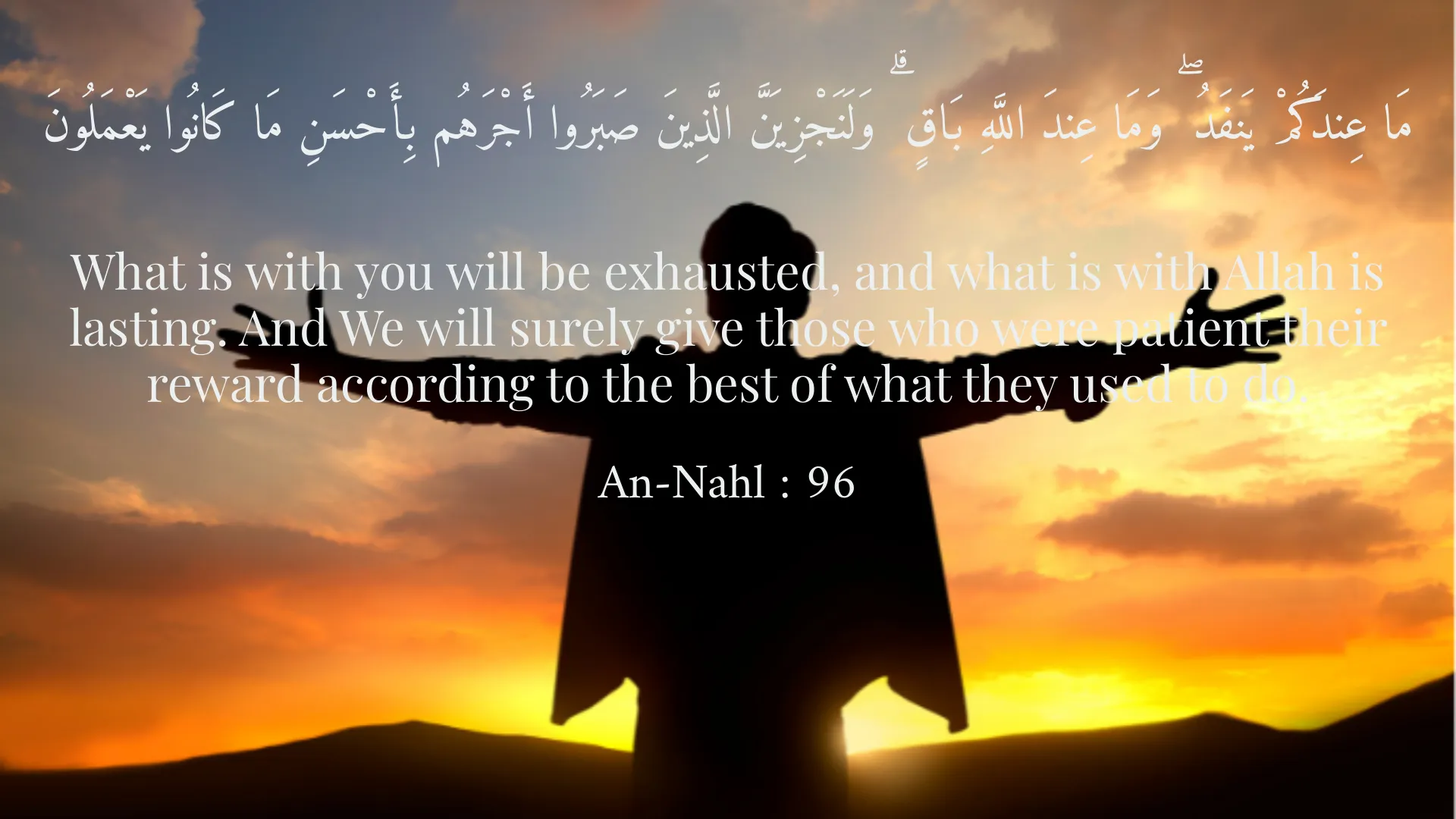
مَا عِندَكُمْ يَنفَدُ ۖ وَمَا عِندَ اللَّهِ بَاقٍ ۗ وَلَنَجْزِيَنَّ الَّذِينَ صَبَرُوا أَجْرَهُم بِأَحْسَنِ مَا كَانُوا يَعْمَلُونَ
What is with you will be exhausted, and what is with Allah is lasting. And We will surely give those who were patient their reward according to the best of what they used to do.
An-Nahl : 96
وَمَا أُمِرُوا إِلَّا لِيَعْبُدُوا اللَّهَ مُخْلِصِينَ لَهُ الدِّينَ حُنَفَاءَ وَيُقِيمُوا الصَّلَاةَ وَيُؤْتُوا الزَّكَاةَ ۚ وَذَٰلِكَ دِينُ الْقَيِّمَةِ
And they were not commanded except to worship Allah, [being] sincere to Him in religion, inclining to truth, and to establish prayer and to give zakat. And that is the correct religion.
Al-Bayyinah : 5
فَمَن يَعْمَلْ مِثْقَالَ ذَرَّةٍ خَيْرًا يَرَهُ
So whoever does an atom's weight of good will see it,
Az-Zalzalah : 7
وَمَن يَعْمَلْ مِثْقَالَ ذَرَّةٍ شَرًّا يَرَهُ
And whoever does an atom's weight of evil will see it.
Az-Zalzalah : 8
Short Story
Once upon a time, in a bustling city, lived a benevolent man named Salim. Salim always helped others, but secretly, he yearned for people to recognize and thank him. One day, a wise scholar passed by and saw Salim laboriously removing a thorn from people's path, yet looking around expectantly for someone to notice him. The scholar approached him with a smile and said, "O Salim, trees do not bear fruit for anyone's gratitude, but to grow and flourish themselves. The reward of a good deed lies in the purity of intention, not in the praise of people. Goodness nurtures its own reward within the heart of the doer, and its best reward is the pleasure of the Almighty, which will never be hidden from you, even if it is not visible in this world." Upon hearing these words, Salim felt as if he had awakened from slumber. From that day on, he performed his good deeds with a purer intention, free from the expectation of immediate reward, and truly found a deeper sense of peace and contentment in his heart that no amount of praise could ever provide.