Quranic Answer
It is a common and profoundly human experience to sometimes feel a sense of weakness or inadequacy in one's own faith, particularly when observing the steadfast devotion and righteous deeds of others. This feeling can stem from various sources: at times, it might be a result of unconscious comparison with others on the path of worship; at other times, it could arise from a lack of understanding regarding the dynamic nature of faith itself and its inherent fluctuations; and sometimes, it is the direct outcome of satanic whispers (Waswasa) designed to discourage an individual from their spiritual journey and devotion to God. The Holy Quran, with its profound insight into the human soul and the reality of faith, offers comprehensive guidance and practical solutions to understand and manage these feelings, helping believers to remain steadfast on the path of Tawhid (Oneness of God) and proximity to the Divine, thereby finding true peace in their hearts. The first crucial point emphasized by the Quran is the individuality of faith and the unique personal accountability of each person. In Surah Al-An'am (Chapter 6, Verse 164), Allah Almighty declares: “And no bearer of burdens will bear the burden of another.” This foundational verse lays down a highly significant principle in the Islamic belief system: each person’s reckoning with their Lord is independent and personal, and no one is responsible for the deeds or faith of another. Faith is, at its core, an intrinsically individual journey that each soul must embark upon and strive to complete through their own efforts, sincerity, and struggle. Comparing oneself to others on this challenging path can lead to two major and destructive pitfalls. Firstly, it can foster envy or jealousy towards what another person possesses or accomplishes, which can ultimately corrupt the heart, remove blessings from one's acts of worship, and destroy inner peace. Secondly, it can lead to despair and hopelessness regarding one's own spiritual progress, creating a false belief that one can never attain the level of faith and perfection seen in others. The Quran warns us against falling into these spiritual traps, advising us to turn our gaze away from the achievements or spiritual states of others and, instead, concentrate wholeheartedly on the rectification and purification of our own souls. True faith is not found in outward displays, which we often only see the surface of, but is deeply rooted in the heart's sincerity and an intimate, pure connection with Allah. What we perceive of others' faith might only be a small fraction of their true spiritual reality, and we often remain unaware of their internal struggles, personal errors, or even hidden hypocrisy (if it exists). Therefore, such comparisons are always incomplete and misleading. Secondly, it is vital to understand the dynamic, evolving, and growing nature of faith. Faith, much like a thriving plant, requires continuous nurturing, sufficient light, and meticulous care to grow, strengthen its stem, deepen its roots, and ultimately bear fruit. In Surah Al-Fath (Chapter 48, Verse 4), the Quran beautifully states: “It is He who sent down tranquillity into the hearts of the believers that they might add faith to their faith.” This verse clearly illustrates that faith is not a static or rigid state; rather, it possesses the capacity for both increase, decrease, and fluctuation. There might be days when an individual feels a profound sense of strength, an unprecedented closeness to Allah, and spiritual vibrancy, while on other days, they might face challenges, doubts, or temptations that can lead to feelings of weakness in faith. These fluctuations are a natural and unavoidable part of the spiritual growth process and divine testing, and they should by no means cause discouragement or despair. Instead, these moments are valuable opportunities for self-reflection, seeking forgiveness (Istighfar) for shortcomings, and redoubling efforts to draw closer to Allah. The ultimate objective is not to reach a fixed 'endpoint' or absolute perfection in faith, but rather to remain steadfast on its 'path,' continuously striving for spiritual progress and elevation, and moving towards divine pleasure. Thirdly, one must appreciate the divine wisdom embedded in the trials and tests for believers, which reveal different dimensions of faith. In Surah Al-Ankabut (Chapter 29, Verses 2-3), Allah states: “Do people think that they will be left to say, ‘We believe’ and they will not be tested? * And We have certainly tested those before them, and Allah will surely make evident those who are truthful, and He will surely make evident the liars.” These profound verses teach us that life is replete with trials and tribulations, and true faith is forged, solidified, and proven amidst the crucible of these examinations. Sometimes, the very feeling of weakness in faith within us is itself a profound test from Allah, designed to prompt introspection, to identify one's vulnerabilities, and to motivate intensified efforts to strengthen them. Observing the strong faith of others can also be a subtle test; will this observation lead us to envy and despair of divine mercy, or will it inspire us to strive harder in our own devotion, self-improvement, and increased reliance on Allah? The Quran emphatically states that the purpose of these trials is to make manifest the truthfulness or falsehood of one's inner faith, not merely to inflict hardship and difficulty. Every hardship is a lesson, and every weakness is an opportunity for growth. The Quranic solutions for strengthening faith and overcoming this sense of weakness can be summarized in several key areas, all of which require determination and consistency: 1. Consistent Remembrance of Allah (Dhikr): As affirmed in Surah Ar-Ra'd (Chapter 13, Verse 28): “Unquestionably, by the remembrance of Allah hearts are assured.” The remembrance of Allah, whether through vocal supplication (recitation of Quran, Du'a, uttering specific adhkar and tasbih) or through contemplation (reflecting on divine signs, meditating on blessings, being mindful of Divine presence), is an immense source of spiritual strength, heart stabilization, and a potent antidote to feelings of weakness and anxiety. When the heart finds solace in the remembrance of Allah, the temptations of comparison, despair, and envy gradually diminish and give way to assurance and reliance on God. 2. Focus on Sincere Righteous Deeds: Instead of getting lost in fruitless comparisons, concentrate on performing righteous deeds with pure intentions, solely for the pleasure of Allah. Even small, consistent acts of worship and sincerity have a profound impact on solidifying and growing faith. Allah does not look at the quantity of deeds but at their quality and the pure intention behind them. This inward focus on oneself and one's intentions diverts attention from external factors and others. 3. Recitation and Deep Contemplation of the Holy Quran: The Quran is the divine guiding word and a healing for the hearts. Regular recitation of its verses, accompanied by deep reflection on their profound meanings, strengthens the spiritual connection with the Creator and enhances one's insight into the reality of faith, the purpose of creation, and one's place in existence. A profound understanding of divine messages prevents feelings of inferiority, discouragement, or hopelessness when observing others' faith, as one then recognizes the true standard. 4. Continuous Supplication (Du'a) and Seeking Allah's Help: Faith is a precious divine gift and grace, and one must constantly ask Allah for it. Praying for steadfastness, an increase in faith, and the removal of weaknesses is a sign of reliance, humility, and complete trust in His infinite power. Du'a is a bridge that connects an individual to the inexhaustible source of power. 5. Associating with the Righteous and Knowledgeable (without detrimental comparison): The Quran advises us to keep company with virtuous people and those of knowledge and piety. Spending time with those who possess strong faith and deep understanding can be highly inspiring, strengthen morale, and motivate. However, one must be careful that such companionship does not lead to harmful comparisons and envy. Benefit from their experiences and knowledge, seek their guidance, but never compare your unique journey with theirs, for everyone is tested on their own path. 6. Self-Awareness and Humble Acceptance: Every human being has unique strengths and weaknesses. Accepting the reality that no one in this world is perfect, including ourselves, helps to alleviate the psychological burden of comparison. The important thing is to strive for continuous, step-by-step improvement, and ultimately move towards divine pleasure, rather than aiming for an illusory and unrealistic perfection based on comparisons with others. This humility before one's own self is, in fact, humility before the Divine will. Ultimately, the Holy Quran guides us to the fundamental truth that faith is a precious trust from Allah, and the effort to preserve and strengthen it is an ongoing, internal, and personal struggle (jihad). Occasional feelings of weakness are not indicators of permanent or fundamental deficiency, but rather constructive nudges to return to oneself, engage in introspection, and seek refuge once again in the firm and comforting fortress of Allah's remembrance. Instead of being preoccupied with the faith of others or the outward appearance of their deeds, and measuring ourselves by external standards, we should look inward and strive to cultivate the seeds of faith within the fertile soil of our own hearts. This path will be blessed, full of tranquility, and abound with growth, because one learns that the true standard and point of comparison is only and solely the pleasure of Allah Almighty, and not the gaze, judgments, or actions of His servants. Every step on this path, no matter how small, is recorded and rewarded by Allah, and in truth, every step towards Allah is a step towards eternal strength and peace.
Related Verses
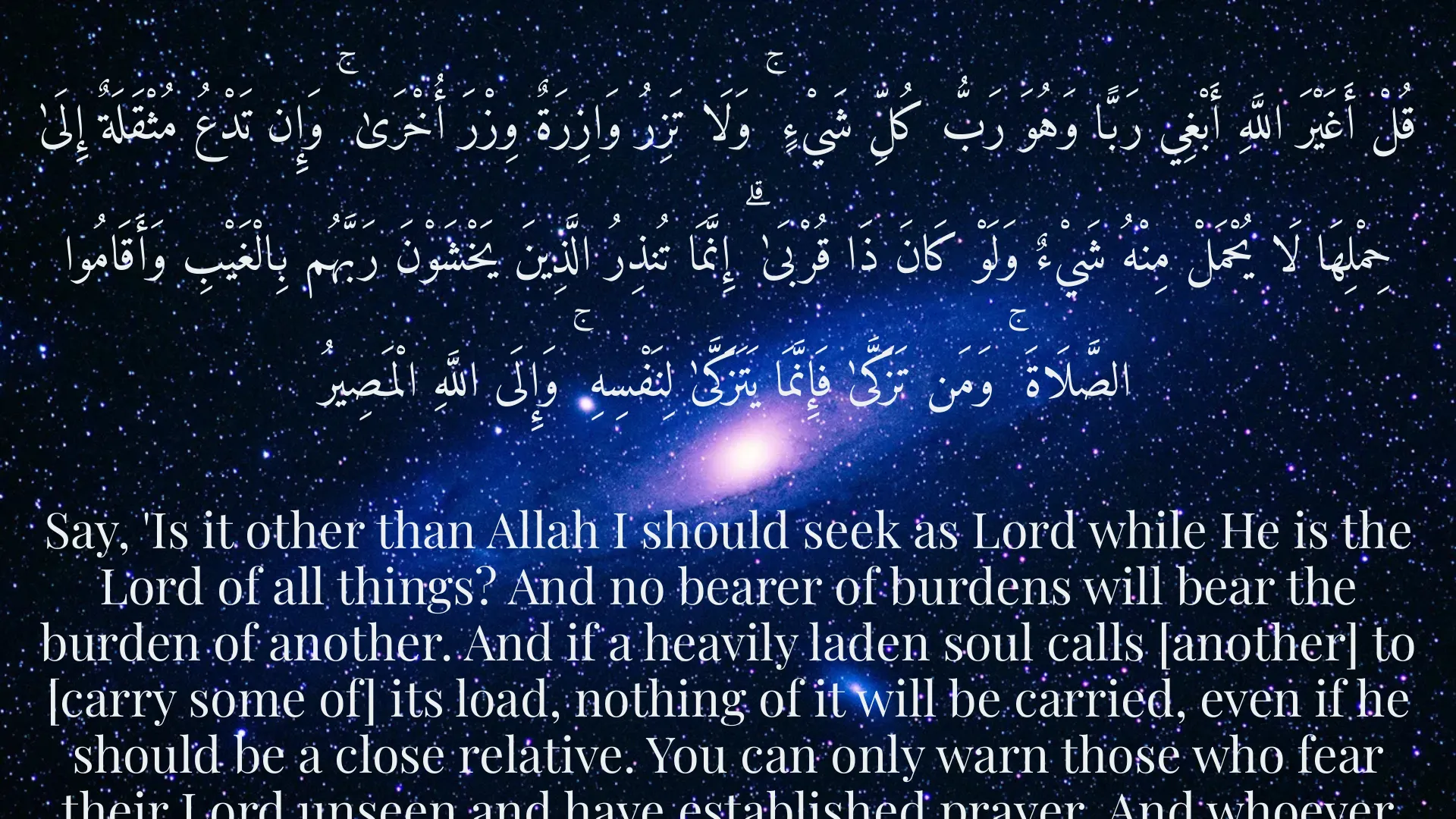
قُلْ أَغَيْرَ اللَّهِ أَبْغِي رَبًّا وَهُوَ رَبُّ كُلِّ شَيْءٍ ۚ وَلَا تَزِرُ وَازِرَةٌ وِزْرَ أُخْرَىٰ ۚ وَإِن تَدْعُ مُثْقَلَةٌ إِلَىٰ حِمْلِهَا لَا يُحْمَلْ مِنْهُ شَيْءٌ وَلَوْ كَانَ ذَا قُرْبَىٰ ۗ إِنَّمَا تُنذِرُ الَّذِينَ يَخْشَوْنَ رَبَّهُم بِالْغَيْبِ وَأَقَامُوا الصَّلَاةَ ۚ وَمَن تَزَكَّىٰ فَإِنَّمَا يَتَزَكَّىٰ لِنَفْسِهِ ۚ وَإِلَى اللَّهِ الْمَصِيرُ
Say, 'Is it other than Allah I should seek as Lord while He is the Lord of all things? And no bearer of burdens will bear the burden of another. And if a heavily laden soul calls [another] to [carry some of] its load, nothing of it will be carried, even if he should be a close relative. You can only warn those who fear their Lord unseen and have established prayer. And whoever purifies himself only purifies himself for [the benefit of] his soul. And to Allah is the [final] return.'
Al-An'am : 164
الَّذِينَ آمَنُوا وَتَطْمَئِنُّ قُلُوبُهُم بِذِكْرِ اللَّهِ ۗ أَلَا بِذِكْرِ اللَّهِ تَطْمَئِنُّ الْقُلُوبُ
Those who have believed and whose hearts are assured by the remembrance of Allah. Unquestionably, by the remembrance of Allah hearts are assured.
Ar-Ra'd : 28
أَحَسِبَ النَّاسُ أَن يُتْرَكُوا أَن يَقُولُوا آمَنَّا وَهُمْ لَا يُفْتَنُونَ
Do people think that they will be left to say, 'We believe' and they will not be tested?
Al-Ankabut : 2
وَلَقَدْ فَتَنَّا الَّذِينَ مِن قَبْلِهِمْ ۖ فَلَيَعْلَمَنَّ اللَّهُ الَّذِينَ صَدَقُوا وَلَيَعْلَمَنَّ الْكَاذِبِينَ
But We have certainly tested those before them, and Allah will surely make evident those who are truthful, and He will surely make evident the liars.
Al-Ankabut : 3
Short Story
One day, a companion of a wise man narrated that in his youth, he would stay awake all night in worship and remembrance, while his father slept beside him. One night, he said to his father, 'O father! All these people are asleep in heedlessness, and not one of them rises for the night prayer. It is as if they are dead!' His father replied, 'O my son! Would that you too were asleep, rather than backbiting people and abstaining from speaking ill of them.' This beautiful story from Saadi's Gulistan reminds us that we should never compare ourselves to others. Instead of looking at the outward appearance of their deeds, we should humbly look within ourselves and strive for self-improvement, so that our hearts may find peace.