Quranic Answer
This is a profound and deeply reflective question that many individuals grapple with throughout their lives: "Despite my good intentions and a heart yearning for what is good, why do circumstances sometimes unfold differently, leading to undesirable outcomes?" The answer to this query is deeply rooted in Quranic teachings and requires a comprehensive understanding of the philosophy of creation, the human being's place in existence, and the role of divine decree (Qadar) alongside human effort. The Holy Quran beautifully elucidates this matter, explaining that the universe is built upon immense wisdom, and every event, even those that appear distressing to us, holds hidden dimensions of goodness and profound lessons for our growth and perfection. One of the most fundamental Quranic concepts in this regard is the notion of "Divine Decree" or "Qadar." Allah (SWT) states in numerous verses that everything is recorded and predestined in the Preserved Tablet (Al-Lawh Al-Mahfuz). In Surah Al-Hadid, verse 22, Allah says: "No disaster strikes upon the earth or among yourselves except that it is in a register before We create it; indeed, that, for Allah, is easy." This verse signifies that Allah has eternal knowledge of all affairs and has decreed them. However, this does not negate human free will. Humanity possesses free will and is accountable for its actions. The relationship between divine decree and human free will is complex; Allah has decreed the overall destiny, but within that framework, has granted humans the power to choose and strive. Sometimes, undesirable outcomes are, in fact, part of Allah's decree to test our patience, faith, and resilience. The Quran explicitly states that this world is a realm of trial and examination. In Surah Al-Ankabut, verses 2 and 3, Allah says: "Do people think that they will be left to say, 'We believe' and they will not be tested? But We have certainly tried those before them, and Allah will surely make evident those who are truthful, and He will surely make evident the liars." These trials sometimes manifest as negative results or the failure to achieve desired goals, even when the intention was good. The purpose of these tests is not merely punishment, but rather to strengthen faith, purify sins, elevate one's spiritual rank, and reveal the true essence of a person's inner self. What we perceive as a "bad outcome" might, in reality, be the seed of a greater good that will blossom in the near or distant future, bringing benefits that we are unable to comprehend at that moment. Another Quranic reason for this phenomenon is the limitation of human perception and knowledge. In Surah Al-Baqarah, verse 216, Allah states: "But perhaps you hate a thing and it is good for you; and perhaps you love a thing and it is bad for you. And Allah knows, while you know not." This pivotal verse directs our perspective towards a higher wisdom. We, based on our limited viewpoint and worldly criteria, perceive outcomes as "good" or "bad," whereas Allah, with His infinite knowledge, is aware of all dimensions and consequences of matters. An apparent failure might save us from a greater danger or open doors to better opportunities that we would never have encountered had our initial goal been achieved. Furthermore, it is crucial to recognize that a good intention, while a necessary condition, is sometimes not sufficient on its own. The Quran places great emphasis on "righteous deeds" (amal salih) and "effort" (sa'y). In Surah Ar-Ra'd, verse 11, it is stated: "Indeed, Allah will not change the condition of a people until they change what is in themselves." This verse highlights the importance of effort, sound planning, consultation, and utilizing worldly means and causes alongside reliance on Allah. Sometimes, our intention is good, but our method of execution is flawed or incorrect. A lack of sufficient knowledge, haste, failure to consult, or overlooking practical details can lead to unintended outcomes. Islam is a religion of intellect and foresight; it encourages us to utilize all our intellectual and physical capacities. A pure intention must be accompanied by robust planning and correct action. Moreover, negative results can sometimes be a reflection of our past actions, even if our current intention is good. In Surah An-Nisa, verse 79, the Quran states: "Whatever good befalls you is from Allah, and whatever ill befalls you is from yourself." This verse indicates that our actions, whether good or bad, have consequences and repercussions in our lives. Sometimes, past sins and shortcomings, even if we have repented, might have lingering effects that manifest in the present. This can also be a form of purification and expiation for past misdeeds. Ultimately, encountering undesired outcomes is an opportunity for spiritual growth and strengthening reliance on Allah (Tawakkul). The Quran teaches us to be patient in the face of difficulties and to be content with divine decree. Belief in Qadar does not imply idleness or lack of effort; rather, it means finding peace in the face of matters that are beyond our will and control. When we strive with good intentions and the desired outcome is not achieved, we should, with patience and reflection, seek to understand the divine wisdom, learn from our mistakes, and continue our path with complete reliance on Allah. These experiences, when viewed through the lens of faith, are not merely "bad," but rather steps towards spiritual ascent and attaining higher ranks in the sight of Allah.
Related Verses
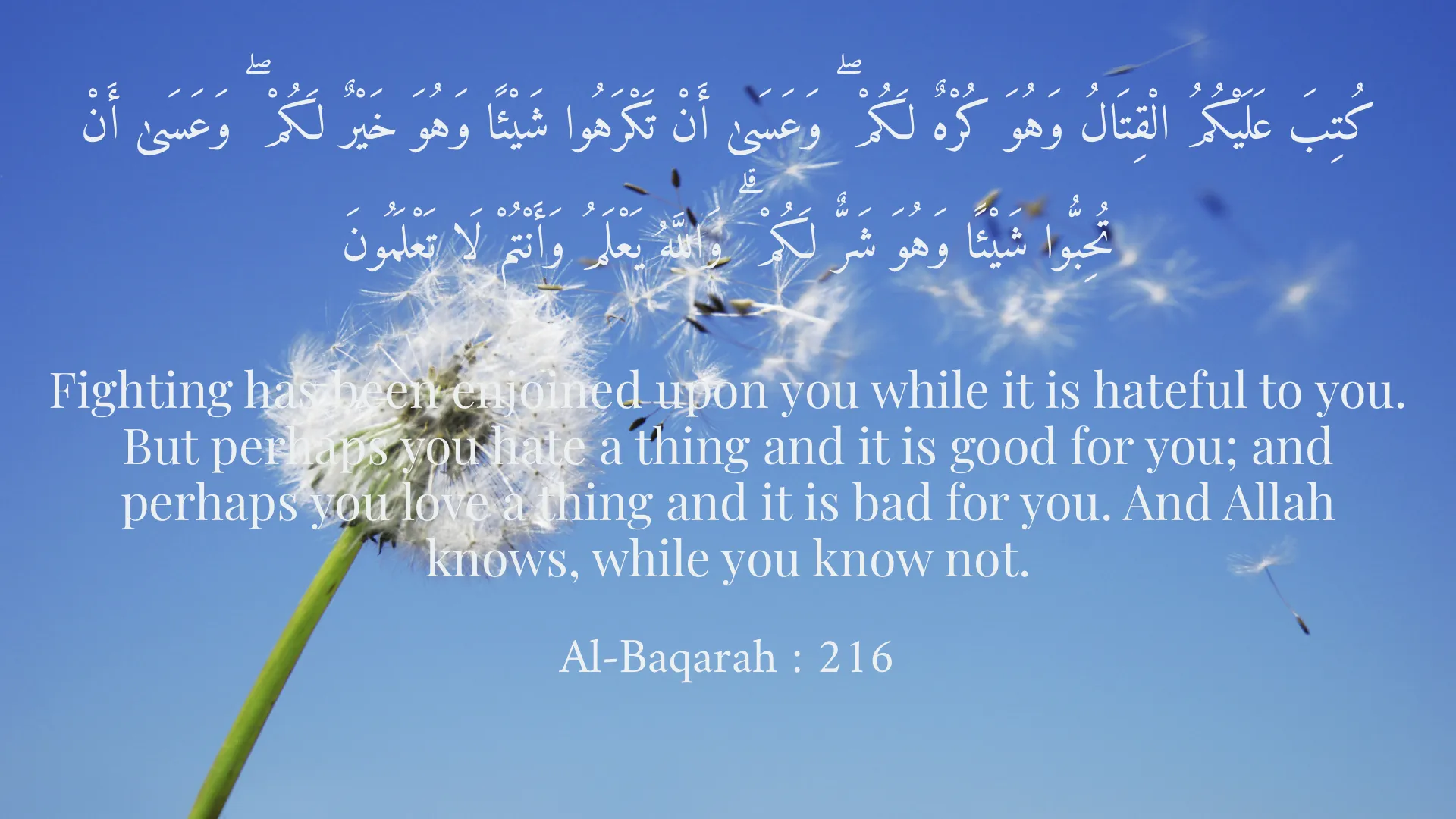
كُتِبَ عَلَيْكُمُ الْقِتَالُ وَهُوَ كُرْهٌ لَكُمْ ۖ وَعَسَىٰ أَنْ تَكْرَهُوا شَيْئًا وَهُوَ خَيْرٌ لَكُمْ ۖ وَعَسَىٰ أَنْ تُحِبُّوا شَيْئًا وَهُوَ شَرٌّ لَكُمْ ۗ وَاللَّهُ يَعْلَمُ وَأَنْتُمْ لَا تَعْلَمُونَ
Fighting has been enjoined upon you while it is hateful to you. But perhaps you hate a thing and it is good for you; and perhaps you love a thing and it is bad for you. And Allah knows, while you know not.
Al-Baqarah : 216
أَحَسِبَ النَّاسُ أَنْ يُتْرَكُوا أَنْ يَقُولُوا آمَنَّا وَهُمْ لَا يُفْتَنُونَ
Do people think that they will be left to say, 'We believe' and they will not be tested?
Al-Ankabut : 2
وَلَقَدْ فَتَنَّا الَّذِينَ مِنْ قَبْلِهِمْ ۖ فَلَيَعْلَمَنَّ اللَّهُ الَّذِينَ صَدَقُوا وَلَيَعْلَمَنَّ الْكَاذِبِينَ
But We have certainly tried those before them, and Allah will surely make evident those who are truthful, and He will surely make evident the liars.
Al-Ankabut : 3
مَا أَصَابَكَ مِنْ حَسَنَةٍ فَمِنَ اللَّهِ ۖ وَمَا أَصَابَكَ مِنْ سَيِّئَةٍ فَمِنْ نَفْسِكَ ۚ وَأَرْسَلْنَاكَ لِلنَّاسِ رَسُولًا ۚ وَكَفَىٰ بِاللَّهِ شَهِيدًا
Whatever good befalls you is from Allah, and whatever ill befalls you is from yourself. And We sent you, [O Muhammad], to the people as a messenger; and sufficient is Allah as Witness.
An-Nisa : 79
Short Story
It is said that in ancient times, a pious man with a pure intention set out on a spiritual journey. With a heart full of good will and seeking divine pleasure, he embarked on his path. Midway, he reached a raging river. His intention was good – to build a bridge to help travelers – but due to flawed calculations or lack of knowledge in construction, the bridge collapsed, causing distress to some. Heartbroken and bewildered, the man wondered: 'Why, despite my good intention, did I encounter nothing but failure?' At that moment, a wise elder appeared and said: 'O young man, a good intention is indeed a crown, but sound planning is the pillar of action. Sometimes, by letting a bridge collapse, Allah warns you of a greater danger on the other side of the river that you would have fallen into had the bridge been completed. Divine wisdom transcends our comprehension, and lessons must be learned even from failures.' The pious man took heed of this advice and understood that a pure intention must be accompanied by wisdom, foresight, and indeed, contentment with divine decree, for Allah holds hidden good even behind bitter appearances.