Quranic Answer
When we ponder the question of why certain events seem to repeat themselves, whether in our personal lives or in the history of nations, the Holy Quran offers a profound and insightful perspective rooted in divine wisdom. While the Quran does not explicitly state, "events repeat themselves," it articulates principles and laws that explain this phenomenon, viewing it not as mere coincidence, but as an integral part of Allah’s wise system for humanity’s education, guidance, and testing. These repetitions are, in essence, opportunities for reflection, change, and spiritual growth, serving as manifestations of Allah's unchanging universal laws. One of the most significant reasons for the repetition of events from a Quranic standpoint is Divine Wisdom and Pedagogical Objectives. Allah (SWT) repeatedly recounts the stories of past prophets and the fates of previous nations in the Quran, often from different angles and with varying emphases. This repetition is not due to a deficiency in expression but serves to reinforce the message, deepen understanding, and highlight the lessons learned. Much like a dedicated teacher who repeats a crucial concept in various ways to ensure students grasp it thoroughly, Allah may allow similar situations to recur in our lives until we truly learn a lesson that has not yet been fully absorbed. These repetitions provide renewed opportunities to contemplate our choices, re-evaluate our behaviors, and correct erroneous paths. Until the necessary lesson is learned, similar trials and challenges may continue to manifest themselves, offering persistent chances for rectification. Another crucial reason is linked to Allah's Unchanging Laws (Sunnatullah) and the Consequences of Human Actions. The Quran explicitly states that Allah will not change the condition of a people until they change what is within themselves. This is an immutable law: our actions have definite consequences. If an individual or a society persists in a wrong path and repeatedly engages in inappropriate behaviors (such as injustice, corruption, or ingratitude), it is natural for similar negative consequences to recur. These recurring problems and challenges serve as a mirror reflecting our own deeds and a warning bell prompting us to reassess our approaches and correct our conduct. Conversely, if one consistently walks the path of righteousness and repeats good deeds, they will witness the recurrence of blessings and good outcomes in their lives. Allah's laws, much like physical laws, are constant and yield predictable results; hence, the repetition of a cause inevitably leads to the repetition of the same effect. Furthermore, the recurrence of events can serve as a Test to Gauge Faith and Patience. Earthly life is replete with trials and tribulations designed to reveal the steadfastness and sincerity of human faith. Sometimes, a particular type of challenge or temptation repeats itself so that an individual can grow stronger, develop greater patience, and deepen their reliance on Allah. These repetitions are opportunities for self-purification, spiritual refinement, and ascending to higher spiritual stations. Allah intends to test His servants through hardships to uncover the essence of their being and help them achieve perfection. If we fail a test, it is probable that the same test will reappear, perhaps in a different form or with varying intensity, until we successfully overcome it. Moreover, Human Forgetfulness and Heedlessness play a significant role in the repetition of events. Humans are inherently prone to forgetfulness and tend to become heedless of warnings and lessons after a period. The recurrence of unpleasant or challenging events can act as an awakening from the Lord, rousing individuals from their slumber of negligence and guiding them back to the remembrance of Allah and a re-evaluation of their lives. These repetitions offer a chance to renew one’s covenant with Allah, seek forgiveness, and return to the straight path. Even the repetition of blessings and divine favors is a form of recurrence given to humans for greater gratitude and appreciation; however, if humanity becomes ungrateful, these blessings might turn into a trial or even be withdrawn. Ultimately, the repetition of events in the tapestry of life and history signifies that nothing in the universe is purposeless or meaningless. Every recurrence, whether on an individual or societal scale, carries a profound message and an opportunity for growth and evolution. Understanding this phenomenon from a Quranic perspective helps us face recurring challenges with a more open and accepting attitude. Instead of despairing, we are encouraged to seek lessons and new solutions, trusting that Allah never exposes His servants to trials without reason and wisdom. This perspective on repetition guides us toward self-improvement, contemplation, and greater reliance on Allah, thereby imbuing our lives with meaning and direction.
Related Verses
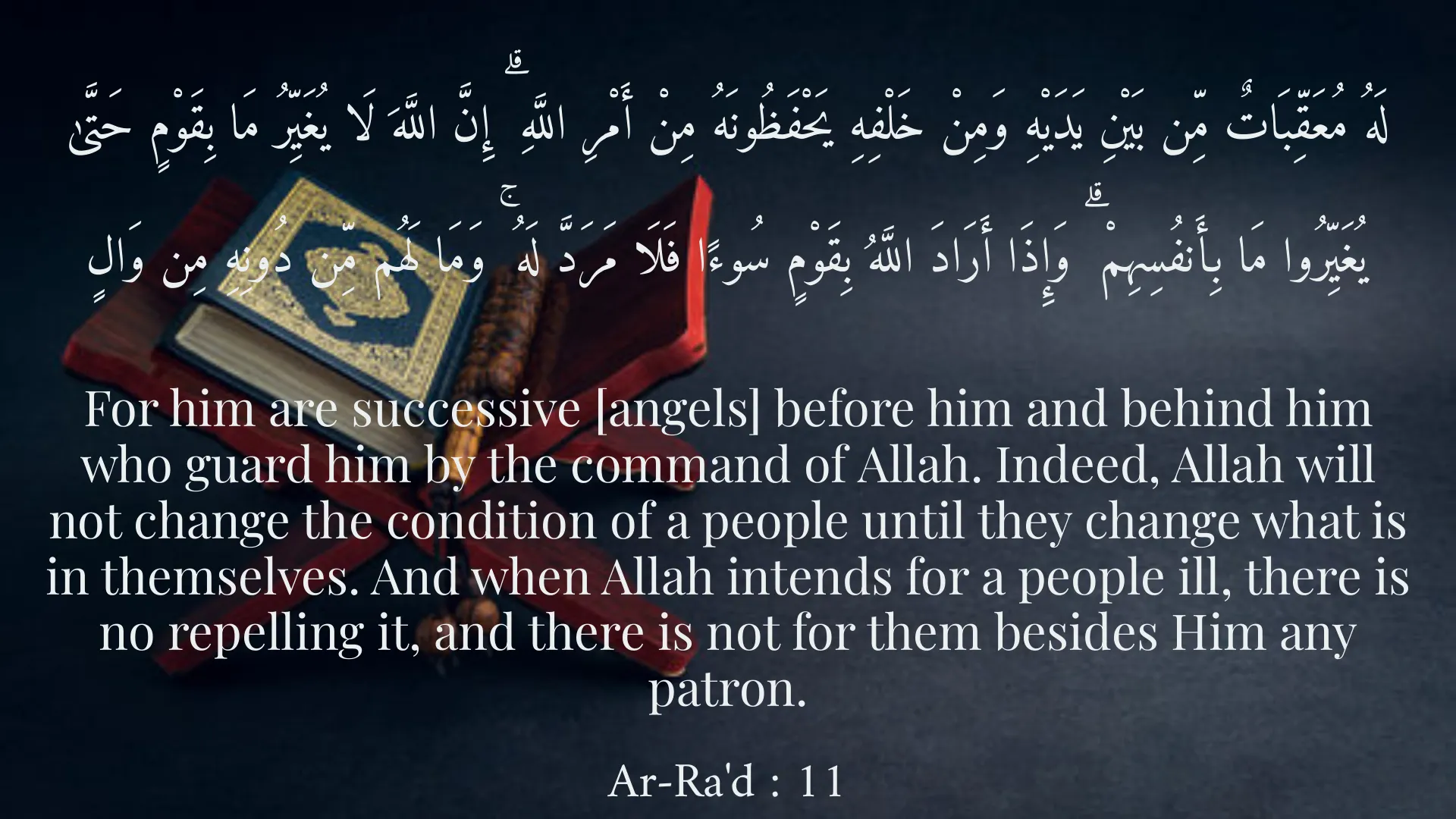
لَهُ مُعَقِّبَاتٌ مِّن بَيْنِ يَدَيْهِ وَمِنْ خَلْفِهِ يَحْفَظُونَهُ مِنْ أَمْرِ اللَّهِ ۗ إِنَّ اللَّهَ لَا يُغَيِّرُ مَا بِقَوْمٍ حَتَّىٰ يُغَيِّرُوا مَا بِأَنفُسِهِمْ ۗ وَإِذَا أَرَادَ اللَّهُ بِقَوْمٍ سُوءًا فَلَا مَرَدَّ لَهُ ۚ وَمَا لَهُم مِّن دُونِهِ مِن وَالٍ
For him are successive [angels] before him and behind him who guard him by the command of Allah. Indeed, Allah will not change the condition of a people until they change what is in themselves. And when Allah intends for a people ill, there is no repelling it, and there is not for them besides Him any patron.
Ar-Ra'd : 11
أَحَسِبَ النَّاسُ أَن يُتْرَكُوا أَن يَقُولُوا آمَنَّا وَهُمْ لَا يُفْتَنُونَ
Do people think that they will be left alone because they say, 'We believe,' and will not be tested?
Al-'Ankabut : 2
وَلَقَدْ فَتَنَّا الَّذِينَ مِن قَبْلِهِمْ ۖ فَلَيَعْلَمَنَّ اللَّهُ الَّذِينَ صَدَقُوا وَلَيَعْلَمَنَّ الْكَاذِبِينَ
But We have certainly tested those before them, and Allah will surely make evident those who are truthful, and He will surely make evident the liars.
Al-'Ankabut : 3
لَقَدْ كَانَ فِي قَصَصِهِمْ عِبْرَةٌ لِّأُولِي الْأَلْبَابِ ۗ مَا كَانَ حَدِيثًا يُفْتَرَىٰ وَلَٰكِن تَصْدِيقَ الَّذِي بَيْنَ يَدَيْهِ وَتَفْصِيلَ كُلِّ شَيْءٍ وَهُدًى وَرَحْمَةً لِّقَوْمٍ يُؤْمِنُونَ
There was certainly in their stories a lesson for those of understanding. Never was it a narration invented, but [it is] a confirmation of what was before it and a detailed explanation of all things and guidance and mercy for a people who believe.
Yusuf : 111
Short Story
It is narrated that in ancient times, there was a man who, every time he decided to travel, faced a similar problem. One time his mount would limp, another time his provisions would go missing, and a third time he would fall into the hands of bandits. Each time he would say to himself, "This is just bad luck!" Until one day, he met a wise man and complained about his misfortune. The sage smiled and said, "My friend, bad luck is not when events repeat themselves; rather, bad luck is when you fail to learn a lesson from the repetition of events and persist in your previous ways." The man fell into deep thought. He then realized that each time he had traveled without sufficient planning, neglected his horse, and chosen unsafe routes. From that day on, he traveled with greater foresight, and whenever he encountered a problem, instead of blaming luck, he sought its root in his own behavior. Thus, his recurring problems gradually disappeared, and his travels became full of peace and blessings. Saadi says: "Experience is the mirror of wisdom."