Quranic Answer
In the journey of servitude and seeking proximity to Almighty Allah, humans are constantly exposed to numerous inner trials and temptations. One of the most subtle yet dangerous of these internal afflictions is 'arrogance' (Kibr), especially when this undesirable trait emerges from the heart of good and benevolent deeds. This phenomenon, which might initially seem paradoxical, has deep psychological and spiritual roots, and the Holy Quran addresses it with unparalleled precision. The fundamental question is: why do our acts of goodness and worship sometimes become a breeding ground for pride and self-aggrandizement instead of cultivating humility and meekness in our hearts? The answer to this question lies in our profound understanding of the true nature of intention, the essence of genuine servitude to the Lord, and the humble position of humanity before Allah's infinite majesty. One of the primary reasons why good deeds can lead to arrogance is the 'lack of complete sincerity' (Ikhlas). The Holy Quran repeatedly emphasizes the importance of sincerity in all acts of worship and good deeds. When our good deeds are not performed solely to gain the pleasure and satisfaction of Almighty Allah, but are mixed with 'riya' (ostentation, performing deeds to be seen and praised by people) or 'ujb' (self-conceit, delighting in one's own goodness and expecting commendation), instead of bringing divine reward and proximity, they unconsciously cause the individual to see themselves as superior and loftier than others, expecting praise and appreciation. In Surah Al-Bayyinah, verse 5, Allah says: “And they were not commanded except to worship Allah, [being] sincere to Him in religion, inclining to truth, and to establish prayer and to give zakah. And that is the correct religion.” This verse clearly shows that the foundation of religion is sincerity in servitude, and any action lacking this vital element is exposed to spiritual afflictions. One who performs good deeds for the approval of people, without even realizing it, falls into the illusion that they are better than others, and this is the beginning of arrogance. Another reason is 'forgetting the true source of blessings and success.' Humans are inherently prone to forgetting the reality that every success, every ability to perform good deeds, every good that originates from them, and even the capacity for pure intention, all stem from Allah's boundless grace and favor. When an individual considers themselves the primary doer and true master in performing good deeds, and instead of showing gratitude to the real Bestower, attributes these successes entirely to their own capabilities and merits, they fall into 'ujb' (self-conceit) and subsequently 'arrogance.' This was the very error of Iblis, who considered himself superior to Adam, being created from fire while Adam was from clay, and was therefore expelled due to this arrogance. In Surah Al-A'raf, verse 12, we read: “He said, 'What prevented you from prostrating when I commanded you?' He said, 'I am better than him. You created me from fire and created him from clay.'” This is a clear example of arrogance stemming from a sense of superiority, deeply rooted in the human psyche. The third factor is 'inappropriate comparison with others.' When an individual compares their good deeds with the shortcomings, weaknesses, or even sins of others, and views themselves as superior in their own self-serving scales, the seed of arrogance is sown in their heart. The Holy Quran strictly forbids mocking, belittling, and judging others. Surah Al-Hujurat, verse 11, states: “O you who have believed, let not a people ridicule [another] people; perhaps they may be better than them; nor let women ridicule [other] women; perhaps they may be better than them. And do not insult one another and do not call each other by [offensive] nicknames. Wretched is the name of disobedience after [one's] faith. And whoever does not repent — then it is those who are the wrongdoers.” This verse highlights the importance of a humble outlook towards others and avoiding judgment and belittling. 'Ignorance of the true essence of servitude' is another contributing factor. Servitude means the utmost humility, submission, and submissiveness before Allah's eternal majesty. Every good deed is merely the fulfillment of a duty; a duty entrusted by the Creator to His creation, for which a reward is also given, not a favor to God or creation. Arrogance is in direct contradiction with the core essence of servitude. One who truly considers themselves a servant always sees themselves as needy and dependent on Allah's grace, and there will never be room for pride in their heart. The dangers of arrogance are very serious and destructive. Almighty Allah dislikes the arrogant, and this is emphasized in numerous verses (such as Surah Luqman, verse 18: “Indeed, Allah does not like those who are self-deluded and boastful” and Surah An-Nahl, verse 23: “Indeed, He does not like the arrogant”). Arrogance acts as a thick veil between a person and the truth, hindering the acceptance of guidance and righteousness. Furthermore, arrogance can diminish the spiritual value of good deeds and even cause them to be nullified, losing their reward in the hereafter. The fate of the arrogant is clearly stated in the Quran, with promises of severe punishment for them. But what is the remedy? The Holy Quran provides clear and effective treatments for this spiritual ailment: First and foremost is 'complete sincerity and purification of intention.' We must constantly examine our intentions and ensure that our actions are solely for Allah. Performing good deeds secretly and avoiding ostentation can be very helpful in this regard. Second, is to 'cultivate humility and meekness' in the heart. Remembering one's weakness and insignificance before Allah's majesty, and recalling creation from humble dust (e.g., Surah Ar-Rum, verse 54: “Allah is the one who created you from weakness”) leads one to humility. Third, is 'constant gratitude' to Allah for every success, as this gratitude acknowledges that all good comes from Him and not from ourselves. Fourth, is 'self-accountability and continuous self-assessment'; that is, regularly reviewing one's intentions and actions and correcting any potential deviations. Fifth, is 'fear of Allah (Taqwa)'; remembering that even good deeds are not a guarantee of salvation, and there is always a potential for slip-ups and errors. And sixth, is to 'absolutely avoid comparing oneself to others' and to focus on self-improvement and purification, rather than judging or seeking superiority over others. Ultimately, it must be understood that good deeds and acts of worship should be a ladder for spiritual ascent and a bridge to divine proximity, continuously increasing our humility and submissiveness before Allah, rather than becoming a pedestal for pride and self-conceit. By constantly safeguarding our intentions, perpetually remembering the majesty of the Lord and our own insignificance, we can free ourselves from the snare of arrogance and transform our righteous deeds into true instruments for attaining divine pleasure and ultimately achieving true peace and happiness.
Related Verses
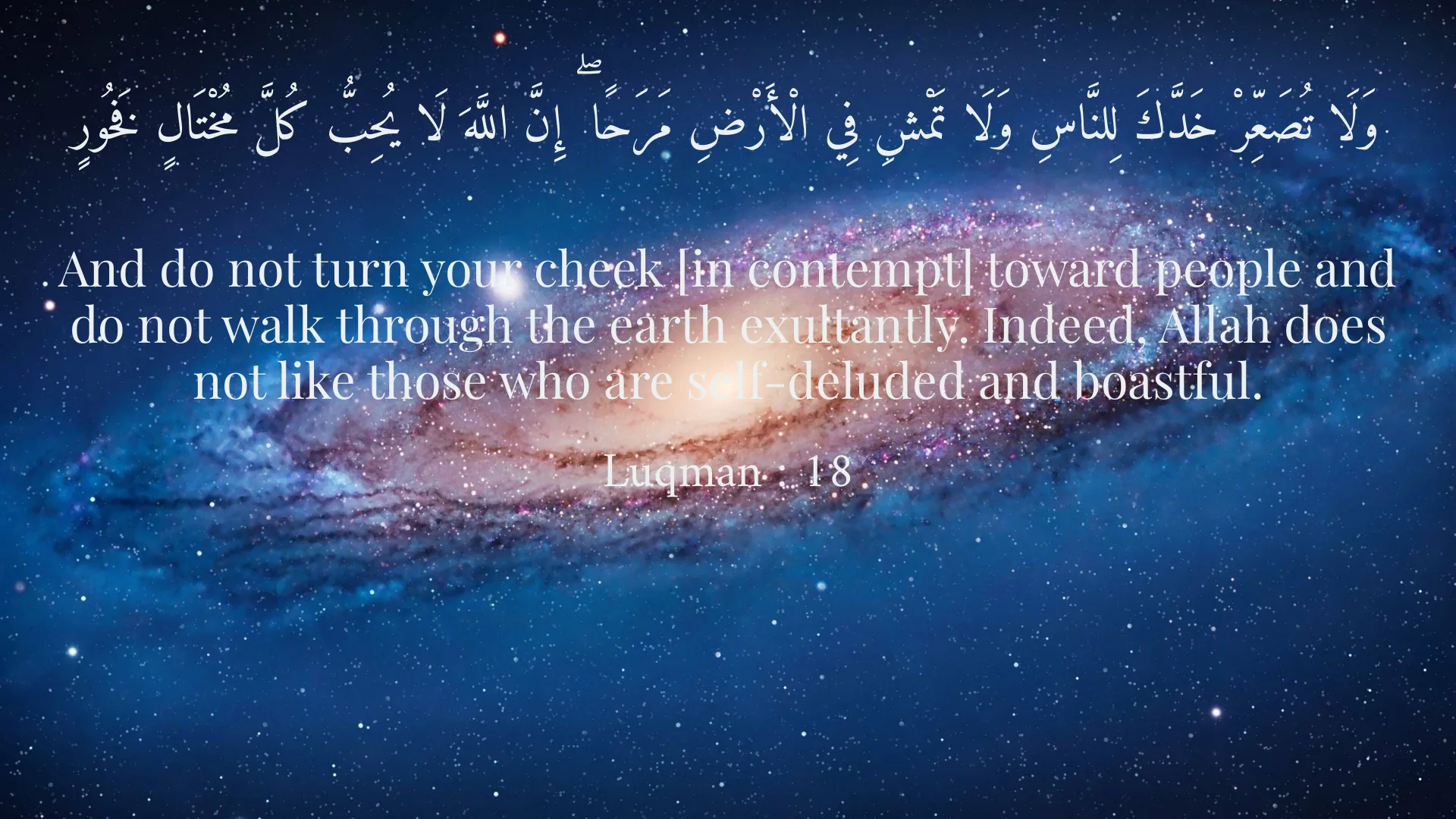
وَلَا تُصَعِّرْ خَدَّكَ لِلنَّاسِ وَلَا تَمْشِ فِي الْأَرْضِ مَرَحًا ۖ إِنَّ اللَّهَ لَا يُحِبُّ كُلَّ مُخْتَالٍ فَخُورٍ
And do not turn your cheek [in contempt] toward people and do not walk through the earth exultantly. Indeed, Allah does not like those who are self-deluded and boastful.
Luqman : 18
وَلَا تَمْشِ فِي الْأَرْضِ مَرَحًا ۖ إِنَّكَ لَن تَخْرِقَ الْأَرْضَ وَلَن تَبْلُغَ الْجِبَالَ طُولًا
And do not walk upon the earth exultantly. Indeed, you will never tear the earth [apart] and you will never reach the mountains in height.
Al-Isra : 37
لَا جَرَمَ أَنَّ اللَّهَ يَعْلَمُ مَا يُسِرُّونَ وَمَا يُعْلِنُونَ ۚ إِنَّهُ لَا يُحِبُّ الْمُسْتَكْبِرِينَ
Assuredly, Allah knows what they conceal and what they declare. Indeed, He does not like the arrogant.
An-Nahl : 23
Short Story
In Saadi's Gulistan, it is related that a wealthy and very devout man, who had performed the Hajj pilgrimage many times, sat arrogantly with a dervish. He spoke with pride and boasting about the multitude of his acts of worship and his numerous Hajj journeys, considering himself superior to others because of these good deeds, repeatedly saying: 'I did this and I did that.' The dervish, with a calm and heartwarming smile, yet with wise words, said: "O friend, if you perform Hajj on foot a hundred times and sacrifice a thousand camels, as long as your heart is not purified from arrogance and pride, and you believe yourself better than others, these outward deeds will not bring you to your desired destination. For true Hajj is the Hajj of the heart, and the real Kaaba is a heart empty of the rebellious and selfish self." The wealthy man pondered these penetrating words and realized that the value of good deeds lies not in their multitude or in ostentation and comparison, but in the purity of intention and humility before the Creator and His servants. From then on, he strove to make every good deed he performed a step towards humility, not a ladder of pride and self-conceit.