Quranic Answer
Understanding why some individuals, despite possessing faith, tend to break down quickly when faced with life's hardships and challenges requires a deep reflection on the nature of faith, divine wisdom in trials, and human spiritual capacities. The Holy Quran clearly states that worldly life is a realm of tests and trials, and no one is exempt from divine examinations. Allah says in the Quran: "And We will surely test you with something of fear and hunger and a loss of wealth and lives and fruits, but give good tidings to the patient." (Al-Baqarah, verse 155). This verse explicitly indicates that fear, hunger, loss of wealth, lives, and harvests are all parts of divine tests. Thus, the occurrence of problems and hardships is inevitable and a part of divine tradition. The quick breakdown of individuals, even with apparent faith, can be attributed to various reasons rooted in Quranic and psychological understandings. One of the most significant reasons is the depth and quality of faith. Faith is not merely a verbal affirmation; it must be deeply rooted in the heart and manifest in actions. The Quran states in Surah Al-Ankabut, verses 2 and 3: "Do people think that they will be left alone because they say, 'We believe,' and will not be tested? But We have certainly tested those before them, and Allah will surely make evident those who are truthful, and He will surely make evident the liars." These verses explicitly declare that merely claiming faith is not enough to be spared from trials, and Allah will distinguish between those who are truthful in their claim of faith and those who are not. Therefore, if faith is superficial and has not reached the level of 'certainty' (yaqeen), it will not withstand the storms of adversity. Another reason is the lack of patience and perseverance. The Holy Quran emphasizes the importance of patience in numerous verses and gives good tidings to the patient. Patience is not merely passive endurance; it is an active resistance against problems, accompanied by trust in divine decree and hope for relief. The absence of this type of patience renders a person helpless in the face of difficulties, and even existing faith cannot act as a protector. Individuals who quickly lose hope may do so because they lack a correct understanding of 'divine promise' – promises that guarantee divine help and support for those who are patient and rely on Allah. They forget that "Indeed, with hardship, there is ease" (Al-Inshirah, verse 5), meaning ease follows every difficulty. Furthermore, weakness in genuine reliance on Allah (Tawakkul) can be a factor. Tawakkul means entrusting one's affairs to God after making every possible effort. If a person, despite having faith, assumes that everything should proceed according to their desires and becomes despairing at the slightest adversity, this indicates a weakness in their Tawakkul. They have forgotten that "And whoever relies upon Allah, then He is sufficient for him" (At-Talaq, verse 3). This weakness in reliance causes the individual to depend only on their limited abilities or external circumstances instead of the infinite power of Allah, leading to a feeling of being unsupported when conditions change. Psychological and mental health issues, such as anxiety and depression, can also play a role. Although faith acts as a shield against many of these problems, sometimes specialized treatment and care are necessary. In such cases, physical and mental weakness can hinder the full manifestation of a person's faith, making them more vulnerable. The Quran also emphasizes the necessity of using intellect and seeking knowledge, which includes psychological knowledge. Finally, differences in degrees of faith, upbringing, and living environment also play a significant role. Some individuals have grown up in environments where they have learned less resilience and resistance to problems. Strong faith is one that is strengthened through experience and action, where an individual becomes stronger and more steadfast after overcoming each divine test. It is important to remember that 'breaking down' does not necessarily mean disbelief, but rather can be a sign of a need to strengthen specific aspects of faith. True faith is like a tree whose roots are deeply embedded in the soil of divine truth, and no storm can uproot it. The remembrance of Allah (Dhikr), prayer (Salah), and supplication (Du'a) are factors that strengthen these roots, as stated in Surah Ar-Ra'd, verse 28: "Those who have believed and whose hearts are assured by the remembrance of Allah. Unquestionably, by the remembrance of Allah hearts are assured." (Verily, in the remembrance of Allah do hearts find rest.) Strengthening this remembrance and continuous connection helps a person remain steadfast during hardships and emerge victorious from trials.
Related Verses
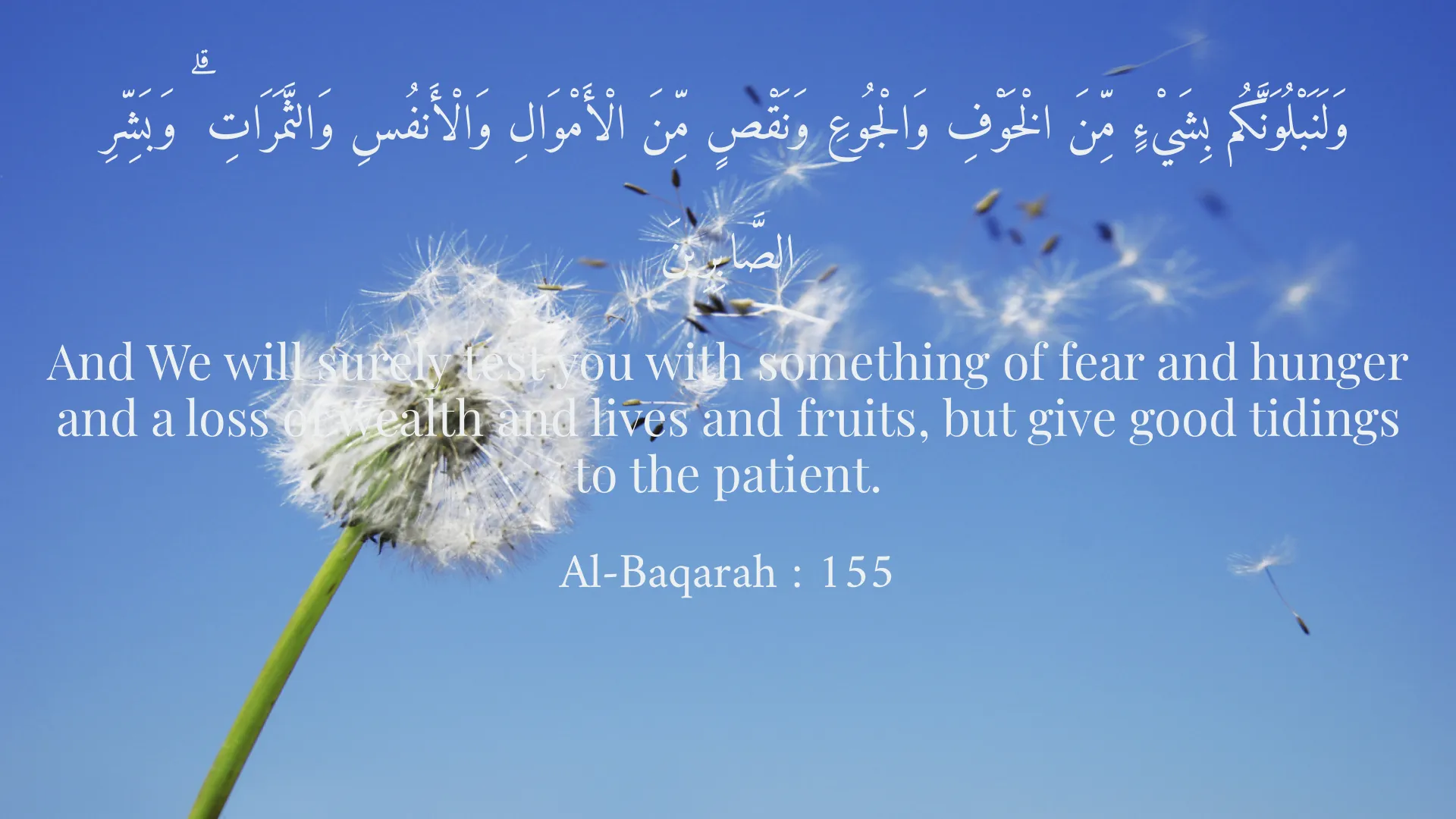
وَلَنَبْلُوَنَّكُم بِشَيْءٍ مِّنَ الْخَوْفِ وَالْجُوعِ وَنَقْصٍ مِّنَ الْأَمْوَالِ وَالْأَنفُسِ وَالثَّمَرَاتِ ۗ وَبَشِّرِ الصَّابِرِينَ
And We will surely test you with something of fear and hunger and a loss of wealth and lives and fruits, but give good tidings to the patient.
Al-Baqarah : 155
أَحَسِبَ النَّاسُ أَن يُتْرَكُوا أَن يَقُولُوا آمَنَّا وَهُمْ لَا يُفْتَنُونَ
Do people think that they will be left alone because they say, 'We believe,' and will not be tested?
Al-Ankabut : 2
وَلَقَدْ فَتَنَّا الَّذِينَ مِن قَبْلِهِمْ ۖ فَلَيَعْلَمَنَّ اللَّهُ الَّذِينَ صَدَقُوا وَلَيَعْلَمَنَّ الْكَاذِبِينَ
But We have certainly tested those before them, and Allah will surely make evident those who are truthful, and He will surely make evident the liars.
Al-Ankabut : 3
الَّذِينَ آمَنُوا وَتَطْمَئِنُّ قُلُوبُهُم بِذِكْرِ اللَّهِ ۗ أَلَا بِذِكْرِ اللَّهِ تَطْمَئِنُّ الْقُلُوبُ
Those who have believed and whose hearts are assured by the remembrance of Allah. Unquestionably, by the remembrance of Allah hearts are assured.
Ar-Ra'd : 28
Short Story
It is said that one day in Nishapur, a frail and emaciated dervish sat by the roadside, complaining about the misfortunes of the world. A learned man who knew him and was aware of his outwardly strong faith, asked him: "O brother, you who always spoke of reliance and patience, what is the cause of this distress?" The dervish sighed and said: "The hardship of time has pressed so hard on my heart that I thought the spring of my faith had dried up." The learned man smiled and said: "O brother, reliance is not claiming bravery in comfort; reliance is being steadfast in adversity. Faith is a tree whose fruit is patience and whose root is certainty. If the root is deep, strong winds may bend the branches, but they will not uproot the tree. Perhaps your faith needs more watering with the water of remembrance and trust in divine decree so that its roots may become firmer." The dervish took heed of this counsel and realized that his breaking was not due to the absence of faith, but to its lack of depth in his heart. From then on, instead of complaining, he occupied himself more with the remembrance of God and reliance, and found peace.