Quranic Answer
Fear of change is a profoundly human phenomenon rooted in psychological and existential factors. From the perspective of the Holy Quran, this fear can be attributed to several fundamental elements, primarily revolving around human nature, one's relationship with the transient world (Dunya), and the understanding of divine will. While the Quran does not directly use the term 'fear of change,' it frequently addresses concepts that explain this fear and offers solutions to overcome it. One of the primary reasons for fearing change is humanity's strong attachment to the 'Dunya' (worldly life) and all that is within it. The Quran repeatedly emphasizes the fleeting and temporary nature of worldly life. In Surah Al-Hadid, verse 20, Allah states: "Know that the life of this world is only play and amusement and adornment and boasting among yourselves and competition in increase of wealth and children." This verse illustrates that humans naturally become attached to their wealth, status, relationships, and current circumstances. Change, by its very nature, poses a threat to these attachments, as it can lead to the loss of what one has grown accustomed to or considers their possession. This fear of loss manifests as anxiety about an unknown future, the potential loss of security and comfort, or even the loss of one's identity. Indeed, whenever a person shifts their balance from dependence on 'Divine stability' to 'worldly stability,' the fear of change and loss intensifies. Another reason is the testing nature of life. The Quran describes life as a scene of trials and tribulations. In Surah Al-Imran, verse 140, we read: "And these days [of varying conditions] We alternate among the people so that Allah may make evident those who believe and [may] take martyrs from among you." This verse clearly indicates that changing conditions (from victory to defeat and vice versa) are part of Allah's divine pattern (Sunnah), intended to distinguish true believers and purify individuals. When change is viewed as a divine test, the fear of failing this test or the hardships it entails can naturally lead to a fear of change itself. Humans are inherently fearful of the unknown and things they cannot control. Change is often accompanied by uncertainty, and this uncertainty becomes a source of anxiety and fear. If a person does not have complete trust in Allah's absolute power and wisdom, this fear is exacerbated. Furthermore, a deficiency in 'Tawakkul' (reliance) and trust in Allah plays a significant role in the fear of change. The Quran constantly invites believers to rely on Allah. In Surah At-Talaq, verse 3, it states: "And whoever relies upon Allah - He is sufficient for him." The fear of change often stems from the belief that one must bear the burden of the future alone and lacks the ability to manage unforeseen consequences. True Tawakkul, however, means that a person strives with all their might but then entrusts the outcome to Allah, knowing that whatever He decrees is best, even if it appears unpleasant at first. A lack or weakness of Tawakkul makes a person vulnerable to life's fluctuations and reinforces the fear of losing control. Fear of change can also arise from a misunderstanding of divine laws (Sunan). The Quran explains that Allah has immutable laws in creation and the management of the universe. Among these divine laws is the law of transformation and evolution. The world is in constant motion and perpetual change; nothing remains static except the Divine Essence. If a person does not accept this reality and expects absolute stability in a dynamic world, every change will be perceived as a threat. Conversely, accepting this divine law helps a person align themselves with the flow of life and, instead of futile resistance, embrace flexibility and adaptability. This Quranic outlook encourages dynamism and innovation within the framework of divine pleasure, rather than retreating into stagnation. Ultimately, by emphasizing the return to Allah and the ultimate purpose of creation, the Quran helps individuals minimize the scope of their fears. When the primary goal of life is to attain Allah's pleasure and the bliss of the Hereafter, worldly changes, no matter how significant, lose their absolute importance and become tools to achieve that noble objective. Fear of change, in this perspective, transforms into an opportunity for growth, testing one's faith, and strengthening reliance on Allah. Therefore, fear of change can be seen as a result of attachment to the world, insufficient reliance on Allah, and a lack of proper understanding of life's testing and changeable nature. The Quran offers the solution in strengthening faith, reliance, and acceptance of divine will.
Related Verses
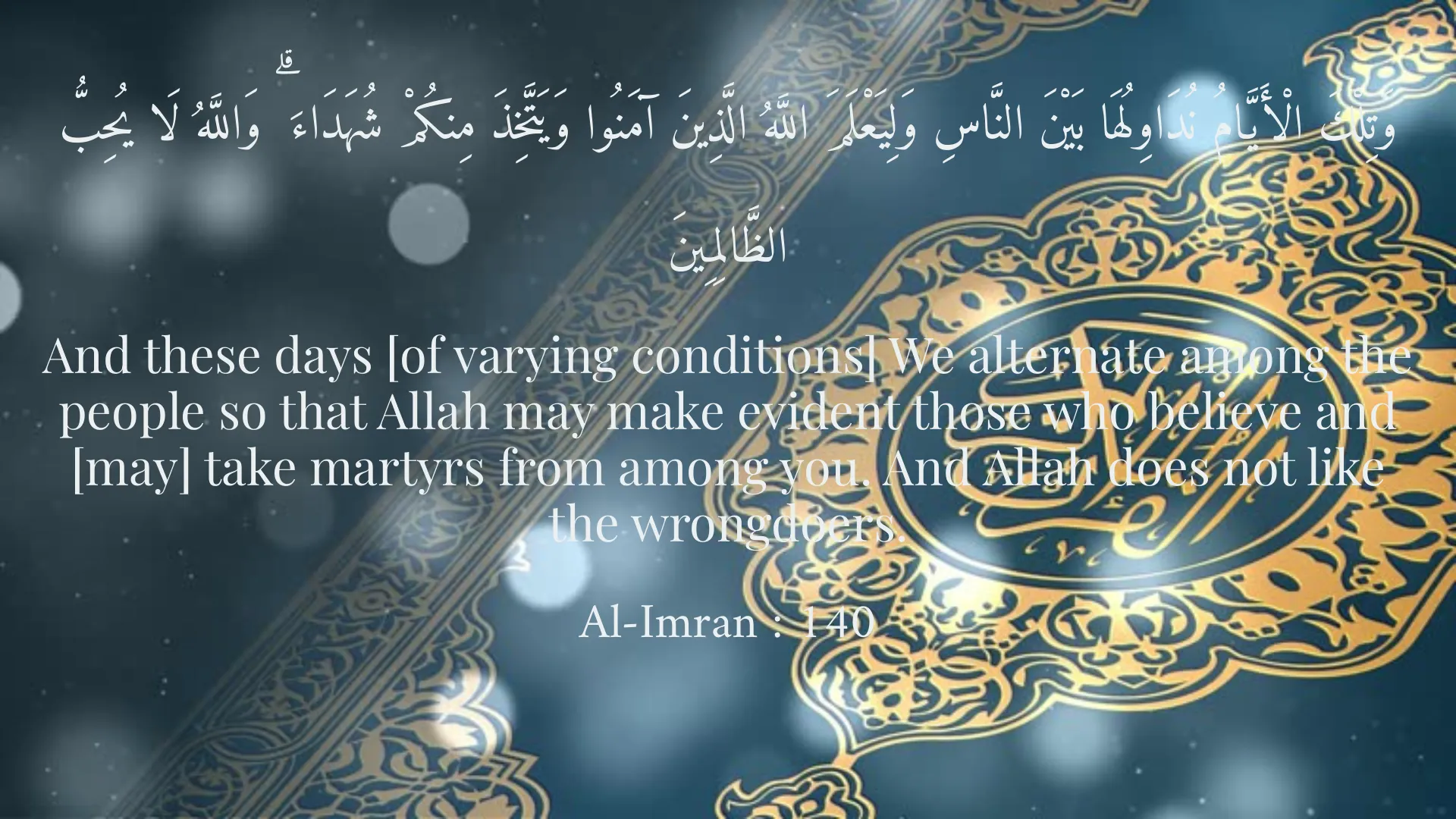
وَتِلْكَ الْأَيَّامُ نُدَاوِلُهَا بَيْنَ النَّاسِ وَلِيَعْلَمَ اللَّهُ الَّذِينَ آمَنُوا وَيَتَّخِذَ مِنكُمْ شُهَدَاءَ ۗ وَاللَّهُ لَا يُحِبُّ الظَّالِمِينَ
And these days [of varying conditions] We alternate among the people so that Allah may make evident those who believe and [may] take martyrs from among you. And Allah does not like the wrongdoers.
Al-Imran : 140
وَمَن يَتَوَكَّلْ عَلَى اللَّهِ فَهُوَ حَسْبُهُ ۚ إِنَّ اللَّهَ بَالِغُ أَمْرِهِ ۚ قَدْ جَعَلَ اللَّهُ لِكُلِّ شَيْءٍ قَدْرًا
And whoever relies upon Allah - He is sufficient for him. Indeed, Allah will accomplish His purpose. Allah has already set for everything a [decreed] extent.
At-Talaq : 3
اعْلَمُوا أَنَّمَا الْحَيَاةُ الدُّنْيَا لَعِبٌ وَلَهْوٌ وَزِينَةٌ وَتَفَاخُرٌ بَيْنَكُمْ وَتَكَاثُرٌ فِي الْأَمْوَالِ وَالْأَوْلَادِ ۖ كَمَثَلِ غَيْثٍ أَعْجَبَ الْكُفَّارَ نَبَاتُهُ ثُمَّ يَهِيجُ فَتَرَاهُ مُصْفَرًّا ثُمَّ يَكُونُ حُطَامًا ۚ وَفِي الْآخِرَةِ عَذَابٌ شَدِيدٌ وَمَغْفِرَةٌ مِّنَ اللَّهِ وَرِضْوَانٌ ۚ وَمَا الْحَيَاةُ الدُّنْيَا إِلَّا مَتَاعُ الْغُرُورِ
Know that the life of this world is only play and amusement and adornment and boasting among yourselves and competition in increase of wealth and children - like the example of a downpour whose resulting plant growth pleases the disbelievers; then it dries and you see it [become] yellow; then it becomes [scattered] debris. And in the Hereafter is severe punishment and forgiveness from Allah and approval. And what is the worldly life except the enjoyment of delusion.
Al-Hadid : 20
Short Story
One of the wise men said to his students, "Why does the duck, whenever the sea becomes turbulent and wavy, never move from its place?" One of the students replied, "Perhaps because it knows that with every wave, it can go up and down without drowning." The wise man smiled and said, "Yes, it trusts the depth of the sea and the divine power that governs it. But sometimes, instead of trusting that infinite power and inner stability, humans cling to superficial stability and the muddy waters of the world. And when the wave of change arrives, they fear and think themselves drowned. Whereas, if they entrust their hearts to the Divine Essence and know that everything is in His hands, every wave will be a ladder for ascent, not a whirlpool for descent." The students learned from this saying and understood that fear of change stems from a lack of reliance and attachment to transient things.