Quranic Answer
The pervasive feeling of lack and inner dissatisfaction, even when surrounded by abundant resources and apparent sufficiency, is a profound and perennial human predicament rooted in our very nature. The Holy Quran, as a divine revelation and a guide for life, addresses this human phenomenon with remarkable depth and insight, explaining its causes and offering profound solutions. From the Quranic perspective, this sense of lack stems primarily from several key factors related to the transient nature of worldly life, human inclinations, and the neglect of our ultimate purpose of creation. Let us explore these reasons to gain a deeper understanding of this challenge and learn how to overcome it. Firstly, and perhaps most significantly, the Quran attributes the feeling of lack despite abundance to humanity's insatiable greed and inherent covetousness. Allah (SWT) mentions this human characteristic in several verses. For instance, in Surah At-Takathur, verses 1-2, it states: “The mutual rivalry (for piling up of worldly things) diverts you, Until you visit the graves.” This verse clearly indicates that humans are inherently driven by a desire for more – more wealth, more power, more fame. This ceaseless competition and desire for accumulation is an unending cycle that never reaches a point of contentment. No matter how much a person acquires, they will always feel it's not enough, either due to comparison with others or the emergence of new desires. This greed acts like a fire that only grows fiercer the more fuel it receives, never truly being extinguished. The Quran teaches us that this avarice not only fails to bring peace but actively distracts us from the true purpose of life and hinders our path to genuine happiness. Secondly, the deceptive and transient nature of this worldly life (Dunya) plays a crucial role. The Quran repeatedly emphasizes that the life of this world is nothing more than play and amusement, a fleeting provision. In Surah Al-Hadid, verse 20, Allah says: “Know that the life of this world is only play and amusement, pomp and mutual boasting among you, and rivalry in respect of wealth and children. It is like the rain, whose vegetation pleases the cultivators; then it dries up and you see it turning yellow; then it becomes (scattered) dust. And in the Hereafter there is severe punishment and forgiveness from Allah and (His) pleasure. And what is the life of this world except a deceptive enjoyment.” This verse beautifully illustrates that attaching our hearts to the world and its material possessions is akin to chasing a mirage; it appears beautiful and desirable from afar, but when we reach it, there is nothing but illusion. When individuals limit their ultimate goal to accumulating wealth, status, and material pleasures, they will never find true satisfaction or peace because these things are inherently impermanent and incapable of fulfilling the deep needs of the soul. This feeling of lack is, in essence, a warning from our innate human disposition (fitra) urging us to seek solace and fulfillment elsewhere. The third factor is the neglect of the remembrance of Allah (Dhikr) and a lack of gratitude (Shukr). The human heart is a vessel that can only be truly filled with the remembrance and love of the Divine. In Surah Ar-Ra'd, verse 28, it is stated: “Those who have believed and whose hearts are assured by the remembrance of Allah. Unquestionably, by the remembrance of Allah hearts are assured.” When a person distances themselves from the primary source of true peace and genuine richness, no matter how much the world bestows upon them, they will still feel empty and incomplete. The remembrance of Allah means acknowledging His presence in every moment of life and recognizing His countless blessings. This recognition leads to gratitude. Gratitude not only increases the blessings (as stated in Surah Ibrahim, verse 7: “And [remember] when your Lord proclaimed, 'If you are grateful, I will surely increase you [in favor]; but if you deny, indeed, My punishment is severe'”), but it also transforms one's perspective towards their possessions. A grateful individual focuses on what they have, rather than what they lack, leading to contentment (Qana'ah) and inner satisfaction. Conversely, if we are ungrateful and overlook blessings, we perpetually feel entitled to more, and this feeling plunges us deeper into the abyss of scarcity. In summary, the feeling of lack despite abundant resources stems from the ego's inclination towards excessive desire, the deceptive allure of worldly appearances, and a detachment from the remembrance of Allah. The Quran offers solutions to this predicament through a change in perspective, focusing on the Hereafter, cultivating gratitude, embracing contentment (Qana'ah), and most importantly, establishing a profound connection with the Creator of the universe. It is only by filling the inner void with spirituality and surrendering to divine decree that humanity can achieve true tranquility and escape the endless craving for worldly possessions. This means transforming a material need into a spiritual one, and nourishing the soul rather than merely the body.
Related Verses
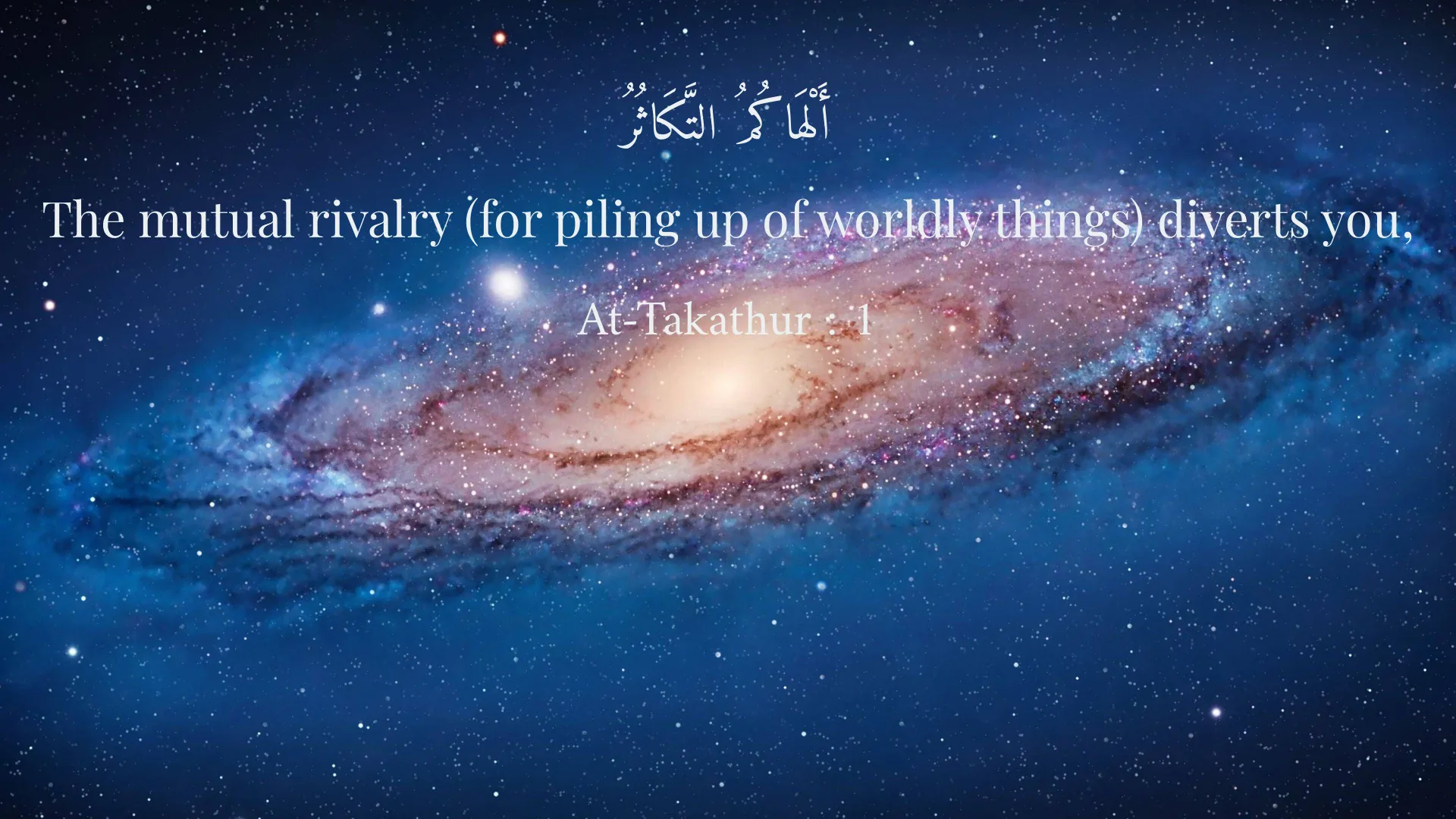
أَلْهَاكُمُ التَّكَاثُرُ
The mutual rivalry (for piling up of worldly things) diverts you,
At-Takathur : 1
حَتَّى زُرْتُمُ الْمَقَابِرَ
Until you visit the graves (i.e., till you die).
At-Takathur : 2
اعْلَمُوا أَنَّمَا الْحَيَاةُ الدُّنْيَا لَعِبٌ وَلَهْوٌ وَزِينَةٌ وَتَفَاخُرٌ بَيْنَكُمْ وَتَكَاثُرٌ فِي الْأَمْوَالِ وَالْأَوْلَادِ ۖ كَمَثَلِ غَيْثٍ أَعْجَبَ الْكُفَّارَ نَبَاتُهُ ثُمَّ يَهِيجُ فَتَرَاهُ مُصْفَرًّا ثُمَّ يَكُونُ حُطَامًا ۖ وَفِي الْآخِرَةِ عَذَابٌ شَدِيدٌ وَمَغْفِرَةٌ مِّنَ اللَّهِ وَرِضْوَانٌ ۚ وَمَا الْحَيَاةُ الدُّنْيَا إِلَّا مَتَاعُ الْغُرُورِ
Know that the life of this world is only play and amusement, pomp and mutual boasting among you, and rivalry in respect of wealth and children. It is like the rain, whose vegetation pleases the cultivators; then it dries up and you see it turning yellow; then it becomes (scattered) dust. And in the Hereafter there is severe punishment and forgiveness from Allah and (His) pleasure. And what is the life of this world except a deceptive enjoyment.
Al-Hadid : 20
الَّذِينَ آمَنُوا وَتَطْمَئِنُّ قُلُوبُهُم بِذِكْرِ اللَّهِ ۗ أَلَا بِذِكْرِ اللَّهِ تَطْمَئِنُّ الْقُلُوبُ
Those who have believed and whose hearts are assured by the remembrance of Allah. Unquestionably, by the remembrance of Allah hearts are assured.
Ar-Ra'd : 28
وَإِذْ تَأَذَّنَ رَبُّكُمْ لَئِن شَكَرْتُمْ لَأَزِيدَنَّكُمْ ۖ وَلَئِن كَفَرْتُمْ إِنَّ عَذَابِي لَشَدِيدٌ
And [remember] when your Lord proclaimed, 'If you are grateful, I will surely increase you [in favor]; but if you deny, indeed, My punishment is severe.'
Ibrahim : 7
Short Story
It is narrated that there was a wealthy merchant who possessed vast riches, yet his heart never found peace. He was constantly striving to increase his possessions, and the more he acquired, the more he felt a sense of lack. One day, he came upon a pious sage sitting peacefully in a garden, content with only barley bread and fresh water. The merchant, astonished, asked: "O man of God, I, with all my blessings and wealth, am not at peace for a moment, yet you, with this poverty, are so calm and content?" The sage smiled and said: "O merchant, you carry your possessions on your shoulders, while I have lifted the burden of my possessions from my shoulders. What satiates the soul is neither the abundance of wealth nor the plenitude of blessings, but rather contentment and the remembrance of the Lord. You wish to hold the world in your fist, and I have wished to cast the world out of my heart. As long as your heart is attached to the world and what is in it, you will never be satisfied, for the world is insatiable. But whenever you open your heart towards the Creator and become content with what He has provided, then even poverty will be richness for you, and lack itself will transform into perfection." The merchant took heed of the sage's words, adopted the path of contentment and gratitude, and found true peace within his existing blessings, rather than in adding more to them.