Quranic Answer
Why does man always seek more? This is a profound question with roots deeply embedded in human nature, and the Holy Quran addresses it with remarkable insight. Indeed, if we observe human lives throughout history and across various societies, we consistently witness this insatiable desire to acquire more wealth, higher status, greater knowledge, wider power, and even increased pleasures. This endless pursuit of 'more' is a universal and pervasive phenomenon that has been clearly analyzed in the verses of the Quran. The Quran identifies this tendency towards 'excessive accumulation' or 'seeking more' as part of human disposition, but not in a way that inherently leads to destruction. Rather, it is a characteristic that can either guide one towards perfection or lead to downfall. In Surah At-Takathur (102:1-2), Allah says: "أَلْهَاكُمُ التَّكَاثُرُ * حَتَّى زُرْتُمُ الْمَقَابِرَ" (Competition in worldly increase diverts you, Until you visit the graves). This verse beautifully illustrates how rivalry and striving for an increase in wealth, children, power, and everything else in this world can distract humans from their primary purpose of creation and the remembrance of the Hereafter. 'Takathur' here refers to boasting about the abundance of possessions and followers and competing in the pursuit of more, which preoccupies humans until the moment of death. This desire for more is further explained in other verses. For instance, in Surah Al-Adiyat (100:8), we read: "وَإِنَّهُ لِحُبِّ الْخَيْرِ لَشَدِيدٌ" (And indeed he is, in love of wealth, intense). Here, 'Al-Khayr' refers to wealth and possessions, and the verse emphasizes the intense human desire to accumulate them. Similarly, in Surah Al-Fajr (89:20), Allah says: "وَتُحِبُّونَ الْمَالَ حُبًّا جَمًّا" (And you love wealth with immense love). These verses provide a clear picture of humanity's natural inclination towards worldly possessions. This inclination is not inherently negative, as it can be a motivator for effort, construction, and progress. However, when it exceeds moderation and becomes the sole purpose, it transforms into something destructive for the human soul and psyche. But what are the roots of this inclination for 'more'? One of the primary reasons is a feeling of insecurity and fear of the future. Humans instinctively seek security and often believe that having more will guarantee it. This includes financial, social, and even psychological security. The fear of poverty, the fear of losing status, and the fear of not achieving aspirations can all fuel this endless cycle of wanting more, keeping humans in a perpetual search for peace and stability, oblivious to the fact that true peace lies within. Another reason is social comparison and boasting. Humans are inherently social beings and often compare themselves to others. Seeing the wealth, status, or success of others can create a sense of need for more in oneself, to avoid falling behind or even to surpass others. This is the concept of 'tafakur' (boasting) mentioned in Surah Al-Hadid (57:20): "اعْلَمُوا أَنَّمَا الْحَيَاةُ الدُّنْيَا لَعِبٌ وَلَهْوٌ وَزِينَةٌ وَتَفَاخُرٌ بَيْنَكُمْ وَتَكَاثُرٌ فِي الْأَمْوَالِ وَالْأَوْلَادِ" (Know that the life of this world is only play and amusement, an adornment and boasting among yourselves, and rivalry in respect of wealth and children). This verse presents the world as an arena for competition in accumulation and boasting; a competition that is often fruitless and distressing. Furthermore, negligence of the primary purpose of creation also contributes to this desire for more. If a person sees their sole purpose in worldly pleasures, acquiring wealth, and status, it is natural for them never to be satisfied, because the world is inherently limited and finite and cannot satisfy the boundless human spirit. The Quran constantly reminds humanity that this life is temporary and that the true, lasting life is the Hereafter. Focusing on this world and forgetting the Hereafter traps humans in this endless cycle and makes them oblivious to the truth of their own existence. Satan also plays the role of tempter in this regard, leading humans towards excess and prolonged desires. However, the Quran, while describing these human characteristics, also provides solutions and remedies so that humans can manage this desire and achieve true happiness. One of the most important solutions is 'Qana'ah' (contentment) and satisfaction with what Allah has apportioned. Qana'ah does not mean ceasing effort, but rather finding peace and contentment in what is available and avoiding excessive greed. The Prophet Muhammad (PBUH) said: "Contentment is an inexhaustible treasure." Contentment helps a person to enjoy what they have and not suffer from what they lack. Another way is 'Shukr' (gratitude). When a person focuses on the blessings Allah has bestowed upon them instead of their deficiencies, their heart fills with satisfaction, and the boundless desire for more diminishes. Gratitude is a gateway to increasing divine blessings and inner contentment. The Quran also emphasizes the importance of 'Infaq' (spending in charity). When a person gives from what they have, they not only help others but also free themselves from the bondage of wealth and worldly possessions. Infaq helps one understand that wealth is merely a means to achieve higher goals, not an ultimate or permanent end. Finally, 'remembrance of the Hereafter' and focusing on the afterlife is crucial. When a person remembers that all these worldly possessions must be left behind and only righteous deeds and piety will remain with them, their perspective on the world changes. Instead of accumulating wealth, they focus on gathering provisions for the Hereafter. This is the insight that can save a person from the snare of 'takathur' and guide them towards true peace and happiness. The Quran does not say that humans should not strive or become wealthy; Islam is a religion of moderation and encourages effort and diligence in acquiring lawful sustenance and legitimate progress. However, this effort must be accompanied by moderation, contentment, and attention to the rights of others and God. Humans must remember that everything is from Allah, and He is the true Owner. This perspective frees a person from the clutches of greed and grants them a profound peace that no amount of worldly wealth can provide. Understanding that insatiability can only be resolved by connecting to the infinite Divine source and finding meaning in spiritual life is the key to liberation from the eternal trap of 'more.' This is how one can succeed in this world while also gathering provisions for the Hereafter, without being enslaved by excessive desires and limiting one's life solely to material wants.
Related Verses
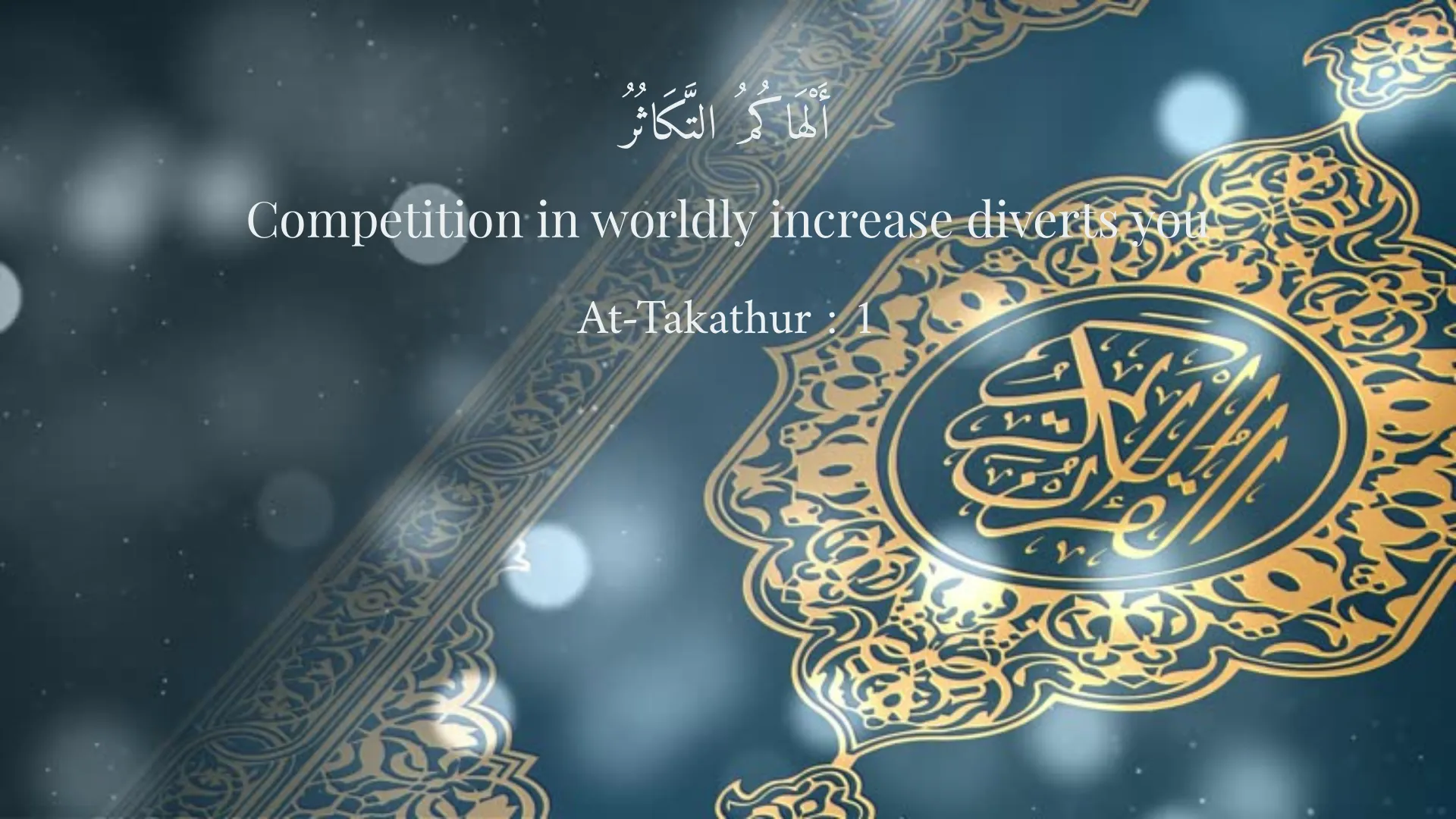
أَلْهَاكُمُ التَّكَاثُرُ
Competition in worldly increase diverts you
At-Takathur : 1
حَتَّىٰ زُرْتُمُ الْمَقَابِرَ
Until you visit the graves.
At-Takathur : 2
وَإِنَّهُ لِحُبِّ الْخَيْرِ لَشَدِيدٌ
And indeed he is, in love of wealth, intense.
Al-Adiyat : 8
اعْلَمُوا أَنَّمَا الْحَيَاةُ الدُّنْيَا لَعِبٌ وَلَهْوٌ وَزِينَةٌ وَتَفَاخُرٌ بَيْنَكُمْ وَتَكَاثُرٌ فِي الْأَمْوَالِ وَالْأَوْلَادِ
Know that the life of this world is only play and amusement, an adornment and boasting among yourselves, and rivalry in respect of wealth and children.
Al-Hadid : 20
Short Story
In Saadi's Gulistan, it is related that there was a powerful king whose treasuries were overflowing with gold and jewels, yet a smile of contentment never graced his lips. He was constantly seeking to conquer another territory and add more wealth to his possessions. He had a wise vizier who advised him repeatedly, but the king paid no heed. One day, as the king was strolling in a beautiful garden, he passed by a dervish sitting peacefully under a tree, eating dry bread with utmost tranquility. The king, surprised, asked, "O dervish, in this arduous world, how do you sit so peacefully and without worries? Do you not yearn for wealth and status?" The dervish replied with a smile, "O King! You possess the wealth of the world, yet your heart is never satisfied, for your satisfaction lies not in what you possess, but in being content with it. I am content with what I have, and my heart is free from the bondage of excessive desires. What you seek is the peace that I find in this very dry bread and the shade of this tree, because I see no need for more. If this heart is not satisfied, no matter how much you give it, it will always demand 'more', and this endless craving will steal your peace." The king pondered the dervish's words and understood that the heart's satisfaction comes not from the abundance of wealth, but from contentment and inner peace. From that day forward, he pursued less accumulation and focused more on inner peace and gratitude.