Quranic Answer
The feeling of emptiness or void, even when engaged in righteous actions and contributing positively to others, is a complex and perplexing experience that many individuals encounter. At first glance, it might seem contradictory: how can an act that is supposed to bring satisfaction and happiness instead leave a sense of hollowness? To address this profound question, we turn to the teachings of the Holy Quran, which offers profound insights into human nature, the purpose of existence, and the true sources of contentment. The Quran guides us to understand that the true value of good deeds lies not merely in their outward appearance, but in their essence, in the heart from which they emanate, and in the ultimate goal they are directed towards. Firstly, the fundamental essence of good deeds in Islam is "Ikhlas," or sincerity. Ikhlas means that the sole intention behind an action should be for the sake of Allah alone, not for human praise, worldly gain, or even mere self-satisfaction divorced from a divine purpose. Allah Almighty states in Surah Al-Bayyinah (Verse 5): "And they were not commanded except to worship Allah, [being] sincerely obedient to Him, inclining to truth, and to establish prayer and to give zakah. And that is the correct religion." This verse underscores that the core of religion and worship lies in the purity of intention directed solely towards Allah. When an individual performs a good deed with a purely materialistic motive – such as seeking fame, commendation, returning a favor, or even alleviating guilt without connecting it to a divine purpose – such an action might leave the doer feeling empty afterward. This is because it failed to connect with the eternal source of spiritual energy and satisfaction, which is Allah (SWT). True contentment and lasting happiness stem from knowing that one's action has been accepted by Allah, and this requires unwavering sincerity. If the action is primarily performed for people or for the self, its results will be temporary and fleeting, much like transient human praise or momentary satisfaction. Secondly, the heart finds tranquility only through the remembrance of Allah. The Holy Quran clearly elucidates this truth in Surah Ar-Ra'd (Verse 28): "Those who have believed and whose hearts are assured by the remembrance of Allah. Unquestionably, by the remembrance of Allah hearts are assured." The human soul was created to know its Creator and to connect with Him. Every good deed, if not accompanied by the remembrance of Allah, or awareness of His presence and power, or reliance on Him (Tawakkul), might be like a body without a soul. One can donate generously, help the needy, or contribute to large charitable projects, but if the remembrance of Allah is absent from their heart, and the intention of drawing closer to Him is missing, then this action, despite its outward greatness, may not fill the spiritual void. The remembrance of Allah (Dhikr) is not merely the recitation of words; it is a state of the heart characterized by presence and awareness of the Creator's magnificence, gratitude towards Him, and reliance on Him in all aspects of life. This continuous connection is what nourishes the soul and grants it serenity, making good deeds imbued with meaning and blessing. Thirdly, the Quranic perspective on worldly life versus the Hereafter. The Quran describes worldly life as a fleeting enjoyment, and the Hereafter as the enduring abode. If an individual performs good deeds expecting immediate or perpetual worldly rewards, they might face disappointment or emptiness when those expectations are not met or when the rewards vanish. In Surah Al-Kahf (Verses 103-104), Allah says: "Say, [O Muhammad], 'Shall we inform you of the greatest losers as to [their] deeds? [They are] those whose effort is lost in worldly life, while they think that they are doing good work.'" This verse warns against individuals who exert great efforts in this worldly life, believing they are doing good deeds, but their striving is lost because their ultimate goal was not righteous or their actions were not built upon true faith and sincere intention for Allah's sake. They might feel empty because their emotional and spiritual investments were placed in an unstable and impermanent domain. Genuine good deeds are those built upon faith in Allah and the Last Day, from which one seeks reward in the Hereafter. Any worldly benefits that accrue are merely a grace from Allah, not the ultimate aim of the action. Fourthly, emptiness can sometimes be a divine message. Occasionally, this feeling of emptiness, even amidst abundant giving and good deeds, serves as an invitation from Allah for introspection and reflection. It might be a reminder that the soul needs something deeper than mere outward actions. It could be a catalyst to seek perfection in sincerity, to deepen one's relationship with Allah, and to re-evaluate one's motivations. It is not a punishment, but rather an opportunity for spiritual growth and drawing closer to the Creator. This feeling can prompt the believer to seek the completeness of faith, certainty (yaqeen), and genuine tranquility that remains unshaken by changing circumstances or the disappearance of material things. Fifthly, the comprehensive context of worship. Good deeds are an integral part of the holistic concept of worship in Islam. Worship is not limited to ritual acts alone but encompasses every good action intended for the sake of Allah. If a person focuses on one aspect of worship (good deeds) while neglecting other dimensions such as contemplating Allah's creation, reflecting on His verses, supplication (du'a), purifying the self (tazkiyah), or even patiently enduring Allah's decrees, they might find themselves in a state of spiritual imbalance. This imbalance can lead to a feeling of emptiness because the soul requires complete nourishment from all forms of worship and closeness to Allah. In conclusion, the feeling of emptiness even in good deeds is an unmistakable sign from the soul that it has not yet found its ultimate purpose and true refuge. The Holy Quran offers an effective remedy for this emptiness by emphasizing complete sincerity to Allah in every action, nourishing the soul with the remembrance of Allah, which is the sustenance and tranquility of hearts, and understanding the reality of worldly life as a passage to the Hereafter, not an end in itself. When intentions are purified and hearts sincerely turn towards the Creator, every good deed, whether small or large, becomes a source of genuine joy, lasting serenity, and satisfaction that is not followed by emptiness. This is the path to filling the spiritual void and transforming good deeds into bridges to reach the state of Ihsan (excellence), where the soul continuously abides in the presence of Allah.
Related Verses
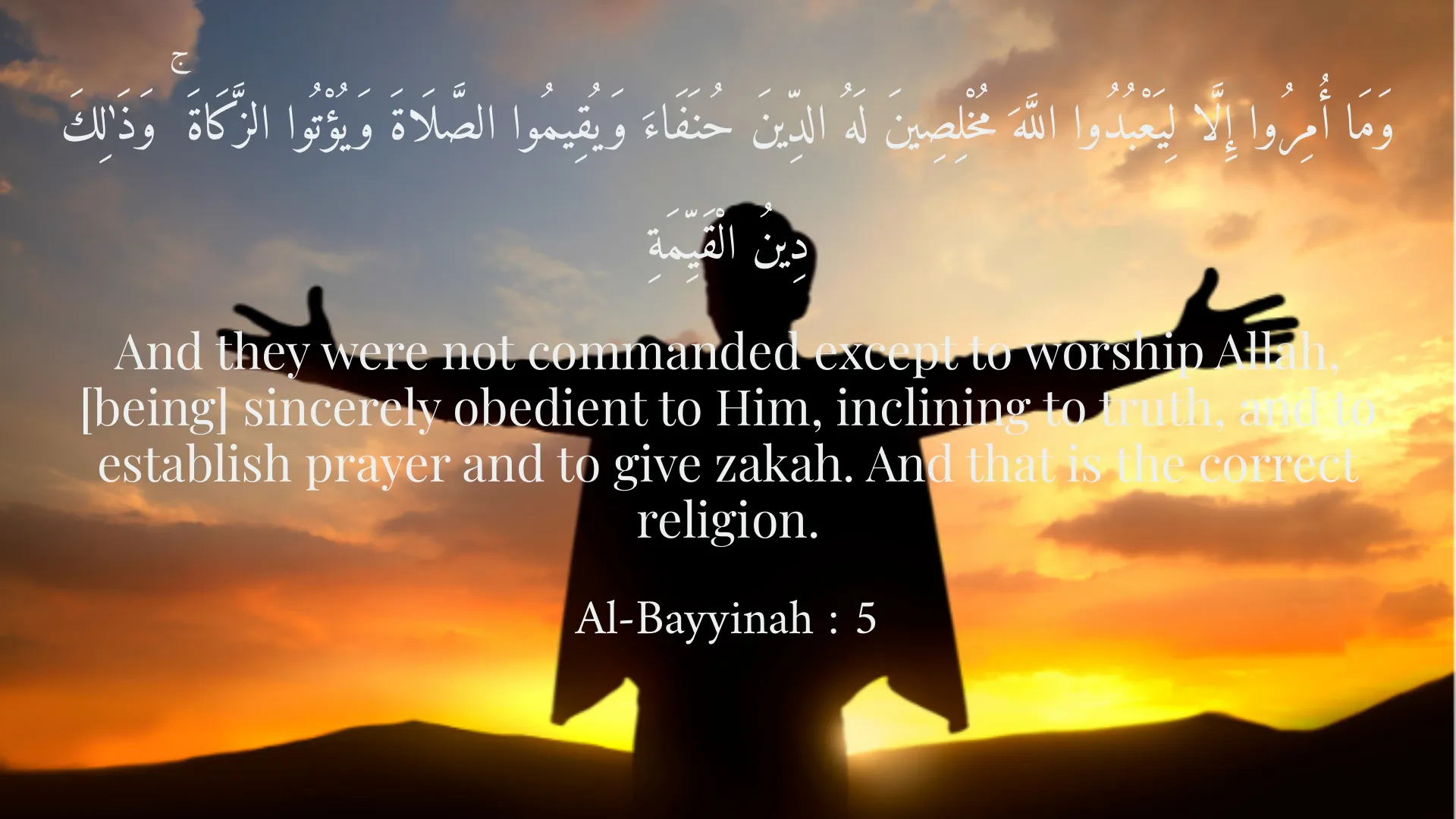
وَمَا أُمِرُوا إِلَّا لِيَعْبُدُوا اللَّهَ مُخْلِصِينَ لَهُ الدِّينَ حُنَفَاءَ وَيُقِيمُوا الصَّلَاةَ وَيُؤْتُوا الزَّكَاةَ ۚ وَذَٰلِكَ دِينُ الْقَيِّمَةِ
And they were not commanded except to worship Allah, [being] sincerely obedient to Him, inclining to truth, and to establish prayer and to give zakah. And that is the correct religion.
Al-Bayyinah : 5
الَّذِينَ آمَنُوا وَتَطْمَئِنُّ قُلُوبُهُم بِذِكْرِ اللَّهِ ۗ أَلَا بِذِكْرِ اللَّهِ تَطْمَئِنُّ الْقُلُوبُ
Those who have believed and whose hearts are assured by the remembrance of Allah. Unquestionably, by the remembrance of Allah hearts are assured.
Ar-Ra'd : 28
قُلْ هَلْ نُنَبِّئُكُم بِالْأَخْسَرِينَ أَعْمَالًا
Say, [O Muhammad], 'Shall we inform you of the greatest losers as to [their] deeds?
Al-Kahf : 103
الَّذِينَ ضَلَّ سَعْيُهُمْ فِي الْحَيَاةِ الدُّنْيَا وَهُمْ يَحْسَبُونَ أَنَّهُمْ يُحْسِنُونَ صُنْعًا
[They are] those whose effort is lost in worldly life, while they think that they are doing good work.
Al-Kahf : 104
Short Story
They say that in ancient times, there lived a wealthy man whose hand was exceedingly generous. He constantly aided the poor and built mosques. People praised him, and his good name was on everyone's lips. Yet, despite all his benevolence and the accolades, he felt an emptiness within; as if no deed truly quenched his soul's thirst. One day, he sought out a wise dervish and recounted his condition. The dervish, with a kind smile, replied: "My friend, you water a tree to bear fruit, not merely to adorn its branches. Intention is the soul of action. Whatever you do for the pleasure of people, its outcome is limited to their praise and is fleeting. But what you do purely for the pleasure of the Almighty, because its roots are in the soil of eternity, yields fruits of lasting peace and freedom from emptiness. Choose your intention, not the admiration of men." The wealthy man took these words to heart, and from then on, he purified his intentions, seeking only the pleasure of the Divine in every good deed. It wasn't long before his heart was filled with a lasting tranquility he had never known before.