Quranic Answer
The question you've raised touches upon one of the deepest existential challenges for humanity, and the Holy Quran addresses its various dimensions with unparalleled insight. Why does it sometimes seem easier to know truths than to act upon them? Why does the gap between 'knowledge' (ilm) and 'action' (amal) become so vast, leading many to falter or never embark on this difficult path? The Quran presents this phenomenon not merely as an individual weakness but as a continuous struggle on the path of human spiritual and moral development, delving into its roots deep within human existence and external influences. Indeed, learning is often a mental and cognitive process that may require intellectual effort and memory, but acting on knowledge demands a strong will, a struggle against the self (nafs), overcoming temptations, and sometimes facing external hardships and pressures. One of the primary reasons highlighted by the Quran is the nature of the human soul itself. The 'nafs,' or the existential 'self' of a human being, has various dimensions, one of which is 'nafs al-ammarah' (the commanding self). This self tends towards evil and worldly desires, constantly inviting humans towards comfort, pursuit of lusts, and evasion of responsibilities. In Surah Yusuf, verse 53, the Quran states: "And I do not acquit myself. Indeed, the soul is a persistent enjoiner of evil, except those upon whom my Lord has mercy. Indeed, my Lord is Forgiving and Merciful." This verse explicitly states that the soul inherently inclines towards evil and sin. Therefore, acting upon what is right and good necessitates a continuous struggle against these carnal desires, which in itself requires an iron will and internal jihad. Learning can occur without these struggles, but action never can. Beyond the 'nafs al-ammarah,' the role of Satan is also very prominent in making it difficult to act on knowledge. Satan, the sworn enemy of humankind, exerts all his effort to divert humans from the path of truth. He beautifies sins, instills fear of good deeds, tempts towards complacency, and injects doubt and despair, thus widening the gap between knowledge and action. The Quran repeatedly refers to Satan's role in deceiving humans, identifying him as an 'open enemy' (aduwwun mubeen). These whisperings can weaken human resolve and prevent individuals from doing what they know is right. Another significant impediment is the love of the world (hubb ad-dunya) and material attachments. Humans naturally gravitate towards wealth, status, fame, and worldly comfort. Sometimes, acting upon religious and moral knowledge necessitates sacrificing some worldly pleasures or enduring hardships. For instance, speaking the truth when it might result in material loss, or spending in the way of Allah which requires letting go of wealth, are actions that, despite one's knowledge of their goodness, become difficult due to the love of this world. This is where material values conflict with spiritual values, and the human soul finds itself at a crossroads. The Holy Quran also warns against hypocrisy (nifaq) and the contradiction between words and deeds. In Surah As-Saff, verses 2 and 3, Allah says: "O you who have believed, why do you say what you do not do? Great is hatred in the sight of Allah that you say what you do not do." These verses explicitly condemn those who possess knowledge and even advise others, but do not act upon it themselves. This indicates that Allah considers action an essential condition for the acceptance of faith and words, and the mismatch between the two incurs divine wrath. This contradiction stems from a weakness of will and the dominance of the 'nafs'. Furthermore, possessing knowledge places a burden of responsibility on an individual. The more one knows, the greater their responsibility to act upon that knowledge. This responsibility can sometimes be a heavy burden, causing some individuals, unconsciously, to avoid acquiring new knowledge or even admitting what they know, in order to escape the burden of acting upon it. However, the Quran severely condemns this. In Surah Al-Jumu'ah, verse 5, it presents a striking parable: "The example of those who were entrusted with the Torah and then did not uphold it is like that of a donkey who carries volumes [of books]. Wretched is the example of the people who denied the signs of Allah. And Allah does not guide the wrongdoing people." This verse clearly illustrates that knowledge without action is useless and even blameworthy, much like an animal carrying precious books but gaining no benefit from their content. To overcome this difficulty, the Quran offers solutions: piety (taqwa), patience (sabr), seeking Allah's help (ista'anah), remembering rewards and punishments, keeping company with the righteous, and continuous seeking of forgiveness (istighfar). Acting upon knowledge is the 'Jihad al-Akbar' (the greater struggle) for a human being; a continuous battle against the self and temptations. Every step taken in this path brings one closer to Allah and perfects one's character. Therefore, the difficulty of action is not merely an obstacle, but an opportunity for human spiritual growth and elevation, a hardship placed by Allah for the purification and advancement of His servants. With a strong will, reliance on Allah, and continuous struggle, one can overcome these difficulties and taste the sweetness of acting upon knowledge.
Related Verses
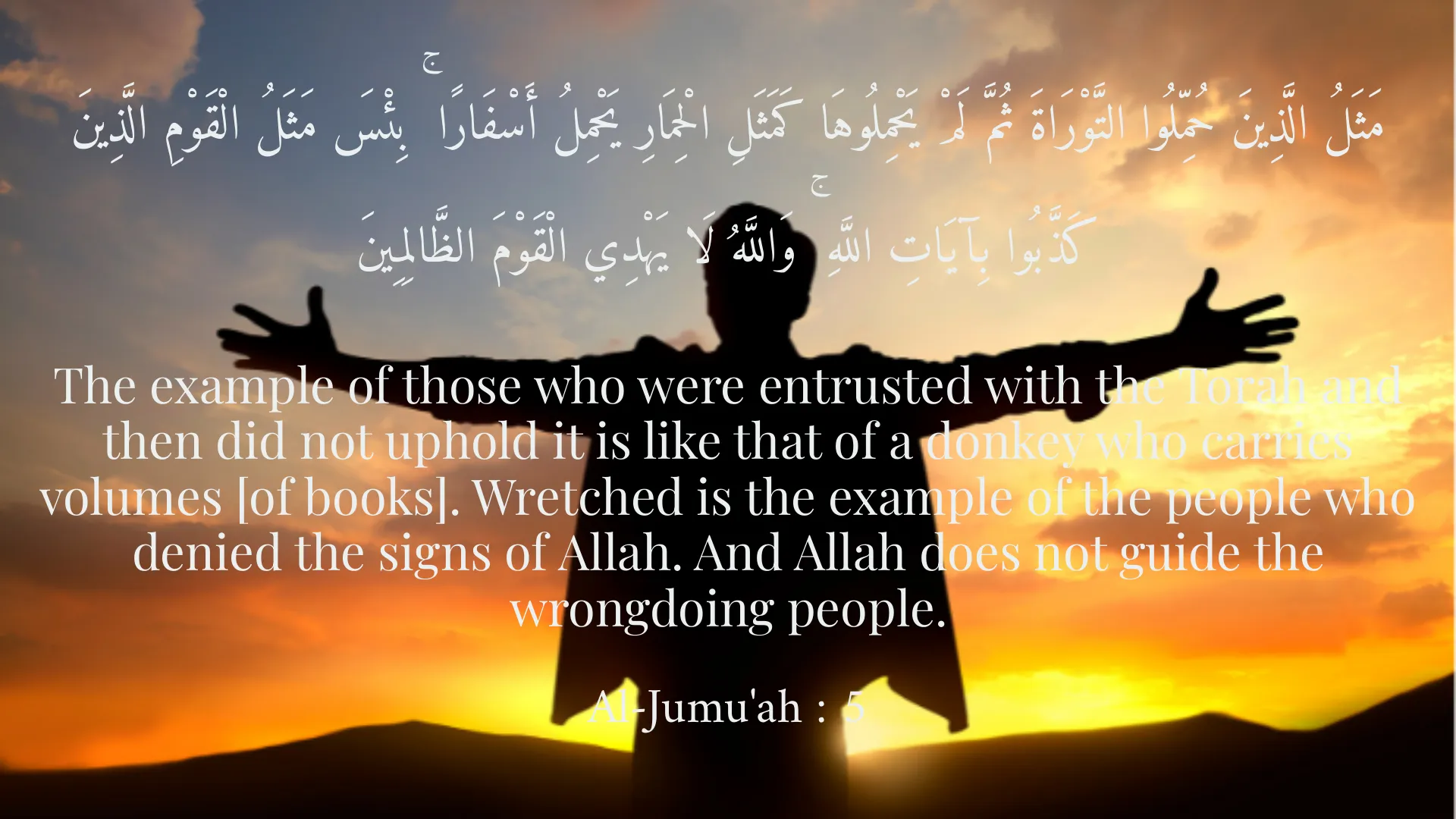
مَثَلُ الَّذِينَ حُمِّلُوا التَّوْرَاةَ ثُمَّ لَمْ يَحْمِلُوهَا كَمَثَلِ الْحِمَارِ يَحْمِلُ أَسْفَارًا ۚ بِئْسَ مَثَلُ الْقَوْمِ الَّذِينَ كَذَّبُوا بِآيَاتِ اللَّهِ ۚ وَاللَّهُ لَا يَهْدِي الْقَوْمَ الظَّالِمِينَ
The example of those who were entrusted with the Torah and then did not uphold it is like that of a donkey who carries volumes [of books]. Wretched is the example of the people who denied the signs of Allah. And Allah does not guide the wrongdoing people.
Al-Jumu'ah : 5
يَا أَيُّهَا الَّذِينَ آمَنُوا لِمَ تَقُولُونَ مَا لَا تَفْعَلُونَ
O you who have believed, why do you say what you do not do?
As-Saff : 2
كَبُرَ مَقْتًا عِندَ اللَّهِ أَن تَقُولُوا مَا لَا تَفْعَلُونَ
Great is hatred in the sight of Allah that you say what you do not do.
As-Saff : 3
وَمَا أُبَرِّئُ نَفْسِي ۚ إِنَّ النَّفْسَ لَأَمَّارَةٌ بِالسُّوءِ إِلَّا مَا رَحِمَ رَبِّي ۚ إِنَّ رَبِّي غَفُورٌ رَّحِيمٌ
And I do not acquit myself. Indeed, the soul is a persistent enjoiner of evil, except those upon whom my Lord has mercy. Indeed, my Lord is Forgiving and Merciful.
Yusuf : 53
Short Story
I have heard that a learned scholar was immersed day and night in studying and accumulating knowledge. He had read thousands of books and acquired hundreds of wisdoms. One day, a student asked him: 'O Master, you possess so much knowledge, yet why does it sometimes seem that acting upon this knowledge is harder than merely acquiring it?' The master smiled and said: 'Knowledge shows the path, but walking it is another story altogether. You might have a precise map to a treasure, but until you step onto the road, fear no obstacles, and embrace the hardships of the journey, you will never reach the treasure. The human self (nafs) seeks comfort and constantly commands it to sit back and merely observe. Action requires rising up and struggling against this inner voice, and this is precisely the difficulty.'