Quranic Answer
Humanity has been in a perpetual quest for security and tranquility since its creation. This relentless pursuit has driven us to unprecedented discoveries, inventions, and advancements in science and technology. Today, we live in an age of information and connectivity, where access to knowledge, resources, and amenities is more abundant than ever before. Yet, surprisingly, despite all this progress, anxiety and worry about the future have not only persisted but, in many societies, have significantly increased. The root of this deep and enduring concern can be traced back to the teachings of the Holy Quran and humanity's understanding of existence and its place within it. The Quran offers profound insights into human nature. In Surah Al-Ma'arij, verse 19, Allah states: "Indeed, mankind was created anxious." This verse highlights that restlessness, greed, and anxiety are inherent parts of human nature, unless tempered by faith and righteous deeds. Humans are inherently driven by a desire for survival, security, and control over their environment. Scientific and technological advancements are, in essence, attempts to achieve this control—efforts to harness nature, cure diseases, extend life expectancy, and ensure prosperity. However, this control is never absolute, as humans cannot encompass divine decree and factors beyond their will. One of the primary reasons for this pervasive worry is humanity's strong attachment to worldly life and its transient allure. The Holy Quran repeatedly reminds us of the fleeting and temporary nature of this worldly existence. In Surah Al-Hadid, verse 20, it states: "Know that the life of this world is only play and amusement, an adornment and boasting among yourselves, and a rivalry in respect of wealth and children. [It is] like the example of a rain whose [resulting] plant growth pleases the disbelievers; then it dries and you see it turned yellow; then it becomes [scattered] debris. And in the Hereafter is severe punishment and forgiveness from Allah and approval. And what is the life of this world except the enjoyment of delusion." This verse clearly articulates that everything we cling to in this world, including wealth, children, status, and beauty, is temporary and unstable. The fear of losing these ephemeral manifestations is a tremendous source of anxiety. People worry about their economic future, the health of their loved ones, job loss, and physical and mental deterioration, because all these belong to the transient world and their longevity is not guaranteed. Medical advancements extend life, but they do not eliminate death; economic progress brings wealth, but it does not eradicate poverty and inequality; technological advancements facilitate communication, but they do not abolish loneliness and isolation. The Quran presents the solution to this anxiety in connecting with Allah Almighty and the concept of Tawakkul (trust in God). In Surah Ar-Ra'd, verse 28, we read: "Those who have believed and whose hearts are assured by the remembrance of Allah. Unquestionably, by the remembrance of Allah hearts are assured." This verse demonstrates that true peace and the eradication of worries are achieved only through faith and the remembrance of Allah. When a person understands that everything is in Allah's hands and that He desires good for His servants, the fear of the future and unpleasant events diminishes. Tawakkul does not mean abandoning effort and planning; rather, it means entrusting the outcome to Allah after making all possible efforts and finding peace in this surrender. Material advancements, no matter how impressive, cannot replace the inner tranquility that comes from faith in the Creator. Furthermore, a correct understanding of divine decree (Qadar) plays a significant role in reducing anxiety. The Quran teaches us that everything in the universe occurs by Allah's permission and will. This understanding liberates humans from the heavy burden of attempting to control the future entirely. Of course, this does not imply absolute determinism, but rather an acceptance of the truth that certain aspects of our lives are under the control of transcendent factors and divine wisdom. This acceptance, instead of creating a sense of helplessness, can be a source of peace, as humans know that even when facing undesirable events, there is a wise will behind the scenes. Ultimately, it can be concluded that while material and technological advancements can provide comfort and convenience in life, they are incapable of fulfilling humanity's deeper spiritual and existential needs. Worry about the future stems from this spiritual void. As long as humans lose their connection with the Creator and the primary purpose of their creation, they will constantly be plagued by anxiety. The ultimate solution to overcome this worry is to return to the divine nature, strengthen faith, trust in God, and prioritize eternal values over worldly ones. This path brings enduring peace and profound assurance that no material progress can provide.
Related Verses
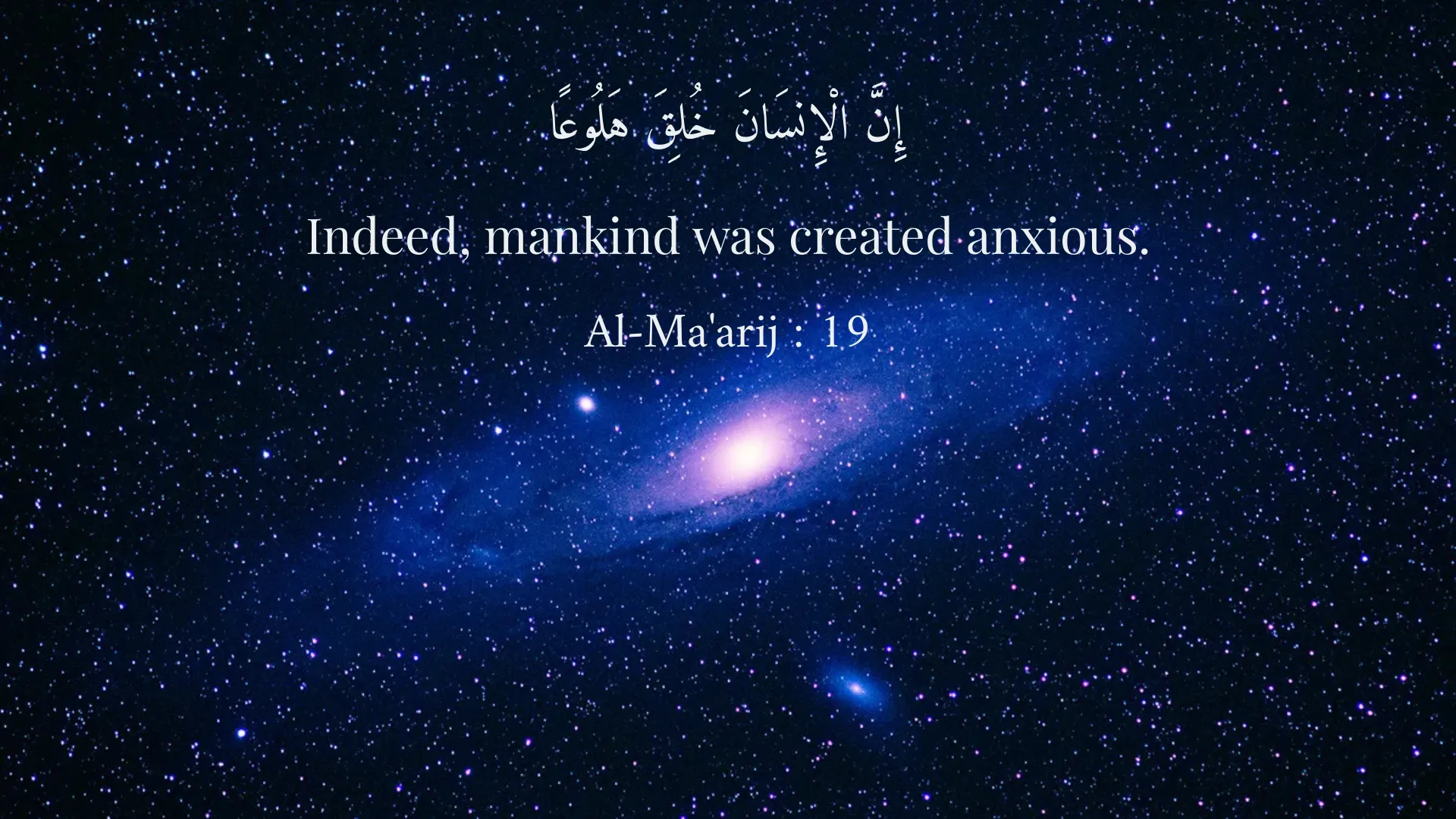
إِنَّ الْإِنسَانَ خُلِقَ هَلُوعًا
Indeed, mankind was created anxious.
Al-Ma'arij : 19
اعْلَمُوا أَنَّمَا الْحَيَاةُ الدُّنْيَا لَعِبٌ وَلَهْوٌ وَزِينَةٌ وَتَفَاخُرٌ بَيْنَكُمْ وَتَكَاثُرٌ فِي الْأَمْوَالِ وَالْأَوْلَادِ ۖ كَمَثَلِ غَيْثٍ أَعْجَبَ الْكُفَّارَ نَبَاتُهُ ثُمَّ يَهِيجُ فَتَرَاهُ مُصْفَرًّا ثُمَّ يَكُونُ حُطَامًا ۖ وَفِي الْآخِرَةِ عَذَابٌ شَدِيدٌ وَمَغْفِرَةٌ مِّنَ اللَّهِ وَرِضْوَانٌ ۗ وَمَا الْحَيَاةُ الدُّنْيَا إِلَّا مَتَاعُ الْغُرُورِ
Know that the life of this world is only play and amusement, an adornment and boasting among yourselves, and a rivalry in respect of wealth and children. [It is] like the example of a rain whose [resulting] plant growth pleases the disbelievers; then it dries and you see it turned yellow; then it becomes [scattered] debris. And in the Hereafter is severe punishment and forgiveness from Allah and approval. And what is the life of this world except the enjoyment of delusion.
Al-Hadid : 20
الَّذِينَ آمَنُوا وَتَطْمَئِنُّ قُلُوبُهُم بِذِكْرِ اللَّهِ ۗ أَلَا بِذِكْرِ اللَّهِ تَطْمَئِنُّ الْقُلُوبُ
Those who have believed and whose hearts are assured by the remembrance of Allah. Unquestionably, by the remembrance of Allah hearts are assured.
Ar-Ra'd : 28
Short Story
In ancient Shiraz, there lived a wealthy merchant who possessed immense riches and boundless fortune. Every day, he would fret about the future of his trade, fearing that his ships might sink or the market would slump. Sleep abandoned his eyes, and he lived in constant dread and anxiety. One day, on his way, he saw a dervish sitting under the shade of a tree, singing with a cheerful face and a tranquil heart. The merchant asked him, "O Dervish, you have no wealth, so how are you so calm and free from sorrow? I, with all my riches, cannot find a moment of peace." The dervish smiled and replied, "O merchant, the secret of my peace is that what I possess is this very moment. The future is in God's hands, and I have entrusted all that is within my power to Him. I am neither gladdened by what comes nor saddened by what goes. I do not attach my heart to fleeting things to fear their demise." The merchant took heed of this counsel and realized that peace lies in liberation from worldly bonds and trust in the Creator, not in accumulating more.