Quranic Answer
It is a profound and thought-provoking question why the Holy Quran, despite being a comprehensive and guiding book, does not delve into the full, scientific details of the 'secret of creation' and fully unveil its hidden layers. The answer to this question lies in understanding the true purpose and primary mission of the Quran. The Quran, first and foremost, is a book for guiding humanity towards recognizing God, believing in His Oneness, and living according to moral and spiritual principles. This divine book, rather than aiming to be a scientific encyclopedia that addresses all the 'how-tos' of creation, focuses on the 'why' and 'purpose' of creation, leading us towards the 'Who' of the Creator. One of the main reasons for this approach is the nature and capacity of human understanding. Many details and hidden layers of creation have been and remain beyond the limited and relative human comprehension throughout various eras. If the Quran were to delve into all these scientific details, it would not only deviate from its primary goal of spiritual guidance and education but might also become difficult or even impossible for the general public to understand. The Quran, with eloquent and clear language, yet comprehensible to all, speaks of the signs and indications of creation; signs that any human being, regardless of their level of knowledge and in any era, can contemplate to grasp the Creator's magnificence and wisdom. The Holy Quran presents creation not as a puzzle to be solved, but as an 'ayah' (sign) for contemplation and reflection. The purpose of these signs is to strengthen faith, foster humility in the face of divine grandeur, and invite gratitude. When the Quran speaks of the heavens and the earth, the alternation of night and day, the creation of humans and animals, and of rain and plants, it seeks to draw our attention to the order, harmony, beauty, and purposefulness of these phenomena. This invitation to observe and reflect leads us to the conclusion that all this order and beauty is not without purpose or accidental, but is underpinned by the infinite knowledge, power, and wisdom of a wise Creator. It is here that the 'secret of creation' transforms from a scientific question into a spiritual and epistemological experience. Furthermore, if the Quran had revealed all the scientific secrets of creation from the outset, it might have reduced humanity's motivation for research, discovery, and scientific progress. God has given humans knowledge and intellect to explore the world themselves and uncover its various layers. The Quran provides general and inspiring guidance, encouraging humanity to acquire knowledge and insight. Many scientific advancements are, in fact, the unveiling of those very 'secrets of creation' that the Quran briefly alluded to and called humanity to ponder upon. The Quran emphasizes the moral and spiritual aspects of creation. The primary purpose of human creation is the servitude and worship of God. "And I did not create the jinn and mankind except to worship Me." (Adh-Dhariyat, Verse 56). This servitude includes recognition, obedience, and gratitude. To achieve this purpose, there is no need to know every particle and every physical mechanism in the universe; rather, it is sufficient for humans to understand God's existence and oneness by observing the signs of His power and wisdom in creation, and to follow the path of guidance. In other words, the Quran teaches us the 'why' and the 'purpose' so that our lives gain meaning, not to elaborate on all the technical and scientific 'how-tos' of the world, which is the work of scientists and researchers throughout history. Ultimately, instead of providing a final and definitive answer to all mysteries, the Quran offers a spiritual and intellectual framework within which humanity can, with awareness and insight, reflect on the world and see every new discovery not as a threat to faith, but as a confirmation of the grandeur and complexity of divine creation. This approach encourages the dynamism and evolution of human knowledge, allowing each generation, with their own knowledge and tools, to reach new depths of understanding the 'secret of creation,' while the core belief in the Creator and the purposefulness of creation remains intact. The Quran, in essence, plants the seed of reflection in the heart so that the fruit of knowledge and servitude may emerge from it, rather than providing a ready-made, packaged fruit of all sciences.
Related Verses
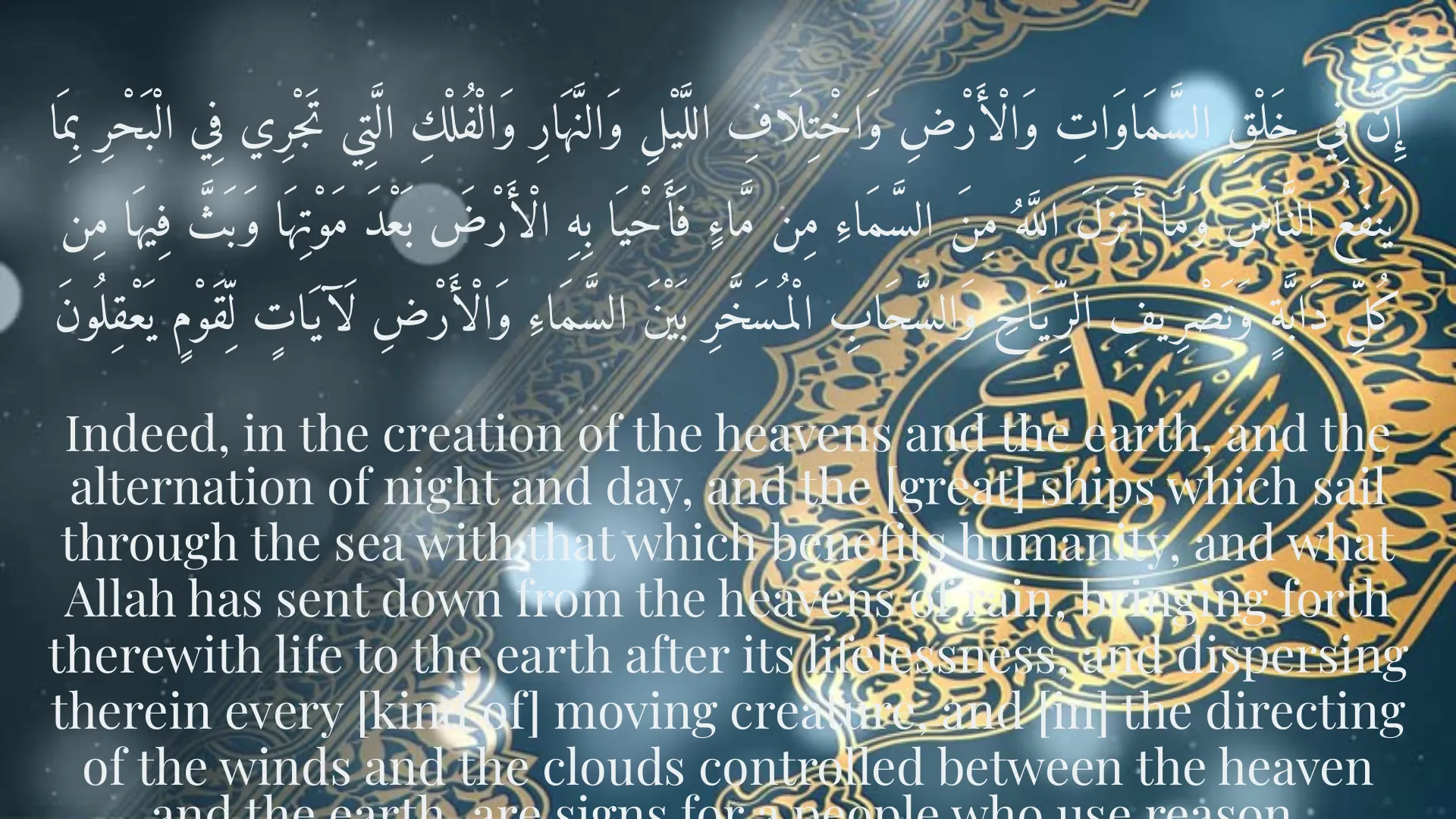
إِنَّ فِي خَلْقِ السَّمَاوَاتِ وَالْأَرْضِ وَاخْتِلَافِ اللَّيْلِ وَالنَّهَارِ وَالْفُلْكِ الَّتِي تَجْرِي فِي الْبَحْرِ بِمَا يَنفَعُ النَّاسَ وَمَا أَنزَلَ اللَّهُ مِنَ السَّمَاءِ مِن مَّاءٍ فَأَحْيَا بِهِ الْأَرْضَ بَعْدَ مَوْتِهَا وَبَثَّ فِيهَا مِن كُلِّ دَابَّةٍ وَتَصْرِيفِ الرِّيَاحِ وَالسَّحَابِ الْمُسَخَّرِ بَيْنَ السَّمَاءِ وَالْأَرْضِ لَآيَاتٍ لِّقَوْمٍ يَعْقِلُونَ
Indeed, in the creation of the heavens and the earth, and the alternation of night and day, and the [great] ships which sail through the sea with that which benefits humanity, and what Allah has sent down from the heavens of rain, bringing forth therewith life to the earth after its lifelessness, and dispersing therein every [kind of] moving creature, and [in] the directing of the winds and the clouds controlled between the heaven and the earth, are signs for a people who use reason.
Al-Baqarah : 164
وَمَا خَلَقْتُ الْجِنَّ وَالْإِنسَ إِلَّا لِيَعْبُدُونِ
And I did not create the jinn and mankind except to worship Me.
Adh-Dhariyat : 56
إِنَّ فِي خَلْقِ السَّمَاوَاتِ وَالْأَرْضِ وَاخْتِلَافِ اللَّيْلِ وَالنَّهَارِ لَآيَاتٍ لِّأُولِي الْأَلْبَابِ
Indeed, in the creation of the heavens and the earth and the alternation of night and day are signs for those of understanding.
Al-Imran : 190
Short Story
One day, a man from a distant village, with a heart full of questions and an eager mind, sought out a sage who had spent his life in contemplation and understanding. The man asked, "O wise sage, for years I have been seeking to discover the secret of creation. I want to know how this world was created and with what precise details?" The sage smiled and said, "My friend, if you plant a small seed in the soil and wait, one day you will see that from that seed, which held nothing but dryness and lifelessness, a green plant has emerged, bearing flowers and fruit. If you cannot grasp the Creator's power and wisdom in this small wonder, how will you be able to comprehend the grandeur of the creation of the heavens and the earth with all its details? The Quran says the same; instead of clinging to every tiny detail of creation and losing yourself, look at its clear and manifest signs and from them fly towards the knowledge of the Creator. The true secret of creation lies in understanding its wisdom and purpose, not in counting every leaf and every seed. In this perspective, you will find peace and wisdom." With these words, the man, instead of an endless search for details, began to reflect on the evident signs of creation, and his heart was enlightened by the light of knowledge.