Quranic Answer
Why should we practice gratitude? This is a profound question whose answer is deeply rooted in the teachings of the Holy Quran. Gratitude is not merely a moral obligation or a pleasant feeling; it is a fundamental pillar in a human being's relationship with their Creator and one of the most effective tools for achieving peace, contentment, and the abundance of blessings in life. The Quran repeatedly emphasizes the importance of gratitude, not only commending it but also presenting it as a divine command and a path towards ultimate success and well-being. Indeed, gratitude is a comprehensive act that has both individual and internal dimensions, as well as social and interactive aspects. This act not only improves an individual's spiritual and psychological state but also has positive effects on their surroundings, leading to divine pleasure and an increase in blessings. The Foundation of Gratitude: Divine Command and Promise of Increase The first and foremost reason to practice gratitude is that Allah Almighty Himself has commanded it. In Surah Al-Baqarah, verse 152, Allah says: “Fadhkurūnī Adhkurkum wa Ashkurū Lī wa Lā Takfurūn” (So remember Me; I will remember you. And be grateful to Me and do not deny Me). This verse clearly indicates that gratitude is not just a remembrance of blessings but an inseparable part of remembering Allah and maintaining a connection with Him. Ingratitude (kufr an-ni'mah), in contrast to gratitude, means to ignore or deny divine blessings, and it is considered a major sin that can lead to the loss of those blessings. Allah Almighty, the primary source of all blessings, desires His servants to be appreciative and to demonstrate this appreciation in their actions and words. The promise of an increase in blessings is one of the sweetest rewards of gratitude. Allah says in Surah Ibrahim, verse 7: “Wa Idh Ta'adhdhana Rabbukum La'in Shakartum La'azīdannakum, wa La'in Kafartum Inna Adhābī Lashadīd” (And [remember] when your Lord proclaimed, 'If you are grateful, I will surely increase you [in favor]; but if you deny, indeed, My punishment is severe.'). This verse explicitly states that gratitude not only ensures the preservation of existing blessings but also leads to their increase. This increase can manifest in material dimensions (such as sustenance, health, peace, worldly success) as well as spiritual dimensions (such as increased faith, wisdom, insight, divine guidance). This divine promise is a cosmic law that is always in effect and is not confined to a specific time or place. The more grateful we are, the more doors of Allah's mercy and favor are opened to us, and our lives become full of blessings. Recognizing Blessings and Overcoming Heedlessness Humans are naturally prone to quickly getting accustomed to what they possess, often taking it for granted. This habit can lead to heedlessness regarding the countless blessings around them. Gratitude is a conscious practice to emerge from this state of heedlessness. When we begin to practice gratitude, our perspective on life changes. Instead of focusing on what we lack or our deficiencies, our eyes are opened to the countless blessings that we might have previously overlooked. Blessings such as health, the ability to see and hear, the act of breathing, potable water, a roof over our heads, family, friends, and even our very existence and the proper functioning of our body parts. In Surah An-Nahl, verse 78, Allah states: “Wallāhu Akhrajakum min Buṭūni Ummhātikum Lā Talamūna Shay'an wa Jaala Lakumu As-Sama wa Al-Abṣāra wa Al-Af'idah Laallakum Tashkurūn” (And Allah has extracted you from the wombs of your mothers while you knew nothing, and He made for you hearing and vision and hearts that perhaps you would be grateful.) This verse makes gratitude the very purpose behind granting us these abilities. Gratitude transforms us from a state of “unknowing” and inattention to one of “recognition” and “appreciation,” helping us to enjoy every moment and everything we have, rather than complaining about life. Strengthening Faith and Proximity to Allah Gratitude is directly linked to faith (Iman) and Tawhid (monotheism). A grateful person wholeheartedly believes that all blessings come from Allah, and there is no power or strength except through Him. This belief deepens the roots of faith within a person, leading them towards greater reliance and submission to divine will. Every time we express gratitude for a blessing, we are, in essence, affirming Allah's greatness, generosity, and mercy. This affirmation leads to greater closeness to Allah, for Allah loves His grateful servants and shows them special favor. In Surah Luqman, verse 12, we read: “Wa Laqad Ātayna Luqmāna Al-Ḥikmah Ani Ashkur Lillāhi wa Man Yashkur Fa'innamā Yashkur Linafsihi wa Man Kafara Fa'inna Allāha Ghanīyun Ḥamīd” (And We had certainly given Luqman wisdom [and said], 'Be grateful to Allah.' And whoever is grateful - his gratitude is only for [the benefit of] himself. And whoever is ungrateful - then indeed, Allah is Free of need and Praiseworthy.) This verse clarifies that gratitude does not benefit Allah, as He is Self-Sufficient and Praiseworthy and has no need for our gratitude; rather, its benefit entirely returns to the grateful person. This benefit manifests as psychological tranquility, inner contentment, and an increase in both material and spiritual blessings, greatly aiding one's spiritual growth. Psychological Well-being and Inner Contentment One of the greatest achievements of practicing gratitude is attaining inner peace and contentment with life. In today's tumultuous world, where people constantly strive for more and habitually compare themselves to others, gratitude provides a secure anchor. When we are grateful, we experience less regret, less envy, and less anxiety. Instead of lamenting what we lack, we focus on what we possess and derive joy from it. This shift in perspective significantly increases overall life satisfaction. A grateful individual can find positive aspects even in difficult and challenging situations, maintaining hope because they know that Allah has ordained good for them in every state, and indeed, with every hardship comes ease. This positive outlook helps them cope better with challenges and experience greater happiness. Avoiding Divine Punishment and a Sign of Servitude The Quran strongly warns against ingratitude and denying blessings, considering it a cause for divine punishment and misfortune. As mentioned in Surah Ibrahim, verse 7, “wa La'in Kafartum Inna Adhābī Lashadīd” (but if you deny, indeed, My punishment is severe). Ingratitude not only leads to the cessation of existing blessings but can also bring about calamities and problems, making one's life difficult. Gratitude, conversely, is a sign of true servitude and obedience to the Lord. A servant who recognizes all blessings as coming from Allah and is grateful has indeed reached a state of submission and contentment, which itself is a source of eternal felicity and places them on the straight path of Allah. This act creates a clear distinction between true believers and ungrateful disbelievers, showing which group has chosen the right path. Ultimately, gratitude is a conscious choice. A choice that transforms life, illuminates hearts, and paves the way for the influx of divine blessings. Practicing gratitude does not require special conditions; it can begin at any moment, by being thankful for the smallest blessings: from the rising sun and fresh air to one's health and personal abilities, and even the existence of opportunities and challenges that empower us to grow. With every act of gratitude, a person takes a step closer to Allah and ascends the ladder of perfection. Therefore, gratitude is not just a recommendation, but a necessity for a meaningful, peaceful, and blessed life.
Related Verses
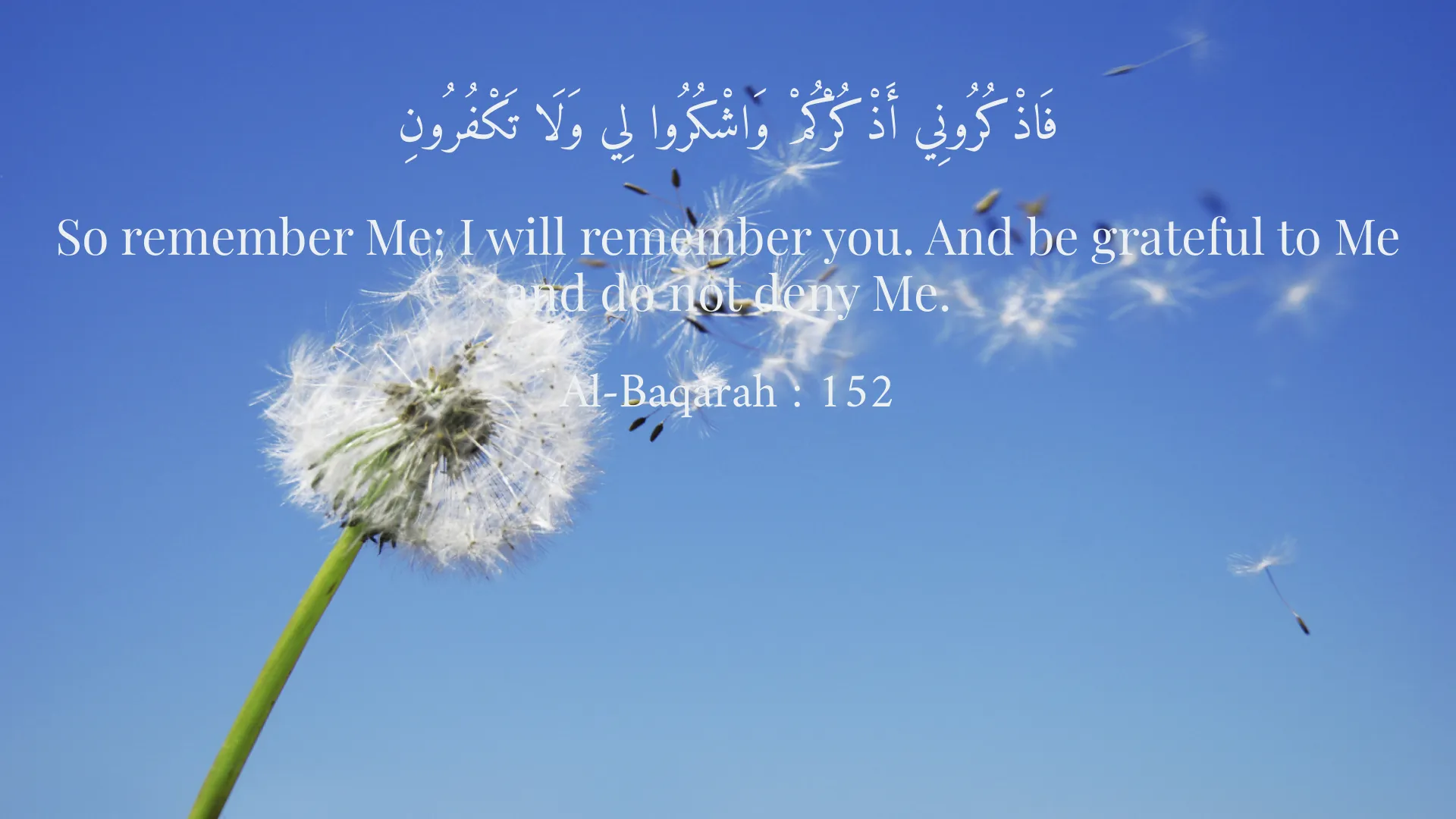
فَاذْكُرُونِي أَذْكُرْكُمْ وَاشْكُرُوا لِي وَلَا تَكْفُرُونِ
So remember Me; I will remember you. And be grateful to Me and do not deny Me.
Al-Baqarah : 152
وَإِذْ تَأَذَّنَ رَبُّكُمْ لَئِن شَكَرْتُمْ لَأَزِيدَنَّكُمْ ۖ وَلَئِن كَفَرْتُمْ إِنَّ عَذَابِي لَشَدِيدٌ
And [remember] when your Lord proclaimed, 'If you are grateful, I will surely increase you [in favor]; but if you deny, indeed, My punishment is severe.'
Ibrahim : 7
وَاللَّهُ أَخْرَجَكُمْ مِنْ بُطُونِ أُمَّهَاتِكُمْ لَا تَعْلَمُونَ شَيْئًا وَجَعَلَ لَكُمُ السَّمْعَ وَالْأَبْصَارَ وَالْأَفْئِدَةَ لَعَلَّكُمْ تَشْكُرُونَ
And Allah has extracted you from the wombs of your mothers while you knew nothing, and He made for you hearing and vision and hearts that perhaps you would be grateful.
An-Nahl : 78
Short Story
It is said that in times past, there lived a pious and poor man in a secluded corner, who, without a single complaint, gave thanks for everything he possessed. Every morning, as the sun shone upon his face, he praised God for his seeing eyes and grateful heart. On the other hand, a king in his palace, with all his wealth and power, was always sad and discontent, complaining about the slightest deficiencies. One day, the king passed by and saw the ascetic man, happy and smiling despite his destitution. The king, surprised, asked him, “O man, how is it that with such a distressed state and empty hands, I see you cheerful and content?” The ascetic replied with a warm smile, “O King, I am grateful that the heavy burden of wealth and responsibility is not upon my shoulders, and my heart is free from worldly attachments. These two seeing eyes, this hearing ear, these capable hands and feet, and this breath that comes and goes effortlessly, are treasures that no king possesses. Whoever recognizes these blessings and is grateful for them shall never be poor.” The king took a lesson from his words and understood that gratitude for blessings is the key to opening hearts and a source of peace, not abundance alone.