Quranic Answer
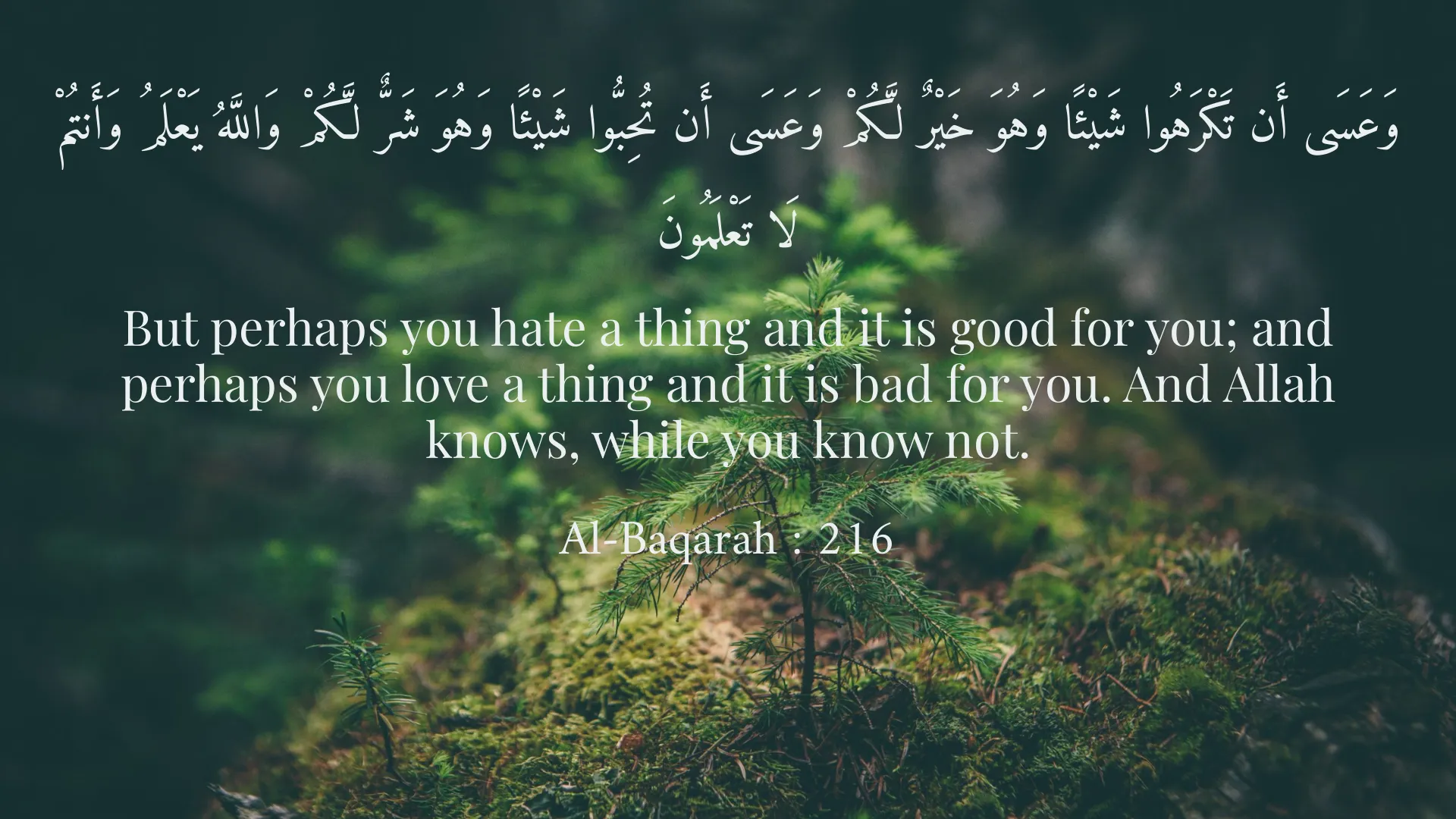
Understanding that humans do not have the capacity to control everything is one of the most fundamental teachings of the Holy Quran, which can bring unparalleled peace to our lives. Human nature tends towards security, predictability, and mastery over circumstances, and this very inclination sometimes drives us to try and control every aspect of life, from the smallest daily details to the most significant life-altering events. However, the Quran, with its deep and wise insight, defines the boundaries of human capabilities and guides us to accept a higher truth: the Creator of the universe is the true Administrator of affairs, and absolute power belongs solely to Him. Time and again, the Quran reminds us that our knowledge is limited, and many matters, even what seems beneficial to us, might not be so in reality, and vice versa. Surah Al-Baqarah, verse 216 states: "But perhaps you hate a thing and it is good for you; and perhaps you love a thing and it is bad for you. And Allah knows, while you know not." This verse clearly indicates that our perception of good and evil is limited and incomplete, whereas Allah, with His infinite knowledge, is aware of all hidden and manifest dimensions of affairs. Attempting absolute control not only leads us to an unattainable goal but also results in anxiety, despair, and spiritual exhaustion. One of the most important concepts derived from the Quran in this regard is the concept of "Tawakkul" (reliance on God). Tawakkul means trusting and relying on Allah after exerting all possible efforts. This does not mean passive resignation; rather, it means that a person does everything in their power to achieve their goals but entrusts the final outcome to the absolute power of Allah. In Surah At-Talaq, verse 3, we read: "And whoever relies upon Allah – then He is sufficient for him. Indeed, Allah will accomplish His purpose. Allah has already set for everything a [decreed] extent." This verse implies that Allah has determined a destiny for every matter, and if a person proceeds with true Tawakkul, Allah Himself will take charge of their affairs. The heavy burden of controlling all variables is lifted from the human being, making them light-hearted. Furthermore, the attempt to control everything can be a sign of arrogance and forgetting one's true place before the Lord. The Quran attributes the ownership and administration of everything to Allah in numerous verses. Surah An-Nur, verse 42 states: "And to Allah belongs the dominion of the heavens and the earth, and to Allah is the final return." When dominion and administration belong to Him, how can a limited creation claim control over everything? This approach is not only unrealistic but can also hinder a person's spiritual growth because it prevents them from reflecting on God's infinite power and submitting to His wise will. True peace and freedom from the anxieties of a changing world are achieved only when a person accepts that their role is to strive on the right path and then rely on the Creator, not to insist on achieving desired outcomes no matter what. Therefore, letting go of the need to control everything means surrendering to divine wisdom and accepting human limitations. This acceptance helps us focus our efforts on what is truly within our control: our intentions, our efforts, our character, and our reactions to events. We can do our best, but we cannot guarantee that the outcome will be exactly what we desire. This Quranic teaching not only lifts a heavy psychological burden from us but also enables us to face life's ups and downs with greater serenity, while simultaneously strengthening our faith in Allah's infinite wisdom and mercy. Ultimately, living with the acceptance that Allah Almighty is the sole Administrator of existence will transform life into a path filled with tranquility, contentment, and reliance; a path where every event, even an undesirable one, can be a gateway to growth and knowledge, for everything is under His watchful eye and will.
Related Verses
وَعَسَى أَن تَكْرَهُوا شَيْئًا وَهُوَ خَيْرٌ لَّكُمْ وَعَسَى أَن تُحِبُّوا شَيْئًا وَهُوَ شَرٌّ لَّكُمْ وَاللَّهُ يَعْلَمُ وَأَنتُمْ لَا تَعْلَمُونَ
But perhaps you hate a thing and it is good for you; and perhaps you love a thing and it is bad for you. And Allah knows, while you know not.
Al-Baqarah : 216
وَمَن يَتَوَكَّلْ عَلَى اللَّهِ فَهُوَ حَسْبُهُ ۚ إِنَّ اللَّهَ بَالِغُ أَمْرِهِ ۚ قَدْ جَعَلَ اللَّهُ لِكُلِّ شَيْءٍ قَدْرًا
And whoever relies upon Allah – then He is sufficient for him. Indeed, Allah will accomplish His purpose. Allah has already set for everything a [decreed] extent.
At-Talaq : 3
وَلِلَّهِ مُلْكُ السَّمَاوَاتِ وَالْأَرْضِ ۖ وَإِلَى اللَّهِ الْمَصِيرُ
And to Allah belongs the dominion of the heavens and the earth, and to Allah is the final return.
An-Nur : 42
وَمَا تَشَاءُونَ إِلَّا أَن يَشَاءَ اللَّهُ ۚ إِنَّ اللَّهَ كَانَ عَلِيمًا حَكِيمًا
But you do not will except that Allah wills. Indeed, Allah is ever Knowing and Wise.
Al-Insan : 30
Short Story
It is narrated that there once was a merchant, extremely greedy and cautious, who meticulously managed everything with great precision and anxiety. He even calculated the winds and rains so that his ships would reach their destination safely. One night, a sudden storm arose and sank his ships, leaving the merchant writhing in agony. At that moment, a simple-hearted dervish passing by saw him and said with a smile, "O man, you did your best, but isn't the command of the winds and rain in the hands of another? Grieve not, for what is destined is beyond your control." Upon hearing this, the merchant paused for a moment and realized that true peace lies not in controlling everything, but in submission and reliance upon the One who is capable of all things.