Quranic Answer
In the rich and comprehensive teachings of the Holy Quran, abstaining from worldly pleasures, when understood correctly, is considered a virtue and a path to drawing closer to God. However, it’s crucial to understand that this 'abstinence from the world,' often referred to as 'zuhd' (asceticism) in Islamic terminology, does not mean absolute abandonment of life or withdrawal from society. Rather, it signifies not allowing one's heart to be enslaved by worldly attachments and not being captivated by its glitters. The primary goal of zuhd is to free the heart from material bonds so that it can turn entirely towards God, preferring His pleasure above all else. The Quran repeatedly invites humanity to reflect on the transient nature of this world and the permanence of the Hereafter, emphasizing that worldly life is nothing but a fleeting and insignificant provision, while the abode of the Hereafter is eternal and everlasting. But to answer the question, 'Can abstaining from worldly pleasures sometimes lead to religious arrogance?' the unequivocal answer is 'Yes,' though not because of the inherent nature of zuhd itself, but due to its misunderstanding or improper application. The Quran strongly forbids pride (kibr), self-admiration (ujb), and arrogance, considering them among the gravest moral vices. Religious arrogance, rooted in self-conceit and a sense of superiority, can be a dangerous affliction for any righteous deed, even for one as inherently good and commendable as zuhd. The danger begins when an individual, due to their abstinence from worldly pleasures and specific acts of worship, starts to perceive themselves as superior to others, leading to what can be termed 'spiritual narcissism.' This feeling of superiority often results in belittling others, making unfair judgments, and even hypocrisy, because instead of performing actions solely for God, the individual seeks to gain status and respect among people, or, more critically, seeks internal validation from themselves—which is the very trap of arrogance. The Quran warns that God does not love the arrogant and self-deluded. In several verses, Allah explicitly states His dislike for arrogance and walking haughtily upon the earth, identifying these as characteristics of those whom He does not love. This arrogance can stem from several factors. First, lack of sincerity (ikhlas): If abstinence from the world is not genuinely for God’s sake but rather for show, fame, or to gain respect, the individual gradually falls into arrogance. Second, judging others: When a person who outwardly abstains from the world looks down upon others’ lives with contempt, viewing them as being consumed by worldly desires, they begin to see themselves as superior. This contemptuous and judgmental gaze is one of the clearest signs of religious arrogance. Third, forgetting divine grace: Every success in zuhd and worship comes from God. If a person forgets this truth and attributes their successes to their own efforts and inherent superiority, the ground for arrogance is laid. Fourth, extremism in zuhd: Sometimes, an excessive form of abstinence from the world that disrupts one’s natural and social life and distracts them from their responsibilities can lead to a form of self-superiority, as the individual might imagine they have reached a higher stage than ordinary people. Islam consistently advocates for moderation and balance, disliking both extremism and negligence. The Quran emphasizes striving for both this world and the Hereafter simultaneously; the famous verse, 'And do not forget your share of the world' (Al-Qasas: 77), clearly states that reasonable and lawful enjoyment of the world and attention to its legitimate needs do not contradict an afterlife-oriented perspective. Rather, the goal is for the world to be a means to reach the Hereafter, not the ultimate end. Those who mistakenly believe that the more they distance themselves from the world, the necessarily closer they become to God, may fall into the trap of arrogance, because the true value of deeds lies in the sincerity of intention and their inner quality, not merely in their outward appearance or quantity. Many companions of the Prophet and divine saints, despite being involved in worldly affairs and ordinary life, possessed pure and ascetic hearts and never succumbed to arrogance. Therefore, abstinence from the world is a true virtue and a path to perfection only when accompanied by humility, modesty, complete sincerity, and avoidance of any self-conceit or superiority complex. The truly believing individual, even at the peak of their servitude and asceticism, sees themselves as a servant, in need of God, and never considers themselves superior to others. They know that every particle of goodness within them is a divine gift and they show compassion for the guidance and well-being of others, rather than judging them with a condescending gaze. The purpose of acts of worship and legitimate spiritual disciplines is to achieve inner peace, divine proximity, and purification of the soul, not to gain status or prestige in this world or to feel superior to others. Whenever this noble goal deviates towards selfishness and arrogance, that act loses its true value and can lead to distance from the Almighty, instead of closeness. This is true not only for zuhd but for any good deed; if Hajj, prayer, fasting, charity, or any good act is tainted with arrogance and hypocrisy, it loses its merit and may even become a burden.
Related Verses
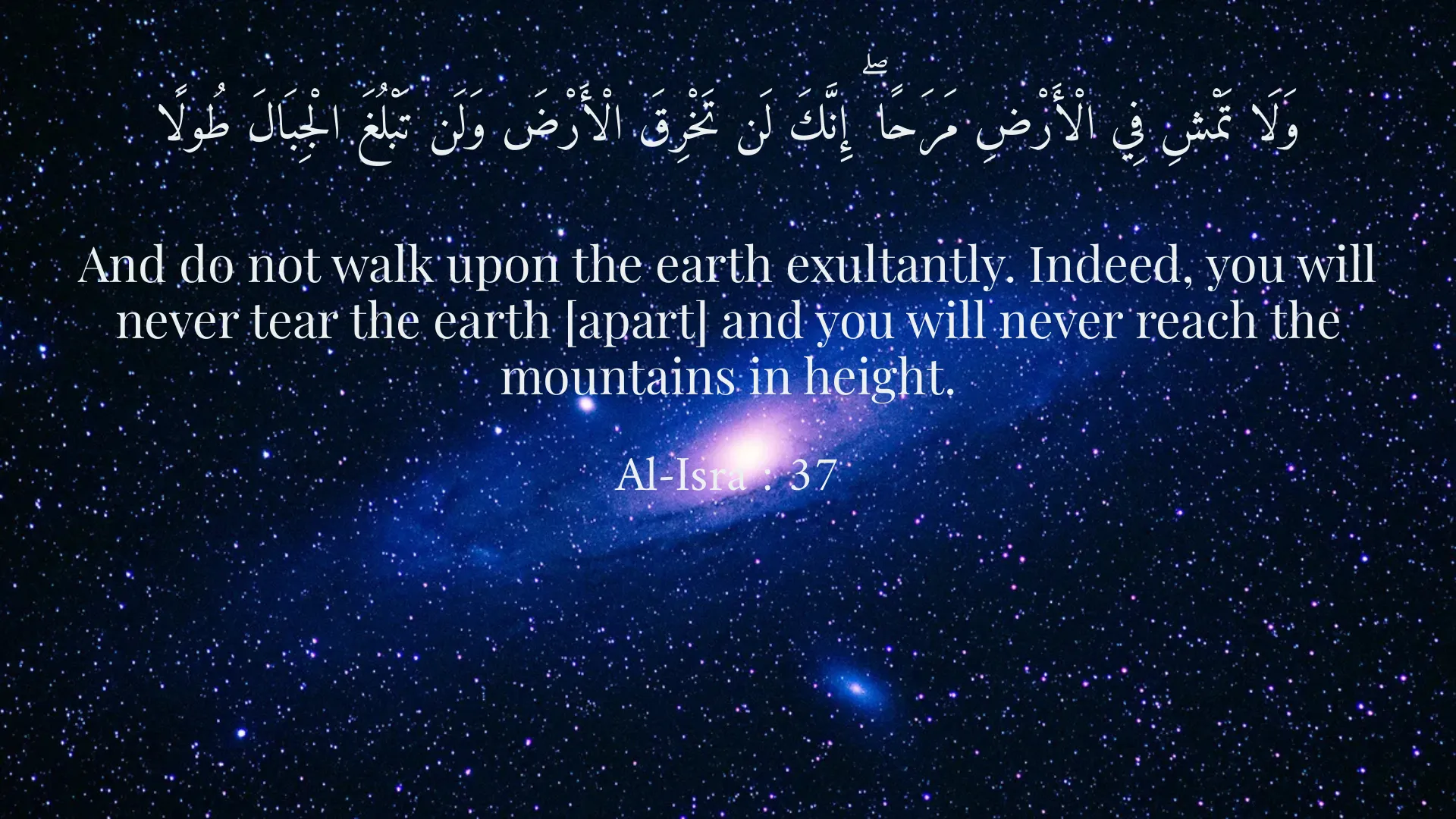
وَلَا تَمْشِ فِي الْأَرْضِ مَرَحًا ۖ إِنَّكَ لَن تَخْرِقَ الْأَرْضَ وَلَن تَبْلُغَ الْجِبَالَ طُولًا
And do not walk upon the earth exultantly. Indeed, you will never tear the earth [apart] and you will never reach the mountains in height.
Al-Isra : 37
وَلَا تُصَعِّرْ خَدَّكَ لِلنَّاسِ وَلَا تَمْشِ فِي الْأَرْضِ مَرَحًا ۖ إِنَّ اللَّهَ لَا يُحِبُّ كُلَّ مُخْتَالٍ فَخُورٍ
And do not turn your cheek [in contempt] toward people and do not walk through the earth exultantly. Indeed, Allah does not like everyone self-deluded and boastful.
Luqman : 18
وَابْتَغِ فِيمَا آتَاكَ اللَّهُ الدَّارَ الْآخِرَةَ ۖ وَلَا تَنسَ نَصِيبَكَ مِنَ الدُّنْيَا ۖ وَأَحْسِن كَمَا أَحْسَنَ اللَّهُ إِلَيْكَ ۖ وَلَا تَبْغِ الْفَسَادَ فِي الْأَرْضِ ۖ إِنَّ اللَّهَ لَا يُحِبُّ الْمُفْسِدِينَ
But seek, through that which Allah has given you, the home of the Hereafter; and [yet], do not forget your share of the world. And do good as Allah has done good to you. And desire not corruption in the land. Indeed, Allah does not like corrupters.
Al-Qasas : 77
Short Story
It is said that in ancient times, there was a devout worshipper who spent many years in seclusion, dedicating himself to worship and abstaining from worldly allurements. He was so steadfast in this path that people regarded him as a paragon of piety and praised him greatly. One day, a thought crossed the worshipper's mind, and he said to himself, 'No one has turned away from worldly pleasures like me, nor has anyone reached this level of asceticism and piety.' At that very moment, a sinful and corrupt man passed by, regretting his sins in his heart and weeping profusely, repenting to God. Coincidentally, the worshipper cast a glance at him and thought, 'This man is immersed in sin, and I am immersed in worship. God will never see these two as equal.' Suddenly, a divine voice reached the worshipper's ear, saying, 'O worshipper! You became arrogant because of your deeds, and you made him despair because of his sins. Know that My mercy encompasses those who repent, and My wrath is upon the arrogant. Perhaps that sinner's repentance will be accepted, and you, because of this very arrogance, will be cast away from My presence.' The worshipper trembled at this voice and realized that true asceticism is accompanied by humility and modesty, not by self-superiority and judging others. From then on, he avoided self-conceit, constantly reflected on his own faults, and prayed for the guidance of others.