Quranic Answer
In the profound and rich teachings of the Holy Quran, the concept of hope (Rajāʾ) holds a very special place. Hope in Allah's vast mercy, His forgiveness, and the reward for good deeds is one of the pillars of faith. It motivates believers to persevere on the path of truth and to avoid despair, which is considered a great sin. The Quran explicitly forbids believers from losing hope, considering it a characteristic of disbelievers, as it states: “And do not despair of the relief of Allah. Indeed, no one despairs of the relief of Allah except the disbelieving people.” (Surah Yusuf: 87). This verse clearly illustrates that hope in divine succor and mercy, even in the most challenging circumstances, is vital for a believer. This hope is not an impediment to action; rather, it is its driving force. However, a crucial subtle point that must be understood in the Quranic perspective is the distinction between 'true hope' and 'vain wishes' or 'misplaced reliance.' Genuine hope, which springs from faith in Allah and His power, is always accompanied by 'righteous deeds' (amal sāliḥ) and 'effort.' The Holy Quran repeatedly emphasizes the importance of 'action' and 'exertion' alongside 'faith.' In numerous verses, faith and righteous deeds are mentioned together, signifying that faith without action and hope without effort are incomplete and fruitless. For instance, in Surah Al-Kahf, verse 110, Allah states: “So whoever would hope for the meeting with his Lord - let him do righteous work and not associate anyone with the worship of his Lord.” This verse explicitly demonstrates that hope for divine mercy and reward must lead to action and diligence in servitude, not to idleness and indifference. Furthermore, the Quran establishes a divine law that change and transformation in the lives of individuals and societies are contingent upon changes within themselves. In Surah Ar-Ra'd, verse 11, we read: “Indeed, Allah will not change the condition of a people until they change what is in themselves.” This verse provides a clear roadmap for any progress and success; it implies that unless an individual or a community strives to improve its condition and takes effective measures, hope for change will merely be an unfounded wish. Therefore, true hope does not lead to inaction; instead, it is the primary motivator for movement, initiative, and continuous effort. One who hopes for Allah's grace and mercy knows that Allah loves those who strive and rewards them accordingly. Another vital aspect in the Quran is the concept of 'Tawakkul' (trust in God). Tawakkul means entrusting one's affairs to Allah after exhausting all possible efforts, not abandoning tasks and waiting idly without any exertion. The Prophet Muhammad (peace be upon him) said: “Tie your camel and then put your trust in Allah.” Although this specific narration is not directly from the Quran, its spirit is profoundly reflected in numerous Quranic verses. The Quran invites believers to reflect, consult, plan, and then trust in Allah. Correct Tawakkul complements action and brings peace of mind, alleviating anxiety, but it is never an excuse for laziness or idleness. Someone who abandons effort with false hope, saying, “Allah is the Provider,” has fundamentally misunderstood the concept of Tawakkul. Allah is indeed the Provider, but He provides through means and through the efforts of His servants. Moreover, the Quran warns us against 'empty desires' and 'baseless illusions.' In Surah An-Nisa, verse 123, it states: “It is not [attainable] by your wishful thinking nor by the wishful thinking of the People of the Scripture. Whoever does evil will be recompensed for it...” This verse clearly indicates that merely wishing for goals, whether worldly or otherworldly, is insufficient. Reward and recompense are based on deeds, not solely on desires. This critiques the mindset that believes one can achieve salvation or success through mere hope without action. In essence, this type of hope, which can also be termed 'false hope' or 'delusion,' is precisely what can lead to inaction and laxity. Such an individual, instead of using hope as a catalyst for action, transforms it into a justification for their laziness. Ultimately, the balance between 'Rajāʾ' (hope) and 'Khawf' (fear of Allah and the consequences of sin and negligence) is crucial in Islam. A true believer is one who is both hopeful of divine mercy and apprehensive of the punishment for sins and shortcomings. These two wings keep the believer on the path of moderation. Pure hope without fear might lead to arrogance and negligence in fulfilling duties, while pure fear without hope might lead to despair. The Quran calls us to walk this middle path: “Call upon your Lord in humility and privately; indeed, He does not like transgressors... And invoke Him in fear and hope. Indeed, the mercy of Allah is near to the doers of good.” (Surah Al-A'raf: 55-56). This implies that hope for mercy must be accompanied by righteous deeds, and these deeds stem from a fear of displeasing Allah by neglecting duties. Therefore, excessive hope only leads to inaction when it deviates from its proper, Quranic path and transforms into an unfounded wish or delusion that contradicts the principle of 'righteous deeds' and 'effort.' True hope in Islam is always progressive and action-generating.
Related Verses
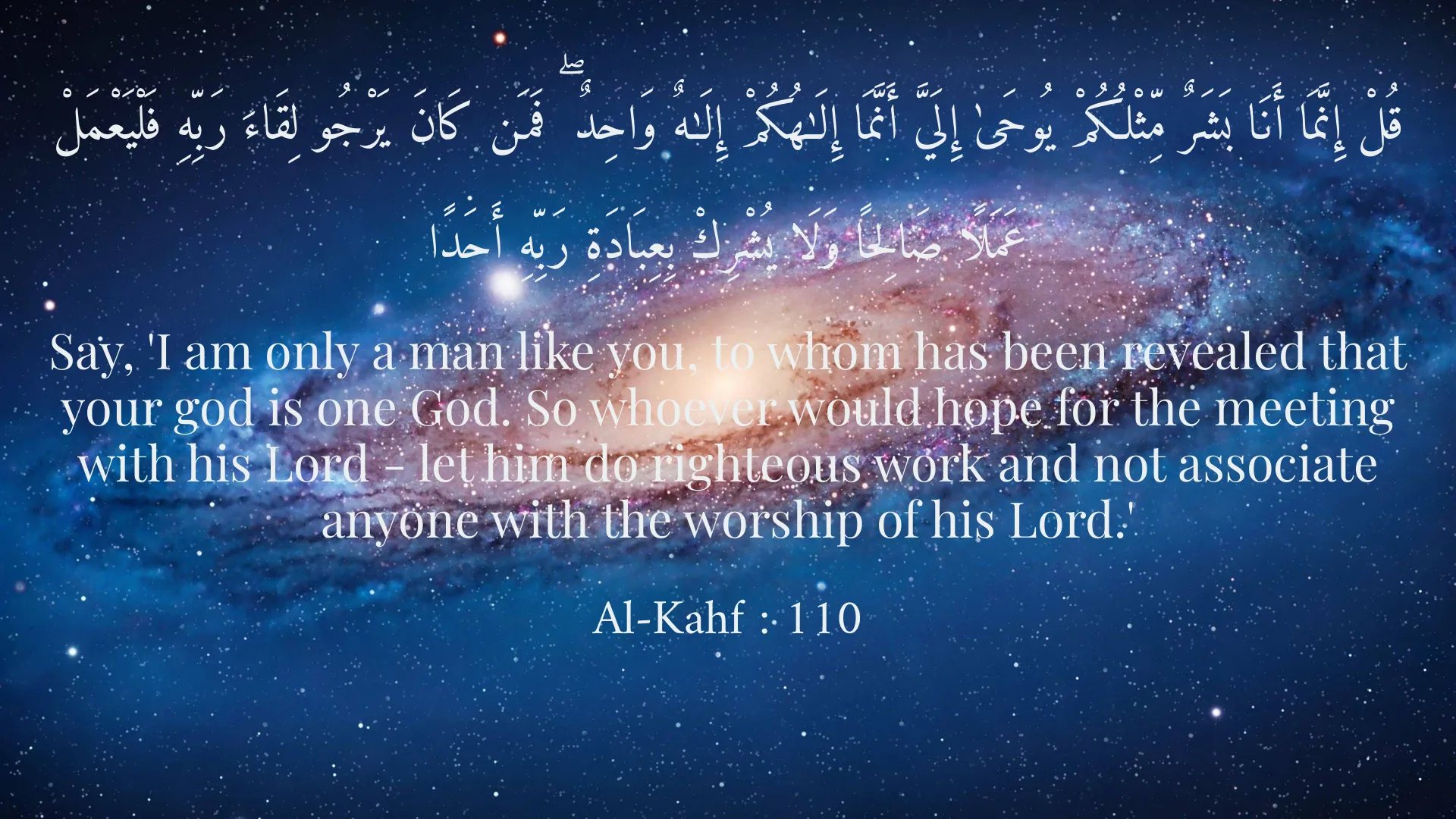
قُلْ إِنَّمَا أَنَا بَشَرٌ مِّثْلُكُمْ يُوحَىٰ إِلَيَّ أَنَّمَا إِلَٰهُكُمْ إِلَٰهٌ وَاحِدٌ ۖ فَمَن كَانَ يَرْجُو لِقَاءَ رَبِّهِ فَلْيَعْمَلْ عَمَلًا صَالِحًا وَلَا يُشْرِكْ بِعِبَادَةِ رَبِّهِ أَحَدًا
Say, 'I am only a man like you, to whom has been revealed that your god is one God. So whoever would hope for the meeting with his Lord - let him do righteous work and not associate anyone with the worship of his Lord.'
Al-Kahf : 110
لَهُ مُعَقِّبَاتٌ مِّن بَيْنِ يَدَيْهِ وَمِنْ خَلْفِهِ يَحْفَظُونَهُ مِنْ أَمْرِ اللَّهِ ۗ إِنَّ اللَّهَ لَا يُغَيِّرُ مَا بِقَوْمٍ حَتَّىٰ يُغَيِّرُوا مَا بِأَنفُسِهِمْ ۗ وَإِذَا أَرَادَ اللَّهُ بِقَوْمٍ سُوءًا فَلَا مَرَدَّ لَهُ ۚ وَمَا لَهُم مِّن دُونِهِ مِن وَالٍ
For him are successive [angels] before and behind him who guard him by the command of Allah. Indeed, Allah will not change the condition of a people until they change what is in themselves. And when Allah intends for a people ill, there is no repelling it. And there is not for them besides Him any patron.
Ar-Ra'd : 11
لَّيْسَ بِأَمَانِيِّكُمْ وَلَا أَمَانِيِّ أَهْلِ الْكِتَابِ ۗ مَن يَعْمَلْ سُوءًا يُجْزَ بِهِ وَلَا يَجِدْ لَهُ مِن دُونِ اللَّهِ وَلِيًّا وَلَا نَصِيرًا
It is not [attainable] by your wishful thinking nor by the wishful thinking of the People of the Scripture. Whoever does evil will be recompensed for it, and he will not find besides Allah any protector or helper.
An-Nisa : 123
Short Story
It is narrated in Sa'di's Gulistan that a dervish pondered to himself: 'Would that God would provide for me without any effort!' With this vain hope, he ceased working and sat in a corner of his house, waiting. Days passed, and his table remained empty. One day, a wise man passed by his house and saw him sitting there, hungry and distressed. The wise man asked, 'Why do you not work?' The dervish replied, 'I have put my trust in God, and I hope that He will provide for me from the unseen.' The wise man smiled and said, 'My friend, true reliance (tawakkul) is to first tie your camel, and then place your trust in God. God is the Provider, but not for one who sits idle and abandons work. He rewards effort and action, not raw wishes.' The dervish took heed of the wise man's words, rose, and engaged in labor. From then on, he never abandoned his hope without action, and his life took on a different hue.