Quranic Answer
From the perspective of the Holy Quran, the concept of 'dependence on humans' is a matter that requires deep clarification and understanding. The Quran teaches us that complete and absolute dependence on any being other than Almighty God can ultimately lead to suffering, disappointment, and despair. This suffering arises from the finite, limited, and imperfect nature of human beings. Humans, no matter how good, capable, or benevolent they may be, are vulnerable, variable, and transient beings. They may become incapacitated, change their minds, or even pass away, and in any of these situations, anyone who has built their primary hope and support upon them will undoubtedly experience turmoil, despondency, and sorrow. The Quran repeatedly emphasizes the concept of 'Tawakkul' (reliance); Tawakkul means absolute trust and entrusting one's affairs to God. This fundamental teaching reminds us that the only true refuge and the only infinite power is the Divine Essence. When a person, instead of relying on the Creator of the universe, ties their entire being and aspirations to a creature like themselves, they are in fact exposing themselves to disappointment. This is because every human being, regardless of their power, wealth, or status, is nothing before the divine power and will, and can never fully fulfill all the needs of another or protect them from all harm. The inability of humans to fully realize aspirations, the changing circumstances, and even their sudden departure from the life of someone who has become dependent on them, all pave the way for deep spiritual and psychological suffering. These sufferings arise not only from the failure to achieve desires but also from feelings of loneliness, helplessness, and the loss of a support system. However, it is important to note that 'absolute dependence' is different from 'healthy social cooperation and interactions.' The Holy Quran by no means negates human relationships, mutual assistance, love, and support for one another; on the contrary, it strongly emphasizes them. Islam envisions a society where individuals are like brothers and sisters, support each other, and assist one another in good deeds and piety. But these interactions should not be such that a person makes their happiness and inner peace dependent on the presence or absence of another individual, or seeks all their hope and support from them. The thin line between a healthy, reciprocal relationship built on love and assistance, and a damaging dependence that leads to the loss of an individual's spiritual and psychological independence, lies precisely here. In healthy relationships, individuals see each other as complementary, not as one giving complete meaning to the other, or feeling non-existent without them. The Quran teaches us that whatever is in the hands of people is perishable, and whatever is with God is enduring. Therefore, clinging to what is perishable will lead to anxiety and apprehension. This teaching applies not only to material matters but also to human relationships. When we become dependent on someone and consider them our sole source of joy, security, or self-worth, we experience immense turmoil with the slightest change in them or the relationship. This uncertainty itself is a great source of suffering. In contrast, reliance on God brings inner peace to a person; for they know that an eternal and infinite power always supports them and is capable of providing relief and assistance in every situation. This inner peace prevents an individual from collapsing even when facing shortcomings or failures in human relationships, instead, they seek help from divine guidance with patience and perseverance. Furthermore, the Quran forbids leaning on oppressors and those whose power has deviated from the path of truth, explicitly stating that such reliance will lead to regret and loss. This indicates that dependence on individuals or groups who do not follow the divine path is not only useless but can lead to irreparable worldly and otherworldly harms. Therefore, while absolute dependence on humans is generally discouraged, the Quran specifically emphasizes guarding against dependence on wrong and oppressive individuals. Ultimately, the message of the Quran in this regard is the liberation and emancipation of humanity from spiritual and psychological constraints. God wants humans to be independent and capable beings who utilize their potentials in the right way and, to achieve their aspirations, not only seek help from other humans (within limits) but ultimately place their reliance upon their Creator. This spiritual independence and true reliance are the roots of all peace, patience, and steadfastness against the sufferings and calamities of life. A person who reaches this stage of reliance, even if they encounter problems or disappointment in their human relationships, will never feel utterly alone, for they always have a vast and boundless refuge that delivers them from every suffering and sorrow and guides them towards felicity. This profound concept of reliance not only negates pathological dependence but also empowers a person to interact optimally even in healthy and reciprocal relationships, without their vulnerability to others becoming a permanent source of suffering.
Related Verses
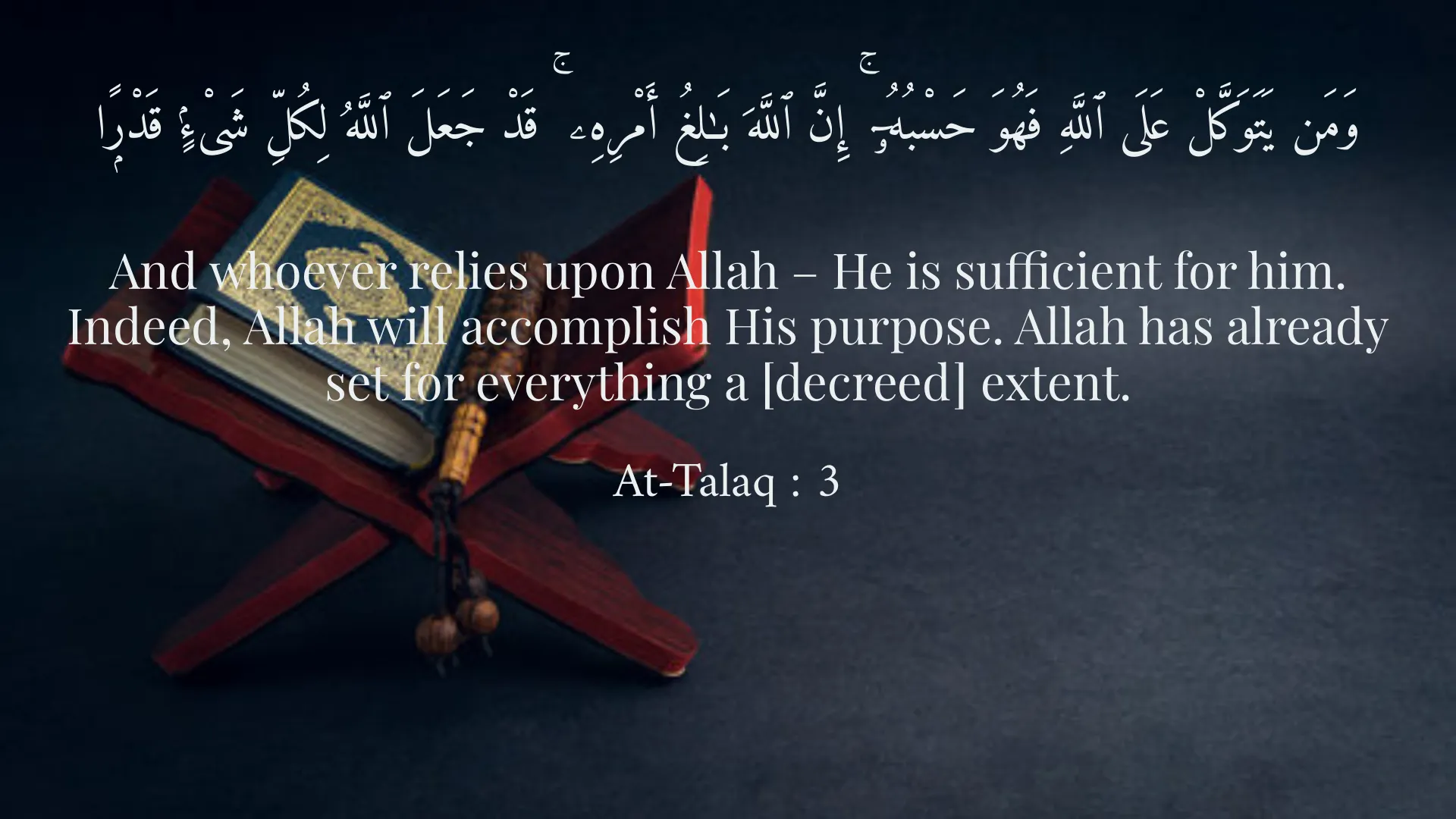
وَمَن يَتَوَكَّلْ عَلَى ٱللَّهِ فَهُوَ حَسْبُهُۥٓ ۚ إِنَّ ٱللَّهَ بَٰلِغُ أَمْرِهِۦ ۚ قَدْ جَعَلَ ٱللَّهُ لِكُلِّ شَىْءٍۢ قَدْرًۭا
And whoever relies upon Allah – He is sufficient for him. Indeed, Allah will accomplish His purpose. Allah has already set for everything a [decreed] extent.
At-Talaq : 3
وَإِن يَمْسَسْكَ ٱللَّهُ بِضُرٍّۢ فَلَا كَاشِفَ لَهُۥٓ إِلَّا هُوَ ۖ وَإِن يُرِدْكَ بِخَيْرٍۢ فَلَا رَآدَّ لِفَضْلِهِۦ ۚ يُصِيبُ بِهِۦ مَن يَشَآءُ مِنْ عِبَادِهِۦ ۚ وَهُوَ ٱلْغَفُورُ ٱلرَّحِيمُ
And if Allah should touch you with adversity, there is no remover of it except Him; and if He intends for you good, there is no repeller of His bounty. He causes it to reach whom He wills of His servants. And He is the Forgiving, the Merciful.
Yunus : 107
يَٰٓأَيُّهَا ٱلنَّاسُ أَنتُمُ ٱلْفُقَرَآءُ إِلَى ٱللَّهِ ۖ وَٱللَّهُ هُوَ ٱلْغَنِىُّ ٱلْحَمِيدُ
O mankind, you are those in need of Allah, while Allah is the Free of need, the Praiseworthy.
Fatir : 15
Short Story
In Sa'di's Gulistan, it is said that a man had tied all his hopes and aspirations to a wealthy and influential merchant. He believed that the merchant's wealth and influence would secure his future, and he neglected his own efforts and self-improvement. Every day, his eyes were fixed on the merchant's hands, and he awaited his approval for every decision. Time turned, and the merchant suffered a great loss, his power waned, and he fell from his position of esteem. The man who had entrusted his entire being to him was not only left destitute of worldly possessions but also became internally despairing and bitter, for his support system had crumbled. It was at that moment that he truly understood that real refuge and lasting security do not lie in the transient hands of humans, but in the everlasting power of the Divine. This suffering, though painful, became a gateway for his heart to turn towards the Truth, and he found a peace he had never known when reliant on creation; a peace that stemmed from reliance on the Creator of existence.