Quranic Answer
The Holy Quran, regarded as the word of God by Muslims, places immense importance on family and the relationships within it. The concept of family transcends just a biological connection; it embodies the principles of love, support, and shared responsibilities. In the verses of the Quran, Allah clearly highlights the significance of family ties and emphasizes the need for mutual assistance among family members. By helping family members, believers not only fulfill their duties but also embark on a path that leads to greater spiritual rewards. One of the key verses that depict this emphasis on family is found in Surah An-Nur (Chapter 24), Verse 61, which states: "There is no blame upon the blind, nor is there blame upon the lame, nor is there blame upon the sick if they do not find something to spend. And whoever volunteers then, indeed, Allah will make them among the ones who are rightly guided." This verse sends a powerful message that in Allah's eyes, one’s ability to help may be hindered by personal circumstances, yet the intention to assist is what holds value. The emphasis on voluntary assistance reflects the essence of cooperation and support within the family unit. Furthermore, this verse signifies that even during times of limitation, there is no shame in one's inability to provide, but what truly matters is the intention and effort to reach out and help when able. The Quran encourages individuals to step forward and offer their support to family members, thereby strengthening their communal ties and fostering a sense of unity that can bridge gaps during challenging times. In addition to Surah An-Nur, the Quran also articulates the virtues of charity toward relatives. Surah Al-Baqarah (Chapter 2), Verse 177, states: "It is not righteousness that you turn your faces toward the east or the west, but [true] righteousness is in one who believes in Allah, the Last Day, the Angels, the Book, and the Prophets, and gives his wealth, in spite of love for it, to relatives..." This verse is pivotal as it associates the act of charity with the broader concept of righteousness—a fundamental aspect of faith in Islam. The idea that true righteousness isn’t confined to rituals or displays of religious piety but extends to genuine acts of kindness, especially towards relatives, showcases the equality of significance that Islam puts on social responsibility. Considering the teachings of this verse, it is clear that financial support and the act of giving to one’s family should act as a fundamental principle for every believer. Moreover, this charitable act, rooted in love and concern for one’s kin, leads to a meaningful expression of faith and fosters closer bonds within family structures, which are pivotal for societal harmony. Moreover, the Quran addresses the behavior that children must exhibit towards their parents. In Surah Al-Isra (Chapter 17), Verse 23, Allah decrees: "And your Lord has decreed that you not worship except Him, and to parents, good treatment..." This verse emphasizes the highest form of respect and kindness that is demanded towards one’s parents. The explicit linking of worshiping Allah and treating parents well signifies that good treatment of one’s parents is closely aligned with the worship of God, hence underlining its importance. The value of parental care and respect is reiterated throughout Islamic teachings, indicating that believers should prioritize their familial responsibilities. Islam urges individuals to treat their parents gently and with compassion, especially as they age. Such virtues can significantly impact relationships, leading to a nurturing environment that promotes love and understanding. Additionally, an intriguing reflection of the Quran’s teachings can be found in the sayings of Prophet Muhammad (peace be upon him). Regarded as a role model for millions of Muslims around the world, he emphasized the importance of family ties through various hadiths. One notable saying is: "The best charity is that given to one's family." This poignant statement emphasizes the priority that should be given to family when it comes to acts of charity and support. It encapsulates the Islamic perspective that family bonds should be cultivated and enriched, with the understanding that such acts lead to a collection of spiritual rewards and blessings. In many ways, the inherent values of support and assistance among family members reinforce the overall perspective of community in Islam. The teachings shared in the Quran and the Hadith collectively highlight the significance of nurturing familial relationships and imbue the idea that when family members help one another, they contribute to a stronger, more viable community. In conclusion, the Holy Quran strongly advocates for family ties, urging believers to commit themselves to helping and supporting family members in all circumstances. The virtues of charity, kindness, and respect towards family members are not merely social niceties; they are intertwined with the very fabric of faith in Islam. The worldly and spiritual rewards associated with these acts encourage Muslims to prioritize family over all else. As one adheres to these teachings, they not only please Allah but also embody the principles of compassion and generosity that are at the heart of Islamic teachings. By assisting family members, believers may find themselves on a path leading to spiritual growth and harmony within both familial and societal realms. Thus, it can be concluded that helping family is not just a virtuous deed in Islam, but a pathway to righteousness, spiritual fulfillment, and reward.
Related Verses
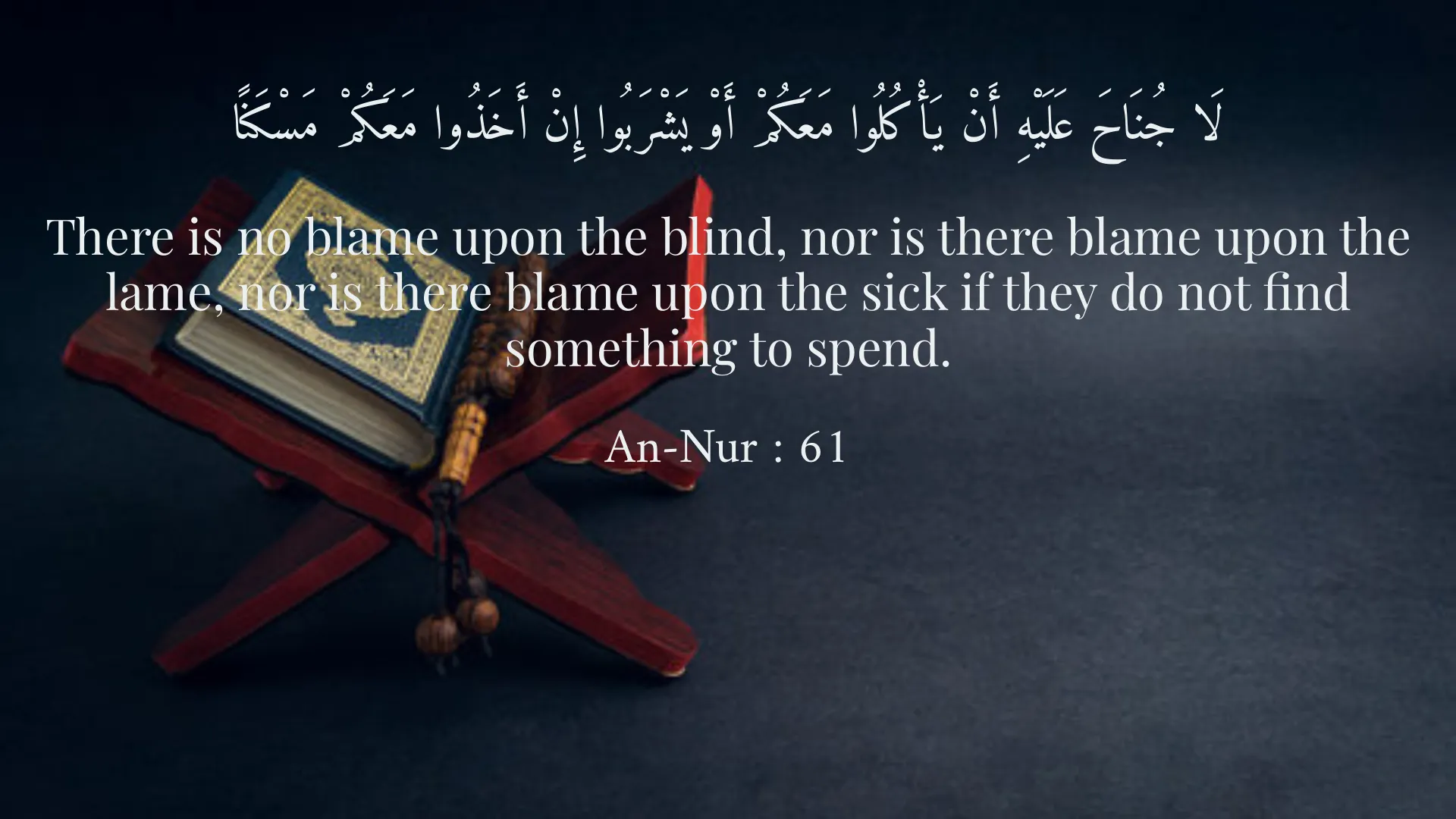
لَا جُنَاحَ عَلَيْهِ أَنْ يَأْكُلُوا مَعَكُمْ أَوْ يَشْرَبُوا إِنْ أَخَذُوا مَعَكُمْ مَسْكَنًا
There is no blame upon the blind, nor is there blame upon the lame, nor is there blame upon the sick if they do not find something to spend.
An-Nur : 61
ليس البر أن تولوا وجوهكم قبل المشرق والمغرب ولكن البر من آمن بالله واليوم الآخر والملائكة والكتاب والأنبياء وأعطى ماله على حبه ...
It is not righteousness that you turn your faces toward the east or the west, but [true] righteousness is in one who believes in Allah, the Last Day, the Angels, the Book, and the Prophets, and gives his wealth, in spite of love for it, to relatives...
Al-Baqarah : 177
وَقَضَى رَبُّكَ أَلَّا تَعْبُدُوا إِلَّا إِيَّاهُ وَبِالْوَالِدَيْنِ إِحْسَانًا
And your Lord has decreed that you not worship except Him, and to parents, good treatment.
Al-Isra : 23
Short Story
One day, Adel was pondering about his life and wondered what mattered most to him. He recalled the verses of the Quran and realized that recognizing life's priorities was essential. He then decided to focus more on establishing a connection with God while also devoting kindness to his parents. After some time, Adel noticed that his life had changed, and he felt a greater sense of peace.