Quranic Answer
The concept of self-love and its relation to servitude to God is a profound and intricate topic in Islamic teachings, requiring careful elucidation. At first glance, it might seem that self-love inherently contradicts the notion of complete submission and absolute servitude to the Creator. However, upon reflection on the verses of the Holy Quran and Islamic principles, we discover that this matter encompasses various dimensions that must be meticulously examined. In truth, 'self-love' has two distinct facets: a constructive and positive aspect, and a destructive and negative one. Differentiating between these two forms of self-love is key to understanding its relationship with servitude. The first type is 'healthy and constructive self-love.' This form of self-love is essentially a kind of care, respect, and appreciation for oneself, which has been entrusted to humanity by the Creator. Our bodies, minds, and souls are divine trusts (amanat), and nurturing them, striving for their growth and perfection, is an integral part of our duty of servitude. Allah has appointed humanity as His vicegerent on Earth (Surah Al-Baqarah, verse 30), and this status itself signifies the value and dignity that Allah has bestowed upon human beings. Therefore, attention to physical and mental health, seeking knowledge, purifying the soul (tazkiyat al-nafs), and striving to actualize one's inherent talents, not only does not contradict servitude but also lays the groundwork for better and more effective servitude. An individual who is physically and mentally healthy and balanced possesses greater capacity to perform acts of worship, serve creation, and advance on the path of divine pleasure. Indeed, this type of self-love is a practical expression of gratitude for the divine blessings bestowed upon us. The Holy Quran frequently emphasizes the purification of the soul (Surah Ash-Shams, verses 7-10). This purification is a form of self-care whose ultimate goal is proximity to Allah. This kind of self-love guides a person towards perfection and deeper understanding, aiding them on their path of servitude. However, the second facet is 'destructive and negative self-love,' often synonymous with narcissism, arrogance, and pride (kibr). This type of self-love signifies false self-aggrandizement, undue superiority complex, and forgetting the true origin of one's power and existence. It is here that self-love enters into clear contradiction with servitude. Servitude in Islam means absolute submission to the Divine Will, acknowledging one's inherent need and poverty before Allah's absolute richness, and humility before His grandeur. One who is afflicted with pride and self-importance regards themselves as the center of existence and refuses to obey and be humble before the Creator. The most prominent Quranic example of this destructive self-love is Iblis, who, due to arrogance and self-superiority (believing himself superior because he was created from fire while Adam was from clay), refused to prostrate to Adam and defied God's command (Surah Al-A'raf, verse 12; Surah Sad, verses 75-76). In numerous Quranic verses, Allah states that He does not love the arrogant (Surah Luqman, verse 18; Surah An-Nahl, verse 23). This type of self-love not only hinders servitude but also deviates a person from the path of truth, leading them to ruin. True servitude elevates a person to the pinnacle of dignity and honor because it connects them to the ultimate source of honor and dignity, which is Allah. A servant of God perceives themselves as a mere speck before the boundless ocean of divine existence, and this realization liberates them from the shackles of pride and ego. In reality, the fundamental contradiction is not with self-love, but with 'self-worship'; meaning, when a person worships their own ego instead of Allah, prioritizing their desires and whims over divine commands. This self-worship is a subtle form of shirk (associating partners with God) that deviates a person from the path of monotheism and true servitude. In conclusion, healthy and balanced self-love, which includes caring for one's body and soul for better servitude and spiritual growth, is not only compatible with servitude but is necessary and complementary to it. This type of self-love guides a person towards perfection and a deeper understanding of their place in existence, prompting them to move with their whole being towards their Creator. However, self-love of the nature of pride, arrogance, and self-worship, which prevents a person from humility before Allah and leads them into disobedience, is in complete contradiction with the concept of servitude and worship. True servitude frees a person from the grip of the commanding self (nafs al-ammarah) and brings them to a state where true self-knowledge leads to knowledge of God, and self-love takes on the hue of love for the Creator, reaching perfection under the shadow of this divine love.
Related Verses
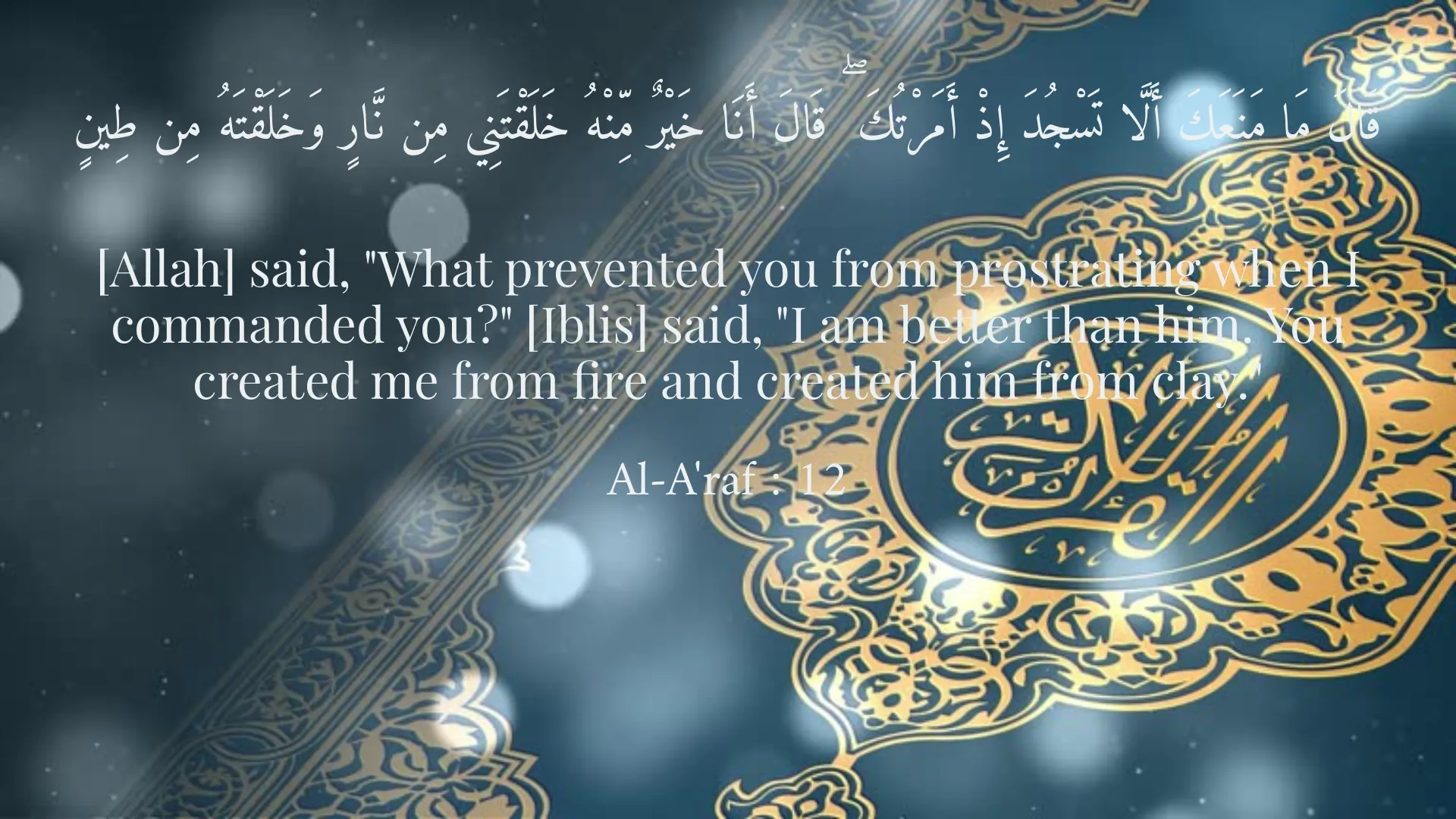
قَالَ مَا مَنَعَكَ أَلَّا تَسْجُدَ إِذْ أَمَرْتُكَ ۖ قَالَ أَنَا خَيْرٌ مِّنْهُ خَلَقْتَنِي مِن نَّارٍ وَخَلَقْتَهُ مِن طِينٍ
[Allah] said, "What prevented you from prostrating when I commanded you?" [Iblis] said, "I am better than him. You created me from fire and created him from clay."
Al-A'raf : 12
وَلَا تُصَعِّرْ خَدَّكَ لِلنَّاسِ وَلَا تَمْشِ فِي الْأَرْضِ مَرَحًا ۖ إِنَّ اللَّهَ لَا يُحِبُّ كُلَّ مُخْتَالٍ فَخُورٍ
And do not turn your cheek toward people with contempt, nor walk through the earth exultantly. Indeed, Allah does not like everyone self-deluded and boastful.
Luqman : 18
قَدْ أَفْلَحَ مَن زَكَّاهَا
He has succeeded who purifies it,
Ash-Shams : 9
وَقَدْ خَابَ مَن دَسَّاهَا
And he has failed who corrupts it.
Ash-Shams : 10
Short Story
One day, a wealthy and wise man, full of self-admiration and boasting of his intellect and fortune, approached a sagacious dervish and asked, "O wise elder, what is the secret to enduring peace?" The dervish replied with a warm smile: "True peace comes not from accumulating possessions, nor from the false greatness one perceives in oneself; rather, it comes from recognizing your place as a servant before the Creator and knowing that your only support is Him. Just as a mighty tree with deep roots bows to the storm and endures, so too does a soul that humbles itself before its Creator find unbreakable peace and strength." The wealthy man was initially bewildered by this seemingly contradictory advice to his self-reliance. But as time passed, he lost his fortune. In this hardship, he recalled the dervish's words, and by turning to servitude and helping others, he found a peace and strength he had never experienced before. He realized that his former 'self-love' was fragile and based on fleeting possessions, whereas humility before God had granted him an enduring sense of self rooted in faith.