Quranic Answer
This is a profoundly important and central question in understanding the teachings of the Quran. The unequivocal answer is a resounding yes: the Holy Quran explicitly and emphatically calls upon humanity to seek truth and adhere to it, even if this pursuit necessitates challenging long-standing traditions, customs, or inherited beliefs. Indeed, one of the primary missions of the Quran is to liberate humanity from the shackles of blind imitation and ignorant prejudice. The Quran introduces itself as the 'Furqan,' meaning the Criterion or the Discriminator between truth and falsehood. This implies that the fundamental role of this divine book is to distinguish between what is genuinely true and what is merely accepted due to habit or ancestral inheritance. Numerous verses in the Quran strongly admonish those who resist the call of the Prophets to truth solely on the grounds of, 'We found our fathers doing it this way' or 'We merely follow the path of our predecessors.' This type of argument, from the Quranic perspective, is entirely irrational and an impediment to guidance. The Quran illustrates how many past nations rejected their prophets simply because they were unwilling to abandon their ancestral traditions, even when those traditions involved idolatry or oppressive practices. This demonstrates that traditions can act as a veil over truth and pose a significant barrier on the path to guidance and perfection. The Quran's invitation to reflection, contemplation, pondering, and insight serves as further evidence of this reality. Many verses urge people to contemplate the divine signs in the universe and within themselves, to reflect on the creation of the heavens and the earth, and to employ their intellect to grasp truths. This pervasive emphasis on rationality and insight indicates that faith in Islam should not be acquired through mere thoughtless imitation. Instead, it must be based on conviction and proof that stems from reflection and truth-seeking. Allah demands that humans utilize their hearing, sight, and hearts, and possess knowledge and awareness regarding their claims, rather than relying solely on conjecture or what they have heard from others. Divine prophets, in every era, rose to challenge the prevailing and deeply entrenched erroneous traditions of their times. Noah, Abraham, Moses, Jesus, and finally Prophet Muhammad (peace be upon them all), all combated the widespread idolatry, injustice, discrimination, and superstitions prevalent among their peoples. Prophet Muhammad (PBUH) emerged in a society heavily influenced by pre-Islamic traditions of ignorance, ranging from idol worship and female infanticide to oppressive social and economic systems. His mission was precisely to challenge these traditions and replace them with the light of monotheism, justice, and divine morality. This struggle against the traditions of ignorance underscores the priority of truth and divine revelation over any human custom or habit. Of course, this does not mean a rejection of all traditions. Islam itself possesses virtuous traditions and a rich heritage of culture and civilization. What the Quran challenges are those traditions that stand in contradiction to the principles of Tawhid (monotheism), justice, ethics, and rationality. It challenges traditions that hinder growth, progress, and a correct understanding of religion. Therefore, it can be said that the Quran invites humanity to a critical and intelligent appraisal of traditions; a beneficial and constructive tradition should be preserved, while a false and misleading one must be abandoned. This approach brings dynamism and rationalism to the understanding of religion and life, avoiding stagnation and fanaticism. In conclusion, the Quran clearly emphasizes the importance of truth-seeking and adherence to it, even when confronting prevailing traditions. This invitation is tantamount to a call for intellectual and spiritual liberation, so that humanity may be freed from the constraints of anything that steers it away from the path of truth and guidance. This approach applies not only to religious matters but to all dimensions of life, including social, cultural, and ethical aspects. It consistently encourages us to use our intellect, insight, and divine revelation to distinguish truth from falsehood, rather than following blindly. This is how a society founded on truth, justice, and awareness is built.
Related Verses
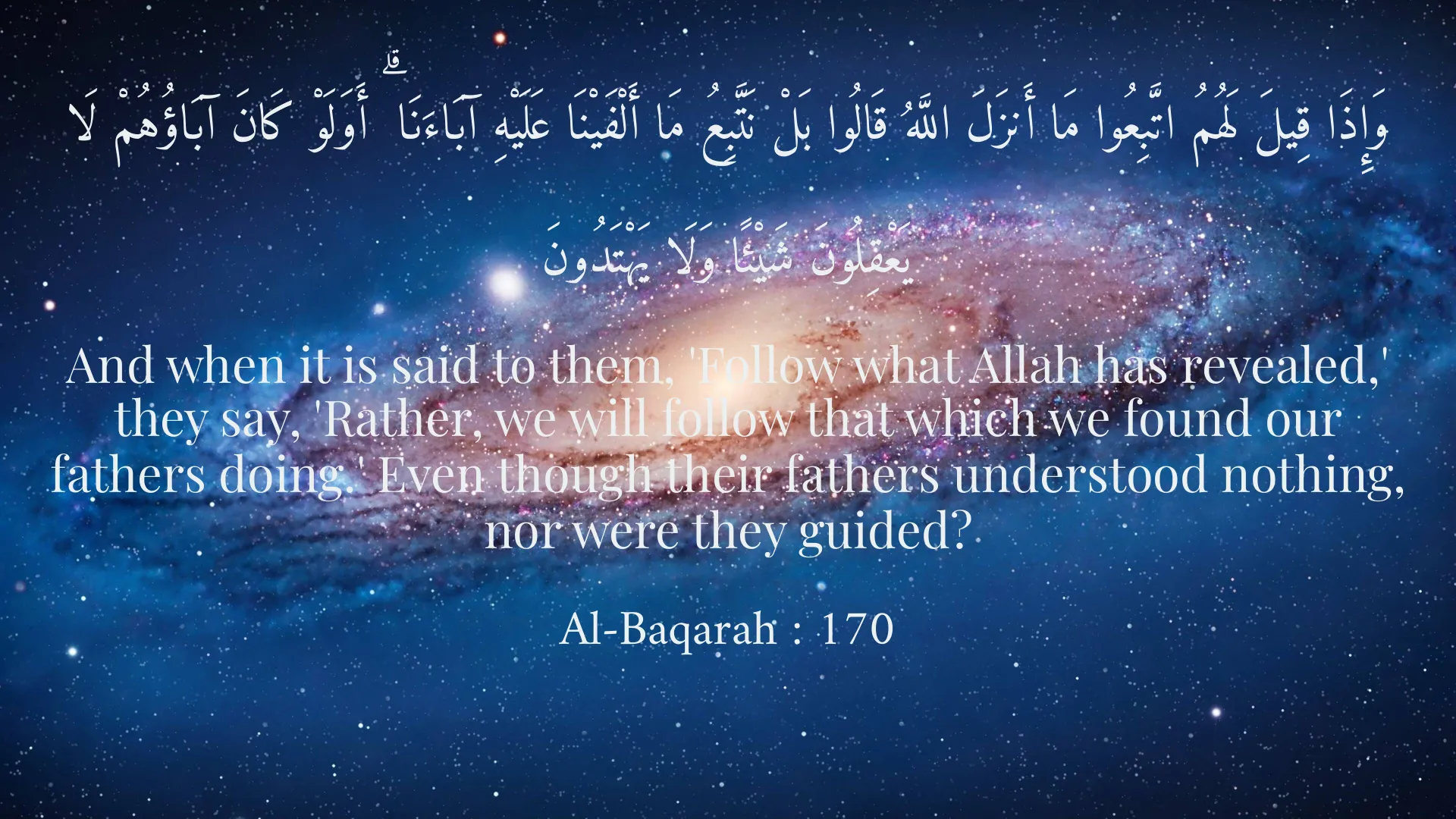
وَإِذَا قِيلَ لَهُمُ اتَّبِعُوا مَا أَنزَلَ اللَّهُ قَالُوا بَلْ نَتَّبِعُ مَا أَلْفَيْنَا عَلَيْهِ آبَاءَنَا ۗ أَوَلَوْ كَانَ آبَاؤُهُمْ لَا يَعْقِلُونَ شَيْئًا وَلَا يَهْتَدُونَ
And when it is said to them, 'Follow what Allah has revealed,' they say, 'Rather, we will follow that which we found our fathers doing.' Even though their fathers understood nothing, nor were they guided?
Al-Baqarah : 170
وَإِذَا قِيلَ لَهُمْ تَعَالَوْا إِلَىٰ مَا أَنزَلَ اللَّهُ وَإِلَى الرَّسُولِ قَالُوا حَسْبُنَا مَا وَجَدْنَا عَلَيْهِ آبَاءَنَا ۚ أَوَلَوْ كَانَ آبَاؤُهُمْ لَا يَعْلَمُونَ شَيْئًا وَلَا يَهْتَدُونَ
And when it is said to them, 'Come to what Allah has revealed and to the Messenger,' they say, 'Sufficient for us is that upon which we found our fathers.' Even though their fathers knew nothing and were not [rightly] guided?
Al-Ma'idah : 104
وَلَا تَقْفُ مَا لَيْسَ لَكَ بِهِ عِلْمٌ ۚ إِنَّ السَّمْعَ وَالْبَصَرَ وَالْفُؤَادَ كُلُّ أُولَٰئِكَ كَانَ عَنْهُ مَسْئُولًا
And do not pursue that of which you have no knowledge. Indeed, the hearing, the sight and the heart - about all those [one] will be questioned.
Al-Isra : 36
Short Story
It is narrated that in a certain land, people had followed a peculiar custom for years: whenever rain was scarce, instead of praying or seeking a solution, they would drag a large stone inherited from their ancestors down from the mountain, believing this act would bring rain. A wise sage was passing by and saw the people toiling with great difficulty, dragging the stone, yet no rain fell. He asked, "Why do you do this?" They replied, "This is the custom of our ancestors; they did so, and rain would come." The sage smiled and said, "Perhaps your ancestors, besides this act, also engaged in sincere prayer, and they mistakenly attributed the blessing to the stone. But sound reason dictates that for rain, one should pray to the Almighty and sow seeds, not pull stones with futile effort." The people initially mocked him, but after years passed with no rain from the stone, and then, through the sage's prayers and efforts in cultivation, the blessing of rain came, they realized that truth sometimes lies hidden beyond old traditions, and one must seek it with the light of intellect and wisdom.