Quranic Answer
The Holy Quran, revered by Muslims as the literal word of God, serves as a profound guide in all aspects of life, including the essential task of child-rearing. Parenting is a responsibility that carries immense significance in Islam, and the Quran offers extensive insights that shape the upbringing of children in a manner that fosters their spiritual, moral, and intellectual development. Through various verses, the Quran emphasizes the importance of kindness, good character, and the critical nature of family relationships, particularly the bond between parents and children. This article delves into the principles as provided by the Quran on child-rearing and how they can be applied in contemporary contexts to nurture well-rounded individuals equipped to benefit society at large. At the very core of child-rearing as outlined in the Quran is the essence of kindness and good character. In Surah Luqman, verses 13-19, we find wisdom shared by Luqman, a sage figure, who counsels his son with profound advice. He advises against associating partners with Allah, a foundational aspect of Islamic belief, and stresses the importance of honoring one’s parents. These recommendations underline the significance of creating a strong moral framework in children from an early age. By instilling such values, parents can nurture a generation capable of understanding and respecting the boundaries of faith and ethical behavior. Moreover, the advice given by Luqman serves as a template for how to raise children within an Islamic society. The relationship between parents and children is paramount, with the Quran continually highlighting the need for strong familial bonds. In Surah Al-Isra, verse 31, the Quran instructs parents to raise their children with love and compassion. It implores them to guide their offspring away from wrongful paths and towards a life of righteousness. This instruction emphasizes the crucial role of parents as the first educators in a child’s life; their actions significantly influence the child’s moral compass. It furthers the narrative that child-rearing is not solely about education in religious texts, but rather encompasses a broader sphere of ethical and social behaviors as well One of the most critical elements of parenting emphasized in the Quran is the importance of being a positive role model. Surah At-Talaq, verse 6 issues a command for men to treat their families with love and patience. This directive underscores the necessity for parents to embody the very values they wish to instill in their children. When parents engage in acts of kindness, exhibit patience, and uphold moral integrity, they inadvertently teach these qualities to their children. Action speaks louder than words, and children are adept at mimicking the behaviors they observe in their parents. Therefore, fostering an environment that promotes love, respect, and support not only aids in the proper upbringing of children but also strengthens family cohesion as a whole. Creating a calm and nurturing environment is arguably one of the most vital aspects of child upbringing. The Quran guides parents to foster a setting where children feel secure, valued, and loved. When children grow up in a harmonious atmosphere, they are more likely to explore their interests, express their thoughts, and develop their personalities. Ultimately, a supportive family environment enables children to thrive emotionally and socially. Furthermore, the pursuit of knowledge is deeply enshrined in Islamic teachings. The Quran encourages parents to motivate their children in the pursuit of education in order to cultivate informed, inquisitive, and capable individuals. The quest for knowledge is described in various Islamic texts as a duty incumbent upon every believer. This commitment to learning extends beyond formal education; it includes nurturing a love for reading, critical thinking, and ethical understanding. When children are encouraged to seek knowledge, they become empowered individuals capable of contributing positively to society. In a practical sense, this commitment to education can manifest in various forms. Parents can provide their children with resources that stimulate their curiosity, engage them in discussions that challenge their thought processes, and foster an atmosphere that values inquiry. Parents can also incentivize academic endeavors by celebrating achievements and encouraging resilience in the face of challenges. This not only reinforces the importance of education but also nurtures a growth mindset—a crucial attribute for success in today’s world. Moreover, the Quranic guidance on parenting extends to how to deal with challenges and setbacks in a child’s upbringing. Parenting is fraught with difficulties, but how parents respond to such challenges can profoundly affect their children’s development. The Quran teaches patience and emphasizes relying on Allah during trying times. By exhibiting patience and drawing on spiritual strength, parents can impart resilience to their children—an essential quality for navigating life’s complexities. In summary, the Holy Quran provides a comprehensive framework for child-rearing that intertwines love, respect, moral education, and encouragement for intellectual pursuit. It emphasizes that being a good parent requires cultivating a loving atmosphere, embodying the values parents wish to espouse, and nurturing their children’s innate curiosity through education. The principles laid out in the Quran serve not only to guide individuals within Islamic jurisdictions but remain pertinent in broader societal contexts as well. By adhering to these timeless teachings, parents can offer their children the foundational qualities necessary for not only personal success but for the betterment of humanity as a whole. Thus, the Quran’s lessons on child-rearing continue to resonate, urging contemporary parents to reflect on their roles and responsibilities in shaping future generations.
Related Verses
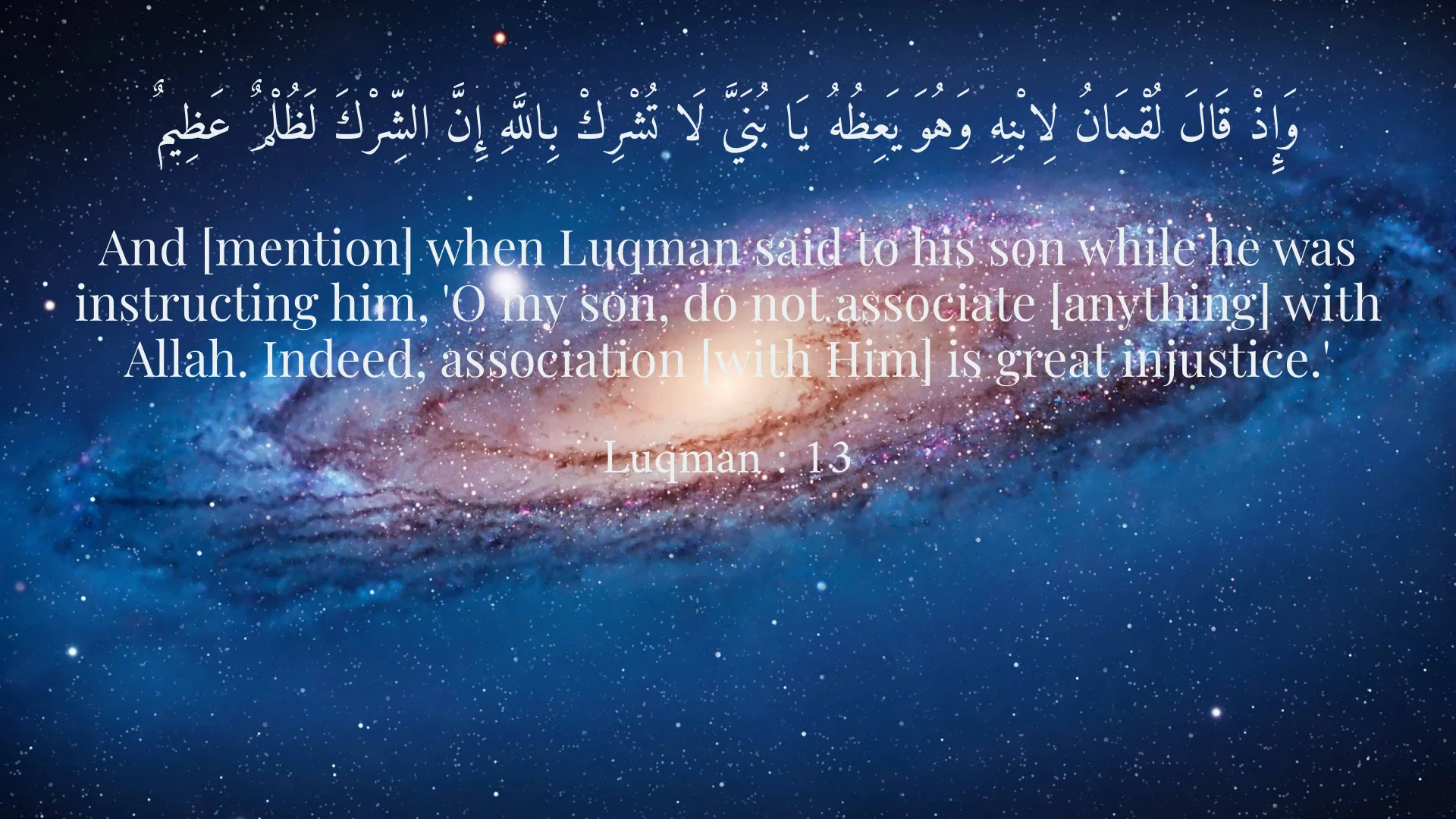
وَإِذْ قَالَ لُقْمَانُ لِابْنِهِ وَهُوَ يَعِظُهُ يَا بُنَيَّ لَا تُشْرِكْ بِاللَّهِ إِنَّ الشِّرْكَ لَظُلْمٌ عَظِيمٌ
And [mention] when Luqman said to his son while he was instructing him, 'O my son, do not associate [anything] with Allah. Indeed, association [with Him] is great injustice.'
Luqman : 13
وَلَا تَقْتُلُوا أَوْلَادَكُمْ خَشْيَةَ إمْلاَقٍ ۖ نَحْنُ نَرْزُقُهُمْ وَإِيَّاكُمْ ۚ إِنَّ قَتْلَهُمْ كَانَ خِطْئًا كَبِيرًا
And do not kill your children for fear of poverty. We provide for them and for you. Indeed, killing them is a great sin.
Al-Isra : 31
لْيُنفِقْ ذُو سَعةٍ مِّن سَعَتِهِۦ ۖ وَمَن قُدِرَ عَلَيْهِ رِزْقُهُ فَلْيُنفِقْ مِمَّا آتَاهُ اللَّهُ ۚ لَا يُكَلِّفُ اللَّهُ نَفْسًا إِلَّا مَا آتَاهَا ۚ سَيَجْعَلُ اللَّهُ بَعْدَ عُسْرٍ يُسْرًا
Let a man of wealth spend from his wealth. And he whose provision is restricted - let him spend from what Allah has given him. Allah does not burden a soul beyond that it can bear. Allah will bring about, after hardship, ease.
At-Talaq : 6
Short Story
One day, a father and his son were heading to the garden. The little boy enjoyed being in nature, and the father said to him, 'Look, my son, just like this tree that grows tall towards the sky, you too can cultivate your talents and reach great heights. But remember, just as a tree grows with nurturing and sunlight, if you want to flourish, you must have love and respect in your life.' This story illustrates the importance of nurturing and proper upbringing for the child.