Quranic Answer
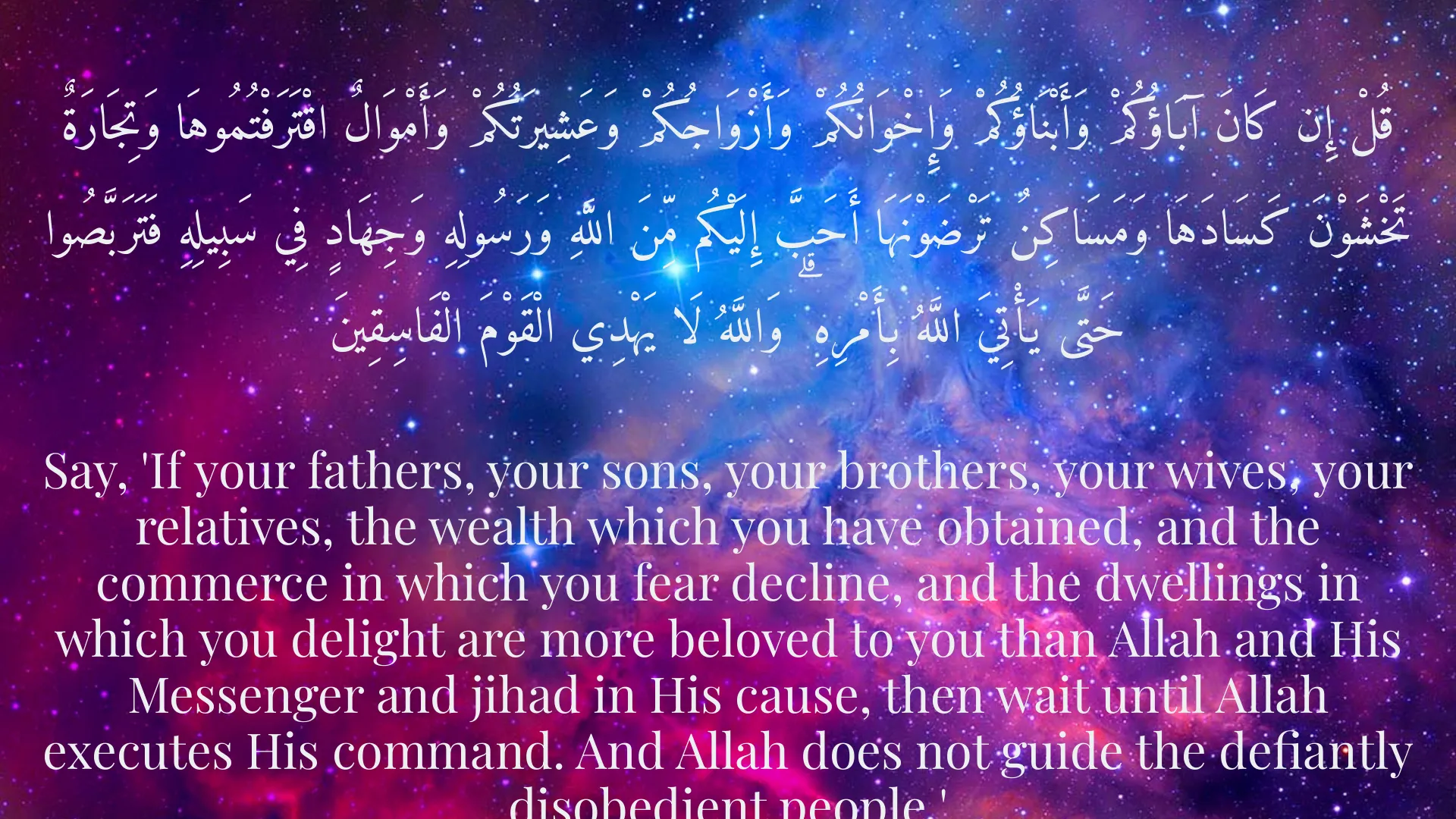
Excessive attachment to worldly life, often referred to in Quranic terms as 'Hubb al-Dunya' (love of the world) or 'Rukun ila al-Dunya' (leaning towards the world), is a state of the heart that, if it exceeds moderation, can become a significant barrier to spiritual growth and closeness to Allah. The Holy Quran never prohibits possessing wealth, family, or lawful worldly pleasures; rather, it emphasizes enjoying them moderately and using these blessings in the path of servitude to God. The problem begins when the world and its manifestations become the ultimate goal, distracting humanity from the ultimate purpose of creation, which is to know and worship the Creator. Signs of excessive attachment to worldly life, which can be inferred from Quranic verses and Islamic teachings, include several aspects that we will discuss in detail. One of the most prominent signs is prioritizing worldly matters over divine obligations and values. If a person reaches a point where acquiring wealth, status, fame, or any worldly gain prevents them from performing prayers, paying Zakat, being truthful, upholding justice, or fulfilling other religious and ethical duties, this is a clear sign of severe attachment to the world. The Quran explicitly addresses this in Surah At-Tawbah, verse 24, stating: "Say, 'If your fathers, your sons, your brothers, your wives, your relatives, the wealth which you have obtained, and the commerce in which you fear decline, and the dwellings in which you delight are more beloved to you than Allah and His Messenger and jihad in His cause, then wait until Allah executes His command. And Allah does not guide the defiantly disobedient people.'" This verse clearly indicates that if love for any worldly manifestation (family, wealth, trade, dwelling) surpasses love for Allah, His Messenger, and striving in His cause, a person is exposed to divine danger and punishment. This prioritization can manifest in daily decisions, career choices, social relations, and even one's lifestyle, indicating a shift in one's ultimate priorities from the divine to the temporal. Another sign is excessive sorrow over the loss of worldly possessions or extreme joy at their acquisition. In Surah Al-Hadid, verse 20, after describing the world as play, amusement, adornment, boasting, and rivalry in wealth and children, the Quran states: "So that you may not grieve over what has escaped you, nor exult [too much] over what has come to you. And Allah does not love every self-deluded boaster." A person attached to the world falls into deep despair and depression when losing wealth or status and becomes engulfed in boundless pride and joy when gaining them. In contrast, a true believer is patient in hardship and grateful and humble in prosperity. This balance demonstrates a correct understanding of the transient nature of this world. The world is repeatedly described in the Quran as 'Mata' al-Ghurur' (deceptive enjoyment), meaning its appearance is beautiful and enticing, but its reality is unstable and worthless. Forgetting the Hereafter and failing to prepare for it is also a strong indicator of worldly attachment. A person who devotes all their effort and ambition to accumulating worldly possessions and pleasures, while neglecting death, accountability, and eternal life, is clearly attached to the world. The Quran, in Surah Al-A'la, verses 16 and 17, states: "But you prefer the worldly life, while the Hereafter is better and more enduring." This preference manifests not only in thought and speech but also in one's actions and life planning. Someone whose entire life plan is solely for this world and has no serious plans for the Hereafter (such as accumulating good deeds, acquiring piety, abandoning sins, paying attention to the rights of others) is attached to the world and neglects the day of reckoning. This negligence leads the individual to shy away from deeds beneficial for the Hereafter, instead spending their time and energy on matters that will ultimately bring them no benefit in the eternal abode. Arrogance and self-admiration due to worldly possessions is another sign. Individuals who become arrogant because of their wealth, position, beauty, or children and look down upon others are caught in worldly attachment. The Quran, in various instances (such as the story of Qarun in Surah Al-Qasas), points to the dire consequences for such individuals. Accumulation and boasting in wealth and children, also mentioned in Surah At-Takathur, fall under this category. These individuals forget that all these blessings are from Allah and can be taken away at any moment, and only what they have done for the sake of Allah will remain for them. This arrogance is often accompanied by a condescending view of the poor and needy and a disregard for their rights, which itself is a sign of deviation from the path of servitude and divine justice. Stinginess and unwillingness to spend in the way of Allah are also consequences of worldly attachment. Those who are excessively greedy for their wealth and cannot spend it in the way of Allah (Zakat, charity, helping the needy) are, in fact, enslaved by the world. The Holy Quran considers spending in charity as one of the ways to purify the soul and detach from worldly attachments. An individual who is attached to the world is constantly worried about their diminishing assets and fears their financial future, consequently holding back from helping others, despite Allah's promise of compensation and blessings for those who spend in His way. An intense love for comfort and aversion to hardship in the path of truth can also be a sign of this attachment. If a person is unwilling to sacrifice even a little of their worldly comfort to defend the truth, fulfill difficult religious duties, or help the oppressed, it indicates that attachment to worldly ease has overcome divine values. To free oneself from excessive worldly attachment, the Quran also offers solutions. Belief in the Hereafter and remembrance of death are among the most important remedies. When a person remembers that this world is transient and their true abode is in the Hereafter, their attachments to the world fade. Furthermore, constant gratitude for divine blessings and spending in the way of Allah help individuals free themselves from dependence on wealth. The Quran, in Surah Al-Qasas, verse 77, states: "But seek, through that which Allah has given you, the home of the Hereafter; and [yet], do not forget your portion of the world." This verse emphasizes the necessity of moderation and proper utilization of the world to achieve the Hereafter, rather than making the world the ultimate goal. The world should be a means to reach the Hereafter, not an end in itself. Ultimately, focusing on servitude and divine pleasure, and placing the world in service of this noble goal, helps a person lead a balanced life and escape the trap of excessive worldly attachment. This does not mean abandoning the world or asceticism, but rather adopting a correct perspective on the world and using it in the path of worship and achieving eternal happiness, just as Imam Ali (AS) said: "The world is the farm of the Hereafter."
Related Verses
قُلْ إِن كَانَ آبَاؤُكُمْ وَأَبْنَاؤُكُمْ وَإِخْوَانُكُمْ وَأَزْوَاجُكُمْ وَعَشِيرَتُكُمْ وَأَمْوَالٌ اقْتَرَفْتُمُوهَا وَتِجَارَةٌ تَخْشَوْنَ كَسَادَهَا وَمَسَاكِنُ تَرْضَوْنَهَا أَحَبَّ إِلَيْكُم مِّنَ اللَّهِ وَرَسُولِهِ وَجِهَادٍ فِي سَبِيلِهِ فَتَرَبَّصُوا حَتَّى يَأْتِيَ اللَّهُ بِأَمْرِهِ ۗ وَاللَّهُ لَا يَهْدِي الْقَوْمَ الْفَاسِقِينَ
Say, 'If your fathers, your sons, your brothers, your wives, your relatives, the wealth which you have obtained, and the commerce in which you fear decline, and the dwellings in which you delight are more beloved to you than Allah and His Messenger and jihad in His cause, then wait until Allah executes His command. And Allah does not guide the defiantly disobedient people.'
At-Tawbah : 24
اعْلَمُوا أَنَّمَا الْحَيَاةُ الدُّنْيَا لَعِبٌ وَلَهْوٌ وَزِينَةٌ وَتَفَاخُرٌ بَيْنَكُمْ وَتَكَاثُرٌ فِي الْأَمْوَالِ وَالْأَوْلَادِ ۖ كَمَثَلِ غَيْثٍ أَعْجَبَ الْكُفَّارَ نَبَاتُهُ ثُمَّ يَهِيجُ فَتَرَاهُ مُصْفَرًّا ثُمَّ يَكُونُ حُطَامًا ۚ وَفِي الْآخِرَةِ عَذَابٌ شَدِيدٌ وَمَغْفِرَةٌ مِّنَ اللَّهِ وَرِضْوَانٌ ۚ وَمَا الْحَيَاةُ الدُّنْيَا إِلَّا مَتَاعُ الْغُرُورِ
Know that the worldly life is only amusement and diversion and adornment and boasting among yourselves and rivalry in [increase of] wealth and children. [It is] like the example of a rain whose [resulting] plant growth pleases the disbelievers; then it dries and you see it [become] yellow; then it becomes [scattered] debris. And in the Hereafter is severe punishment and forgiveness from Allah and approval. And what is the worldly life except the enjoyment of delusion.
Al-Hadid : 20
بَلْ تُؤْثِرُونَ الْحَيَاةَ الدُّنْيَا
But you prefer the worldly life,
Al-A'la : 16
وَالْآخِرَةُ خَيْرٌ وَأَبْقَىٰ
while the Hereafter is better and more enduring.
Al-A'la : 17
وَابْتَغِ فِيمَا آتَاكَ اللَّهُ الدَّارَ الْآخِرَةَ ۖ وَلَا تَنسَ نَصِيبَكَ مِنَ الدُّنْيَا ۖ وَأَحْسِن كَمَا أَحْسَنَ اللَّهُ إِلَيْكَ ۖ وَلَا تَبْغِ الْفَسَادَ فِي الْأَرْضِ ۖ إِنَّ اللَّهَ لَا يُحِبُّ الْمُفْسِدِينَ
But seek, through that which Allah has given you, the home of the Hereafter; and [yet], do not forget your portion of the world; and do good as Allah has done good to you. And desire not corruption in the land. Indeed, Allah does not like corrupters.
Al-Qasas : 77
Short Story
It is narrated that a wealthy king spent sleepless nights fearing the loss of his treasures. His servant observed him staying awake until dawn, adding to his coffers daily, yet finding no peace. One day, he saw a dervish sleeping peacefully under a tree with only a piece of bread and a jug of water. The servant told the king, 'O King! This dervish, despite all his poverty, is so at peace as if he is the king of the world, and you, with all your wealth, seem to be the poorest in the world.' The king asked, 'What is the secret?' The servant replied, 'He has detached his heart from the world and is content with his little possessions, while you are not content with much, and your desires increase daily. Whoever binds their heart to the world, the world enslaves them; and whoever detaches their heart from the world, the world becomes their servant.' The king took heed of this saying and understood that peace lies in contentment, not in the abundance of wealth.