Quranic Answer
Death, an undeniable truth and the inevitable destiny of every living being, is mentioned repeatedly in the Holy Quran. It is not merely the end of earthly life but a gateway to eternal existence and the beginning of a new phase for humanity. Therefore, preparation for death is not only unavoidable but also one of the fundamental duties of every Muslim. The Quran provides comprehensive and complete guidance for this preparation, all centered around a righteous and purposeful life in this world, showing us how to approach the meeting with our Lord with a tranquil heart and a confident soul. This preparation is formed through several fundamental pillars, each complementing the other. Firstly and most importantly, the pillar of preparing for death is "sincere and heartfelt faith" (Iman) in God and the Hereafter. The Quran explicitly states that every soul shall taste death, and then to its Lord will it be returned, that He may inform it of what it used to do (Al-Imran: 3:185, Al-Jum'ah: 62:8). This deep conviction that worldly life is temporary and a mere passage, and that we will ultimately be held accountable for our deeds, serves as a powerful motivator for righteous behavior and avoiding sins. Faith is not just a claim; it must manifest in our daily actions and conduct. This means a heartfelt belief in the Oneness of Allah, the prophethood of His messengers, His divine books, His angels, and most importantly, the Day of Judgment and the afterlife where our deeds will be rewarded or punished. Without this firm faith, any preparation will be incomplete, as we would have lost sight of the starting point and the ultimate destination. Faith grants an individual a broader perspective on worldly life, guiding them towards higher objectives. Secondly, the step is "Taqwa," which means God-consciousness or piety. The Quran repeatedly calls believers to Taqwa and considers it the best provision for the Hereafter (Al-Baqarah: 2:197). Taqwa implies a constant awareness of God's presence and striving to obey His commands and refrain from His prohibitions. This includes fulfilling obligatory acts of worship such as the five daily prayers (Salah), fasting during the month of Ramadan (Sawm), giving charity (Zakat) to the needy, and performing pilgrimage (Hajj) for those who are able. It also encompasses abstaining from forbidden acts like lying, backbiting, oppressing others, engaging in usury (riba), and committing polytheism (shirk) by associating partners with Allah. Every action performed for the sake of Allah becomes a provision for the Hereafter and forms the foundational stone of preparation for death. Taqwa acts as a strong shield against errors and sins, keeping the heart pure for meeting its Lord. Thirdly, the aspect is "Amal Salih," or righteous deeds. The Quran places great emphasis on good deeds, considering them the key to salvation in this world and the Hereafter. Surah Al-Mulk, verse 2, states that Allah created death and life to test which of you is best in deed. These righteous deeds are not limited to individual acts of worship; they also include kindness and goodness to parents (Al-Isra: 17:23), helping the needy and deprived members of society, establishing justice in individual and social relations, honesty in speech and conduct, peacemaking, kindness to God's creation, and any good work that benefits the individual and society. The Quran clearly states that whoever does an atom's weight of good or evil will see it (Az-Zalzalah: 99:7-8). Therefore, every moment of life is an opportunity to add to the scale of good deeds and build a valuable provision for the journey to the Hereafter. Fourthly, continuous "Tawbah" (repentance) and seeking forgiveness are crucial. Humans are prone to error and inevitably commit mistakes and sins. However, Allah Almighty is Most Forgiving and Most Merciful, and He has always kept the door of repentance open for His servants. The Quran encourages believers to turn back to God, regret their sins, and seek forgiveness (An-Nisa: 4:17). True repentance involves regretting the sin, abandoning it, a firm resolve not to repeat it in the future, and rectifying any wrongs or infringements on others' rights. Living with a pure heart and without persistence in sin is one of the best ways to prepare for meeting one's Lord. Repentance washes away the dust of sins from the soul, guiding the individual with a clean and pure heart towards their Creator. Fifthly, "remembrance of death" (Dhikr al-Mawt) is essential, not in a way that leads to despair or inertia, but as a stimulus for action and self-improvement. The Quran, in numerous verses, reminds us of death to awaken humanity from heedlessness and to seize the opportunities of life. Remembering death helps individuals re-evaluate life's priorities, reduce excessive attachment to worldly possessions, and instead of accumulating fleeting wealth and power, focus on gathering provisions for the Hereafter. This remembrance serves as a reminder and a warning, teaching us that time is limited and every moment must be utilized in the best possible way. Sixthly, "Tawakkul" (trust in Allah) and avoiding undue fears are crucial. While preparation for death through righteous deeds and piety is vital, this preparation should not be accompanied by paralyzing fear and obsession. The Quran reassures believers that with trust in Allah and fulfillment of duties, there is no cause for excessive worry. Allah is Just and Merciful and does not burden any soul beyond its capacity. Trust in Allah means complete reliance on divine planning and power, and submission to His will, with the assurance that He orchestrates the best for His servants. Preparation for death is, in essence, "living a righteous life." A life in which a person truly worships God, respects their own rights and the rights of others, utilizes divine blessings correctly and in a way that pleases Him, and constantly strives to attain the pleasure of the Lord. This path not only prepares one for the afterlife but also bestows meaning, tranquility, and blessings upon one's worldly life. Therefore, with each passing day, we should reflect on whether we have prepared provisions for the "tomorrow" that the Quran speaks of. This perspective transforms life and helps a person step towards their inevitable destiny with a confident heart and a tranquil soul. This preparation is continuous and ever-present, not limited to a specific moment. It means every breath, every glance, every word, and every step we take should be in the path of Allah's pleasure, so that at the moment of bidding farewell to this world, we not only have no fear but eagerly anticipate meeting our Lord and return to Him with an open countenance.
Related Verses
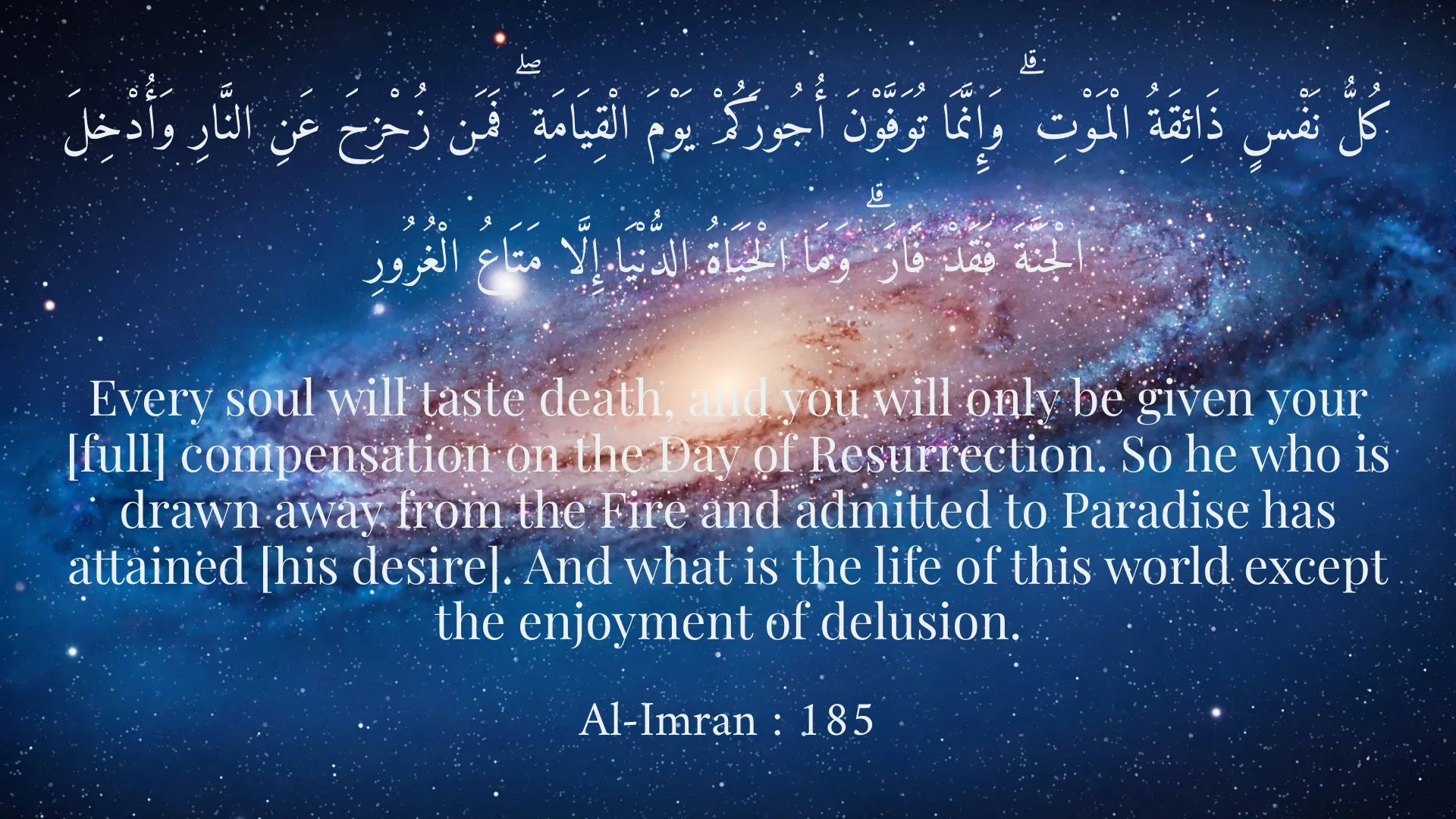
كُلُّ نَفْسٍ ذَائِقَةُ الْمَوْتِ ۗ وَإِنَّمَا تُوَفَّوْنَ أُجُورَكُمْ يَوْمَ الْقِيَامَةِ ۖ فَمَن زُحْزِحَ عَنِ النَّارِ وَأُدْخِلَ الْجَنَّةَ فَقَدْ فَازَ ۗ وَمَا الْحَيَاةُ الدُّنْيَا إِلَّا مَتَاعُ الْغُرُورِ
Every soul will taste death, and you will only be given your [full] compensation on the Day of Resurrection. So he who is drawn away from the Fire and admitted to Paradise has attained [his desire]. And what is the life of this world except the enjoyment of delusion.
Al-Imran : 185
يَا أَيُّهَا الَّذِينَ آمَنُوا اتَّقُوا اللَّهَ وَلْتَنظُرْ نَفْسٌ مَّا قَدَّمَتْ لِغَدٍ ۖ وَاتَّقُوا اللَّهَ ۚ إِنَّ اللَّهَ خَبِيرٌ بِمَا تَعْمَلُونَ
O you who have believed, fear Allah. And let every soul look to what it has put forth for tomorrow - and fear Allah. Indeed, Allah is Acquainted with what you do.
Al-Hashr : 18
الَّذِي خَلَقَ الْمَوْتَ وَالْحَيَاةَ لِيَبْلُوَكُمْ أَيُّكُمْ أَحْسَنُ عَمَلًا ۚ وَهُوَ الْعَزِيزُ الْغَفُورُ
[He] who created death and life to test you [as to] which of you is best in deed - and He is the Exalted in Might, the Forgiving.
Al-Mulk : 2
Short Story
It is recounted that there was once a reputable merchant who had amassed great wealth. One day, he set out with a caravan for a foreign land. Along the way, they met another caravan returning from a journey, bringing news that a prominent man from their city, who possessed lofty palaces and vast gardens, had passed away, and all his wealth had gone to his heirs, with nothing accompanying him to the grave but a shroud and a few pieces of wood. The merchant pondered to himself, 'I have toiled so much and accumulated wealth, but my end will also be like this.' At that moment, he recalled the saying: 'This world is a bridge; pass over it, but build no house upon it.' From then on, that wise merchant changed his way of life. Instead of adding to his worldly possessions, he devoted himself to charity and alms-giving. He built mosques, repaired bridges, helped the poor, and supported knowledge and literature. When many years had passed, and old age approached, and his inevitable end arrived, he departed from this world with a tranquil heart and a joyful soul, for he knew that what would accompany him on this eternal journey was not silver and gold, but rather the righteous deeds he had performed for the sake of God. He had built his home not on the fleeting bridge of this world, but in the eternal abode of the Hereafter, and this was true preparation for the final journey.