Quranic Answer
Understanding how God perceives us is one of the most profound and transformative insights a believer can attain. This perspective transcends human judgments, societal expectations, or even our own self-perceptions. The Holy Quran constantly reminds us that the true worth of a human being lies in their connection with the Creator and their obedience to His commands. When we strive to see ourselves from a divine viewpoint, we are essentially returning to the roots of our existence and recognizing the esteemed status God has ordained for us. This outlook not only paves the way for our spiritual growth but also fortifies us against challenges and feelings of inadequacy. The first and foremost lesson the Quran teaches us about humanity is its inherent dignity and honor. In Surah Al-Isra, verse 70, Allah states: “And We have certainly honored the children of Adam and carried them on the land and sea and provided for them of the good things and preferred them over much of what We have created, with [definite] preference.” This verse clearly indicates that humans are not ordinary beings; rather, they hold a special and superior position among creation. Allah has bestowed upon us intellect, free will, the power of choice, and the ability to distinguish right from wrong. This intrinsic dignity gives us a sense of worth and reminds us that we should never consider ourselves worthless or without purpose. Another divine perspective on humanity is our role as Allah’s vicegerent (Khalifa) on Earth. In Surah Al-Baqarah, verse 30, we read: “And [recall] when your Lord said to the angels, 'Indeed, I will make upon the earth a successive authority (khalifa).'” This verse shows that humans were created not only for worship but also for the stewardship and development of the Earth. Allah has entrusted us with the responsibility to uphold justice, spread goodness, and combat corruption. When we see ourselves as God’s vicegerents, we develop a deeper sense of responsibility regarding our actions and their impact. From the divine perspective, our life is a grand test. In Surah Al-Insan, verse 2, it is stated: “Indeed, We created man from a sperm-drop mixture that We may try him; and We made him hearing and seeing.” This viewpoint helps us to see difficulties, challenges, and even our sins within the framework of a growth journey. Allah knows that we have weaknesses and may err, but what matters is that we learn from these tests, repent, and return to Him. He values our efforts and remorse, not flawless perfection from the outset. One of the most crucial aspects of God’s view of us is His knowledge of every detail of our being and actions. In Surah Qaf, verse 16, it is recited: “And We are closer to him than [his] jugular vein.” This proximity signifies Allah’s absolute awareness of our thoughts, intentions, and even the slightest whispers of our hearts. He not only sees our outward deeds but is also aware of their underlying motivations and intrinsic quality. This absolute knowledge increases our accountability and steers us towards sincerity and away from hypocrisy. When we know that we are constantly under the watchful eye of the Most Merciful and All-Knowing Observer, we strive to be the best version of ourselves. It is vital to understand that Allah is not despairing of our sins. In Surah Az-Zumar, verse 53, it is stated: “Say, 'O My servants who have transgressed against themselves [by sinning], do not despair of the mercy of Allah. Indeed, Allah forgives all sins. Indeed, it is He who is the Forgiving, the Merciful.'” This verse opens a boundless door of hope and forgiveness for us. Allah sees our weaknesses and mistakes, but more importantly, He observes our remorse and our desire to return. He judges us not based on a single sin, but on the totality of our life's journey, our repentance, and our efforts towards self-correction. This expansive mercy gives us the courage to rise again after every stumble and to step towards Him. Ultimately, to see ourselves from God’s perspective, we must look beyond appearances and material things. Allah looks at hearts and intentions. Our worth in His sight is determined by our piety (taqwa), sincerity, good deeds, patience, gratitude, and our kindness towards His creation. He has given us the opportunity to reach the highest degree of human perfection through sincere worship, striving for good, and fostering a close relationship with Him. Seeing oneself from the divine perspective means embracing our inherent dignity, taking responsibility for our role as vicegerents, learning from our tests, and relying on His infinite mercy. This perspective grants us peace, purpose, and motivation to constantly walk on the path that pleases our Creator and to consider ourselves worthy of His love and favor. This is true self-knowledge that leads to self-improvement and eternal felicity.
Related Verses
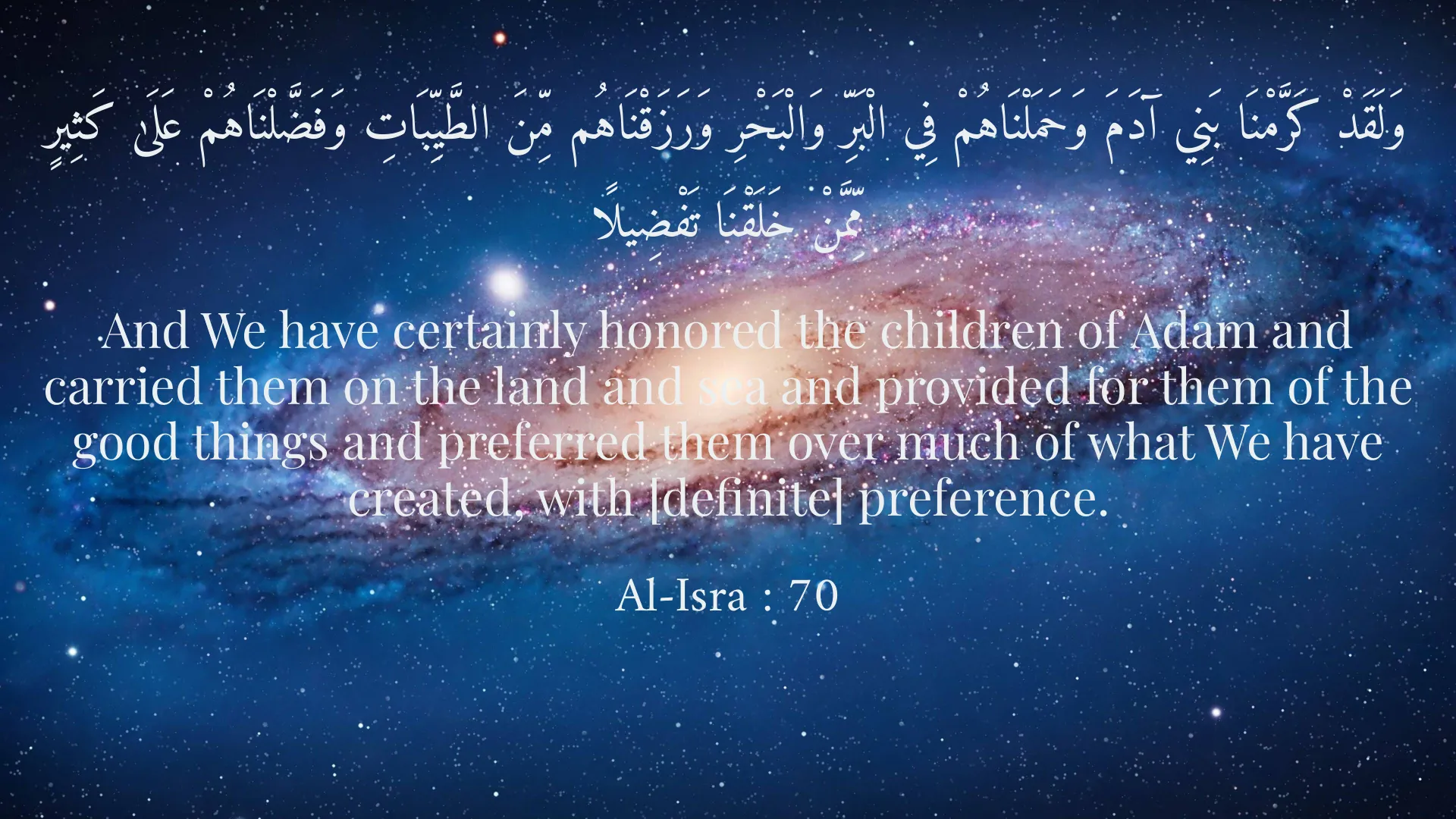
وَلَقَدْ كَرَّمْنَا بَنِي آدَمَ وَحَمَلْنَاهُمْ فِي الْبَرِّ وَالْبَحْرِ وَرَزَقْنَاهُم مِّنَ الطَّيِّبَاتِ وَفَضَّلْنَاهُمْ عَلَىٰ كَثِيرٍ مِّمَّنْ خَلَقْنَا تَفْضِيلًا
And We have certainly honored the children of Adam and carried them on the land and sea and provided for them of the good things and preferred them over much of what We have created, with [definite] preference.
Al-Isra : 70
وَإِذْ قَالَ رَبُّكَ لِلْمَلَائِكَةِ إِنِّي جَاعِلٌ فِي الْأَرْضِ خَلِيفَةً ۖ قَالُوا أَتَجْعَلُ فِيهَا مَن يُفْسِدُ فِيهَا وَيَسْفِكُ الدِّمَاءَ وَنَحْنُ نُسَبِّحُ بِحَمْدِكَ وَنُقَدِّسُ لَكَ ۖ قَالَ إِنِّي أَعْلَمُ مَا لَا تَعْلَمُونَ
And [recall] when your Lord said to the angels, "Indeed, I will make upon the earth a successive authority." They said, "Will You place upon it one who causes corruption therein and sheds blood, while we declare Your praise and sanctify You?" Allah said, "Indeed, I know that which you do not know."
Al-Baqarah : 30
وَلَقَدْ خَلَقْنَا الْإِنسَانَ وَنَعْلَمُ مَا تُوَسْوِسُ بِهِ نَفْسُهُ ۖ وَنَحْنُ أَقْرَبُ إِلَيْهِ مِنْ حَبْلِ الْوَرِيدِ
And We have already created man and know what his soul whispers to him, and We are closer to him than [his] jugular vein.
Qaf : 16
قُلْ يَا عِبَادِيَ الَّذِينَ أَسْرَفُوا عَلَىٰ أَنفُسِهِمْ لَا تَقْنَطُوا مِن رَّحْمَةِ اللَّهِ ۚ إِنَّ اللَّهَ يَغْفِرُ الذُّنُوبَ جَمِيعًا ۚ إِنَّهُ هُوَ الْغَفُورُ الرَّحِيمُ
Say, 'O My servants who have transgressed against themselves [by sinning], do not despair of the mercy of Allah. Indeed, Allah forgives all sins. Indeed, it is He who is the Forgiving, the Merciful.'
Az-Zumar : 53
Short Story
One day, a pious Sheikh was speaking to his disciples about the importance of self-knowledge and humanity's standing before the Lord. One disciple asked, "O Sheikh, how can I see myself from the perspective of the Almighty, so that I may better discern the path to salvation?" The Sheikh smiled and said, "Be careful not to blind the eyes of your heart to outward appearances. I once saw a wealthy man, seated on a throne of honor, surrounded by many servants and retinues. He imagined he held a high status with God. But one night, in a dream, he saw an angel who told him: 'You are not judged by your wealth and power, but by the extent of your humility and benevolence.' So, the man arose in the morning, distributed his treasures in the way of God, and cleansed himself of worldly dust. He understood that the true value of a person is not in wealth or status, but in the purity of intention and good deeds. So you, too, should see yourself in the mirror of your pure actions and intentions, not in the mirror of worldly desires and people's judgments. The purer your heart and the nobler your deeds, the dearer you will be to God, for He is All-Seeing and All-Knowing of both the hidden and the manifest, and He bestows true reward upon those who seek His pleasure."