Quranic Answer
The Holy Quran, as a divine guide, offers a profound and comprehensive definition of 'success' that fundamentally differs from prevalent materialistic interpretations in today's world. In contemporary culture, success is often equated with tangible achievements like immense wealth, fame, power, high positions, and the pursuit of fleeting worldly pleasures. Many people assume that the more they possess these worldly manifestations, the more successful they are. However, the Quran teaches us that this type of success, though seemingly attractive, is not lasting and cannot bring true satisfaction and inner peace. The Quran shifts our perspective from a purely worldly and material success towards a more comprehensive and enduring success, known as 'Falah' or salvation, which encompasses good in both this world and the hereafter. At the core of this transformation in understanding success, from the Quranic perspective, is the prioritization of lasting spiritual values over ephemeral material ones. Real success, according to the Quran, lies not in the accumulation of wealth or the acquisition of power, but in achieving the pleasure of Allah, purity of soul, performing righteous deeds, and securing eternal felicity. In Surah Al-Mu'minun, verses 1 to 11, Allah enumerates the characteristics of the successful believers: those who are humble in their prayers, avoid idle talk, pay Zakat (charity), guard their chastity, are trustworthy, fulfill their trusts and covenants, and maintain their prayers. These verses clearly indicate that true success is found in adhering to moral, spiritual, and devotional principles, not merely in worldly achievements. These characteristics form the foundation of a fruitful and meaningful life, the results of which become apparent in both worlds. In essence, success in the Quranic view is a process of inner growth and elevation that brings a person closer to perfection, leading to true tranquility and eternal bliss. The Quran repeatedly emphasizes that worldly life is transient and temporary, and it should not distract a person from their ultimate purpose of creation. In Surah Al-Kahf, verse 46, it states: "Wealth and children are [but] adornment of the worldly life. But the enduring good deeds are better to your Lord for reward and better for [one's] hope." This verse explicitly states that wealth and children are merely adornments of this worldly life, but lasting righteous deeds are superior in reward with your Lord and better in hope. This perspective creates a fundamental shift in priorities, where striving to build a prosperous afterlife takes precedence over merely accumulating wealth and power in this world. Thus, success is no longer limited to the brief span of worldly life but extends into eternity, which imbues human life with greater meaning and depth. Furthermore, the Quran promotes balance and moderation in life. Believers are encouraged to enjoy worldly bounties, but they should never become enslaved by them or forget their ultimate goal. True success is a balance between material and spiritual needs, such that material possessions serve as a means to achieve greater spiritual objectives. In Surah Al-Qasas, verse 77, we read: "But seek, through that which Allah has given you, the home of the Hereafter; and [yet], do not forget your share of the world. And do good as Allah has done good to you." This verse reminds us to seek the abode of the Hereafter with what Allah has bestowed upon us, without forgetting our legitimate share in this world, and to do good as Allah has done good to us. This balanced view prevents a person from either becoming completely engrossed in worldly pleasures and forgetting the afterlife, or from entirely abandoning worldly life and depriving themselves of lawful divine blessings. Ultimately, the Quran also transforms our view of success from mere individualism to social responsibility. True success is intertwined with helping others, upholding justice, and striving for the betterment of society. A person who only considers their personal interests and does not seek the well-being of others, even if they achieve great worldly accomplishments, is not considered truly successful from the Quranic perspective. This social dimension of success in Islam significantly contributes to solidarity and empathy within the Islamic community, paving the way for an ideal and divinely guided society. Therefore, the Quran views success not merely as a material destination, but as a continuous spiritual, ethical, and social journey, the ultimate goal of which is attaining divine pleasure and eternal bliss. This fundamental transformation frees individuals from fleeting concerns and grants them lasting peace and a deeper meaning in life.
Related Verses
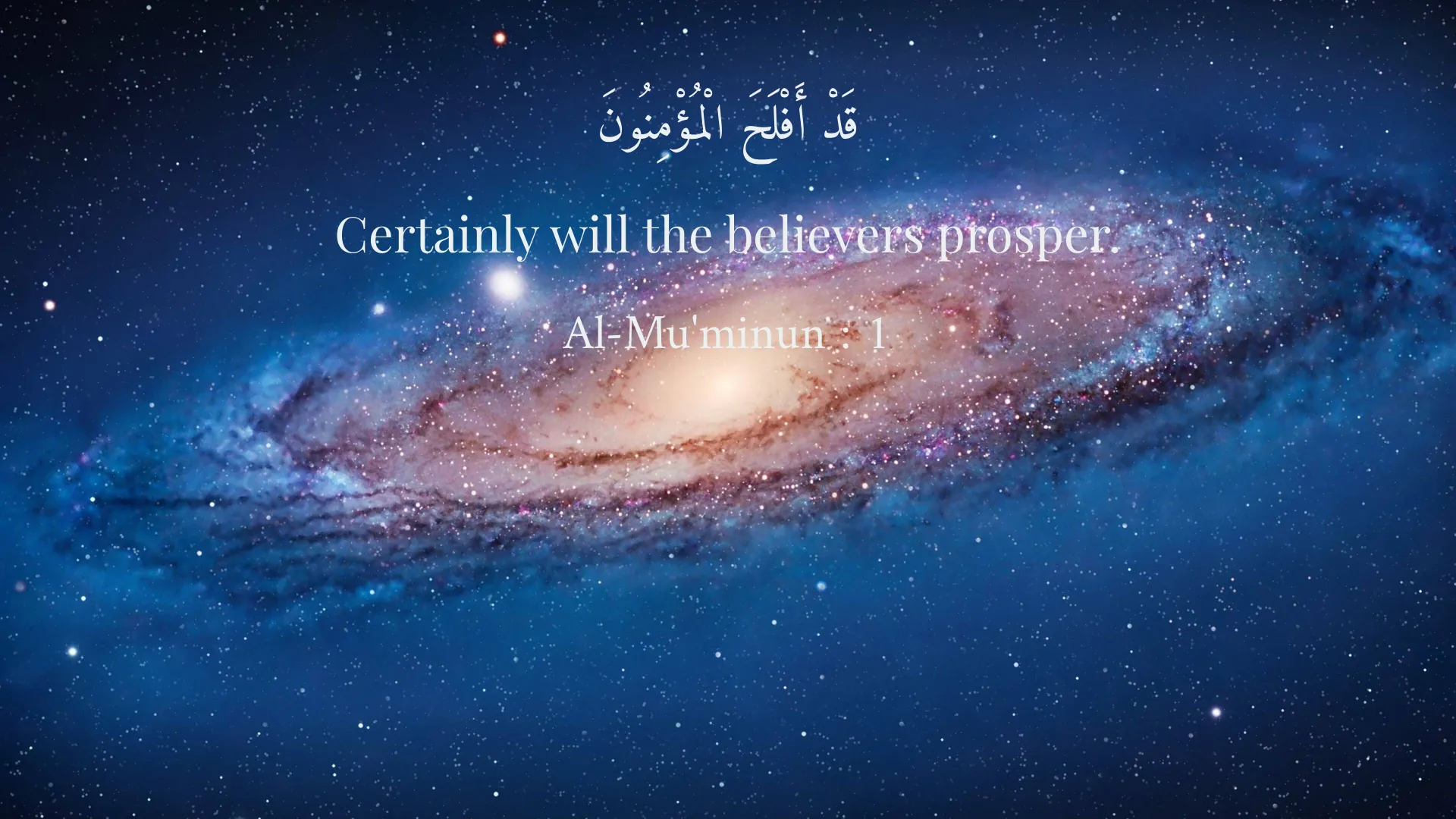
قَدْ أَفْلَحَ الْمُؤْمِنُونَ
Certainly will the believers prosper.
Al-Mu'minun : 1
أُولَٰئِكَ هُمُ الْوَارِثُونَ
Those are the inheritors.
Al-Mu'minun : 10
الَّذِينَ يَرِثُونَ الْفِرْدَوْسَ هُمْ فِيهَا خَالِدُونَ
Who will inherit Paradise. They will abide therein eternally.
Al-Mu'minun : 11
الْمَالُ وَالْبَنُونَ زِينَةُ الْحَيَاةِ الدُّنْيَا ۖ وَالْبَاقِيَاتُ الصَّالِحَاتُ خَيْرٌ عِندَ رَبِّكَ ثَوَابًا وَخَيْرٌ أَمَلًا
Wealth and children are [but] adornment of the worldly life. But the enduring good deeds are better to your Lord for reward and better for [one's] hope.
Al-Kahf : 46
Short Story
It is told that in ancient times, there lived a merchant named Karim, who was constantly striving to accumulate wealth and expand his trade. He saw success only in the abundance of possessions and status. Every day, his wealth grew, and he built larger houses, yet it seemed he never found true peace. One day, he encountered an ascetic dervish sitting in a corner of a mosque, engrossed in the remembrance of God with remarkable serenity. Karim, with an air of pride, said to the dervish, 'O Dervish, you waste your life in idleness. Behold the fortunes I have amassed and the successes I have achieved!' The dervish replied with a gentle smile, 'O Karim, true success lies in what accompanies you into the grave, not what puts you in it. The wealth and status of this world are like a fleeting shadow that changes constantly and eventually vanishes. But goodness and God's pleasure are like a light that illuminates you in this world and the hereafter.' The dervish's words were like water on Karim's fire of greed. He fell into deep thought, and for the first time in his life, pondered the true meaning of success. From that day forward, Karim not only continued his trade but also dedicated a large portion of his wealth to charity and helping the needy, and he devoted himself to worship and remembrance. He realized that the peace he had sought for years was not in accumulating wealth, but in giving and in the pleasure of the Almighty. He understood that true success is the tranquility of the heart and the light of the hereafter, not merely filling one's pockets and achieving the fleeting desires of this world.