Quranic Answer
Achieving a balance between the life of this world (Dunya) and the Hereafter (Akhirah) is one of the most fundamental and vital teachings of the Holy Quran, serving as a guide for human prosperity in both realms. The Quran does not instruct us to completely abandon worldly life and focus solely on the Hereafter, nor does it advocate for our entire concern to be absorbed by worldly matters. Instead, it presents a middle, balanced path where Dunya acts as a farm for Akhirah, a means to achieve divine pleasure and eternal happiness. This balance implies understanding the rightful place of each and dedicating appropriate attention to both. In numerous verses, the Holy Quran addresses this topic. One of the clearest verses in this regard is Surah Al-Qasas (28:77), which states: "But seek, through that which Allah has given you, the home of the Hereafter; and [yet], do not forget your share of the world; and do good as Allah has done good to you. And desire not corruption in the land. Indeed, Allah does not like corrupters." This verse explicitly states that our primary goal should be the Hereafter, but we must not forget our portion of this world. The "share of the world" includes material needs, lawful sustenance, family welfare, healthy recreation, and enjoying God's blessings, provided that this enjoyment does not distract us from our ultimate goal, which is the Hereafter. To establish this balance, we must first adopt a correct perspective on both Dunya and Akhirah. This world is a place of trial and an opportunity to gather provisions for the Hereafter. Every good deed we perform in this world, such as prayer, fasting, charity, kindness to parents, helping the needy, acquiring beneficial knowledge, and even striving for lawful earnings, can be considered an investment for the Hereafter. Dunya is a means to achieve perfection and closeness to God. The Quran teaches us to always desire good in both this world and the Hereafter, as we read in Surah Al-Baqarah (2:201): "And among them is he who says, 'Our Lord, give us in this world [that which is] good and in the Hereafter [that which is] good and protect us from the punishment of the Fire.'" This supplication demonstrates that seeking good things in both this world and the Hereafter from God is desirable and affirmed in Islam. The key to this balance lies in the divine intention behind all our actions. When our daily tasks, studying, working for income, raising children, and even sleeping are accompanied by the intention of seeking closeness to God and His pleasure, that worldly act transforms into an act of worship with an eternal reward. The Prophet Muhammad (peace be upon him) said: "Indeed, actions are by intentions." This Hadith illustrates the depth of this connection. Therefore, if we strive to earn a livelihood with the intention of not being dependent on others, supporting our family, and serving society, this worldly effort also aligns with the path to the Hereafter. Furthermore, enjoying lawful blessings from God and the beauties of this world, as long as it does not make us forget God, lead to arrogance or transgression, or cause us to neglect the rights of others, is not only permissible but in some cases encouraged. Surah Al-A'raf (7:32) asks: "Say, 'Who has forbidden the adornment of Allah which He has produced for His servants and the good [lawful] things of provision?'" This verse indicates that enjoying the beauties and pure things of this world is not forbidden, but it must be done with moderation and gratitude. Ultimately, this balance is a dynamic and continuous process. Human life is a combination of material and spiritual dimensions, and true success depends on comprehensive attention to both. Neither being consumed by the world to the extent that the Hereafter is forgotten, nor excessive asceticism that leads to neglecting worldly and social responsibilities, are approved by the Quran. Instead, with alertness, planning, and sincere intention, we must transform this worldly life into a strong bridge for crossing over to the eternal abode of the Hereafter, and always keep the remembrance of God and the Day of Judgment alive in our hearts and minds. This constant remembrance prevents us from overindulging in worldly pleasures and motivates us towards righteous deeds, while not depriving us of the vitality and hope in worldly life. In essence, balance means having a heart connected to God and an active hand in the world for its development and service.
Related Verses
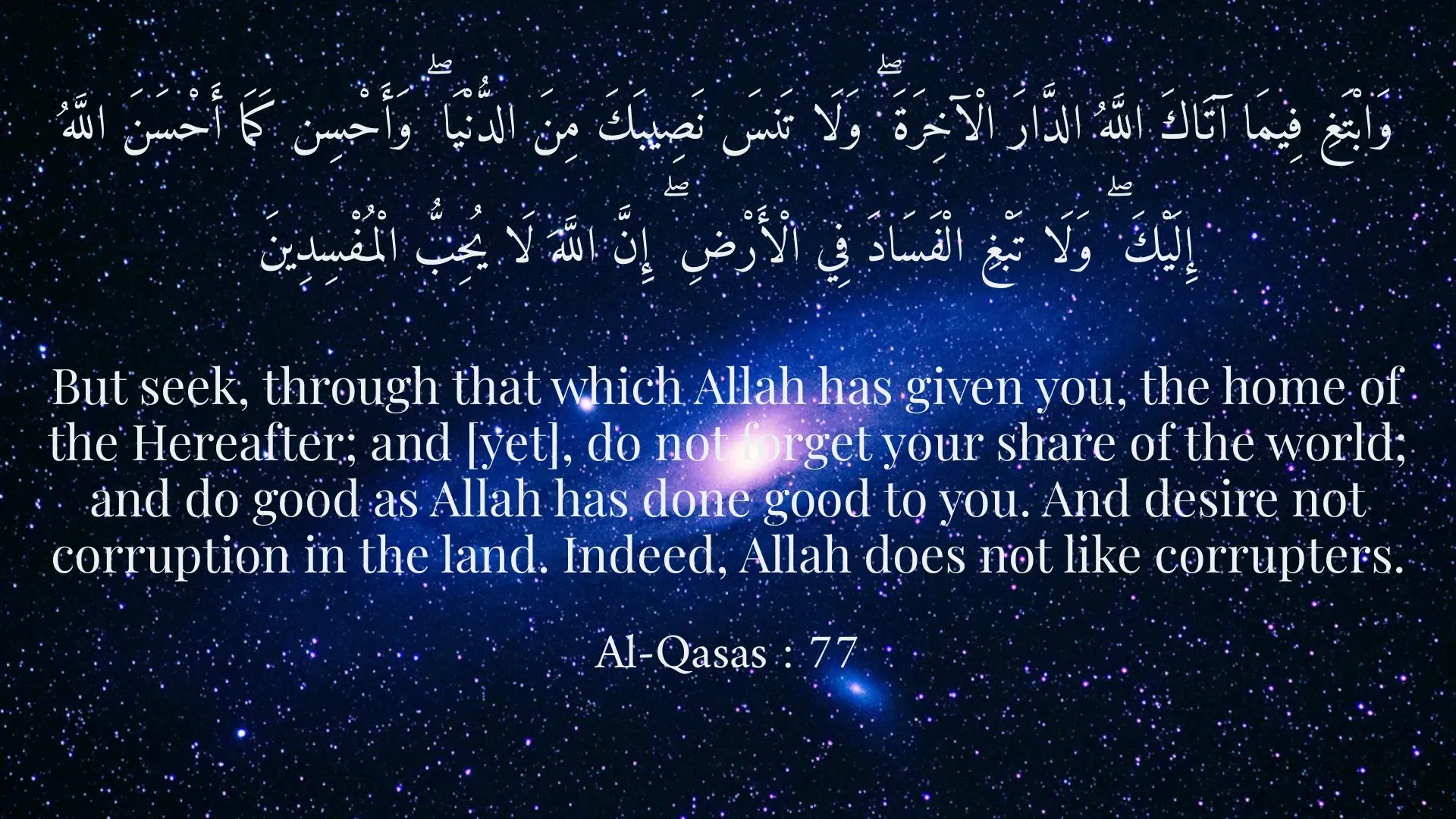
وَابْتَغِ فِيمَا آتَاكَ اللَّهُ الدَّارَ الْآخِرَةَ ۖ وَلَا تَنسَ نَصِيبَكَ مِنَ الدُّنْيَا ۖ وَأَحْسِن كَمَا أَحْسَنَ اللَّهُ إِلَيْكَ ۖ وَلَا تَبْغِ الْفَسَادَ فِي الْأَرْضِ ۖ إِنَّ اللَّهَ لَا يُحِبُّ الْمُفْسِدِينَ
But seek, through that which Allah has given you, the home of the Hereafter; and [yet], do not forget your share of the world; and do good as Allah has done good to you. And desire not corruption in the land. Indeed, Allah does not like corrupters.
Al-Qasas : 77
وَمِنْهُم مَّن يَقُولُ رَبَّنَا آتِنَا فِي الدُّنْيَا حَسَنَةً وَفِي الْآخِرَةِ حَسَنَةً وَقِنَا عَذَابَ النَّارِ
And among them is he who says, 'Our Lord, give us in this world [that which is] good and in the Hereafter [that which is] good and protect us from the punishment of the Fire.'
Al-Baqarah : 201
قُلْ مَنْ حَرَّمَ زِينَةَ اللَّهِ الَّتِي أَخْرَجَ لِعِبَادِهِ وَالطَّيِّبَاتِ مِنَ الرِّزْقِ ۚ قُلْ هِيَ لِلَّذِينَ آمَنُوا فِي الْحَيَاةِ الدُّنْيَا خَالِصَةً يَوْمَ الْقِيَامَةِ ۗ كَذَٰلِكَ نُفَصِّلُ الْآيَاتِ لِقَوْمٍ يَعْلَمُونَ
Say, 'Who has forbidden the adornment of Allah which He has produced for His servants and the good [lawful] things of provision?' Say, 'They are for those who have believed in [this] worldly life [but] exclusively for them on the Day of Resurrection.' Thus do We detail the verses for a people who know.
Al-A'raf : 32
Short Story
They say that in ancient times, there was a wealthy and renowned merchant who possessed abundant riches, yet his heart was always restless, fearing that his wealth might vanish or that he would fall short in his accountability after death. One day, he approached a wise sage, who had insight into the passage of time and worldly affairs, and asked, 'O wise elder, how can I benefit from this world and simultaneously gather provisions for my Hereafter?' The sage smiled and replied, 'O young man, this world is like a bridge you must cross, not a house in which to reside. If you build the bridge well and traverse it easily, you will reach your destination. But if you build a permanent dwelling on the bridge, you will neither find rest yourself nor make the way smooth for others. Consider worldly possessions as tools to achieve noble goals, not the goal itself. Be like a farmer who sows good seeds in this farm (the world) so that at harvest time (the Hereafter), he reaps a bountiful crop. Enjoy it, but never forget the destination, and know that every good deed that springs from you is like a seed that grows in the soil of the Hereafter.' The merchant took the sage's words to heart and understood that with a tranquil heart and an open hand, he should profit from this world for the Hereafter. From then on, instead of merely accumulating, he engaged in charity and good deeds, finding peace in both realms.