Quranic Answer
Understanding the balance between the love for God and the love for humanity is at the core of a fulfilling spiritual life in Islam. These two forms of love are not contradictory; rather, they are complementary and deeply rooted in the teachings of the Holy Quran. The Quran teaches us that love for Allah (SWT) is the foundation and essence of every other form of love, and it must take precedence over all other affections. This love is not merely an emotional sentiment but encompasses obedience, worship, humility, gratitude, and striving to earn divine pleasure in every aspect of life. When a person's heart is overflowing with divine love, this light illuminates all dimensions of their being, influencing how they interact with others. The Holy Quran explicitly states that love for Allah and His Messenger (peace be upon him) must have priority over any other love. In Surah At-Tawbah, verse 24, Allah says: "Say, [O Muhammad], 'If your fathers, your sons, your brothers, your spouses, your relatives, wealth which you have obtained, commerce wherein you fear decline, and dwellings with which you are pleased are more beloved to you than Allah and His Messenger and jihad in His cause, then wait until Allah executes His command. And Allah does not guide the defiantly disobedient people.'" This verse provides a clear criterion for evaluating affections; it does not mean that love for family or wealth is condemned, but rather that these loves should not impede the fulfillment of divine obligations or take precedence over divine commands. Love for God must be so powerful that, in moments of conflicting interests, His will takes precedence over any other desire or inclination. This prioritization benefits not only one's afterlife but also provides peace and correct direction in their worldly life. On the other hand, Islam strongly emphasizes the necessity of love and kindness towards human beings. This love manifests in various forms, including benevolence towards parents, observing the rights of relatives, helping the needy, justice in dealing with all people, compassion towards orphans and the poor, and even kindness to animals. In Surah Al-Isra, verse 23, immediately after commanding the worship of the One God, kindness to parents is enjoined: "And your Lord has decreed that you not worship except Him, and to parents, good treatment. Whether one or both of them reach old age [while] with you, say not to them [so much as], 'uff,' and do not repel them but speak to them a noble word." This unbreakable link between 'Haqq Allah' (rights of God) and 'Haqq al-Nas' (rights of people) demonstrates that love for God, without love for His creation, is incomplete. The Prophet Muhammad (PBUH) said: "Creation is God's family, and the most beloved of people to God is the one who is most beneficial to His family (His creation)." This noble Hadith clearly shows that serving humanity and showing kindness to them is itself a form of worship and an expression of love for God. The true balance is achieved when love for human beings stems not from selfish desires or personal gain, but for the sake of God and to earn His pleasure. This means that if love for a person or a thing distances one from the path of truth and divine command, it must be corrected. However, if love for human beings is in line with divine objectives—meaning we are kind to them to earn divine reward, or help them to alleviate injustice—then this love is not only permissible but highly recommended and rewarded. For instance, love for one's spouse and children, when accompanied by raising them according to divine principles and respecting each other's rights, is a form of worship. Similarly, when a believer views society with a divine perspective, they strive to establish justice, assist the oppressed, and prevent corruption; these are all manifestations of love for God expressed through actions towards humanity. In other words, love for God is like a deep root that nourishes the tree of human existence, and love for human beings constitutes the branches and leaves of this tree, bearing fruits of mercy, justice, and benevolence. Without the root, the branches wither, and without the branches, the tree would be fruitless. Therefore, to achieve balance, it is essential to continuously cultivate divine love in our hearts and manifest it through our actions towards His creation. This approach protects individuals from extremism in both areas; neither does their love for God isolate them from society, nor does their love for society make them forget God. Both are interdependent and pave the way for human perfection. This harmony between the two loves not only provides peace and direction to the individual but also ensures stability in personal and social life, building a society based on love, justice, and mercy. Understanding this reciprocal relationship is the key to achieving balance in a believer's life and opens a path to success and salvation.
Related Verses
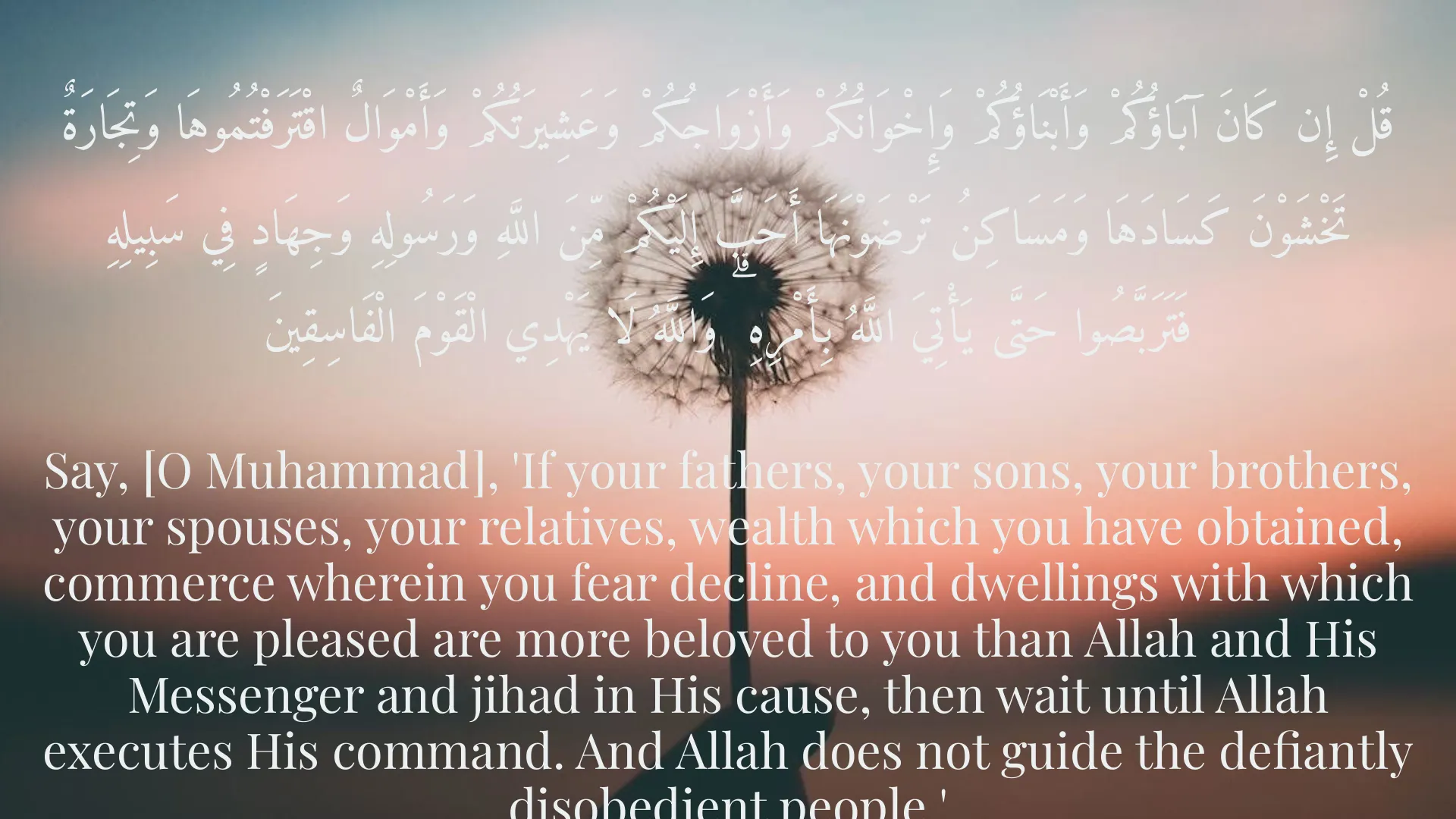
قُلْ إِن كَانَ آبَاؤُكُمْ وَأَبْنَاؤُكُمْ وَإِخْوَانُكُمْ وَأَزْوَاجُكُمْ وَعَشِيرَتُكُمْ وَأَمْوَالٌ اقْتَرَفْتُمُوهَا وَتِجَارَةٌ تَخْشَوْنَ كَسَادَهَا وَمَسَاكِنُ تَرْضَوْنَهَا أَحَبَّ إِلَيْكُمْ مِّنَ اللَّهِ وَرَسُولِهِ وَجِهَادٍ فِي سَبِيلِهِ فَتَرَبَّصُوا حَتَّى يَأْتِيَ اللَّهُ بِأَمْرِهِ ۗ وَاللَّهُ لَا يَهْدِي الْقَوْمَ الْفَاسِقِينَ
Say, [O Muhammad], 'If your fathers, your sons, your brothers, your spouses, your relatives, wealth which you have obtained, commerce wherein you fear decline, and dwellings with which you are pleased are more beloved to you than Allah and His Messenger and jihad in His cause, then wait until Allah executes His command. And Allah does not guide the defiantly disobedient people.'
At-Tawbah : 24
وَقَضَىٰ رَبُّكَ أَلَّا تَعْبُدُوا إِلَّا إِيَّاهُ وَبِالْوَالِدَيْنِ إِحْسَانًا ۚ إِمَّا يَبْلُغَنَّ عِندَكَ الْكِبَرَ أَحَدُهُمَا أَوْ كِلَاهُمَا فَلَا تَقُل لَّهُمَا أُفٍّ وَلَا تَنْهَرْهُمَا وَقُل لَّهُمَا قَوْلًا كَرِيمًا
And your Lord has decreed that you not worship except Him, and to parents, good treatment. Whether one or both of them reach old age [while] with you, say not to them [so much as], 'uff,' and do not repel them but speak to them a noble word.
Al-Isra : 23
وَمِنَ النَّاسِ مَن يَتَّخِذُ مِن دُونِ اللَّهِ أَندَادًا يُحِبُّونَهُمْ كَحُبِّ اللَّهِ ۖ وَالَّذِينَ آمَنُوا أَشَدُّ حُبًّا لِّلَّهِ ۗ وَلَوْ يَرَى الَّذِينَ ظَلَمُوا إِذْ يَرَوْنَ الْعَذَابَ أَنَّ الْقُوَّةَ لِلَّهِ جَمِيعًا وَأَنَّ اللَّهَ شَدِيدُ الْعَذَابِ
And [yet], among the people are those who take other than Allah as equals [to Him]. They love them as they should love Allah. But those who believe are stronger in love for Allah. And if only they who have wronged would consider [that] when they see the punishment, [they would be certain] that all power belongs to Allah and that Allah is severe in punishment.
Al-Baqarah : 165
Short Story
It is narrated that a poor man asked Sheikh Saadi: How is it that kings, with all their pomp and glory, are still not negligent in serving the dervishes and the needy? The Sheikh smiled and said: 'A king whose heart is illuminated by the light of divine love will never neglect his subjects. For he knows that serving creation is precisely the worship of the Creator. If divine love takes root in the heart, the eye of the soul opens to the suffering of others, and the hand of generosity becomes boundless. They attend to the people because they fear God, and they consider this service a path to the Beloved's pleasure. So know that whoever is a friend of God is also good to His servants, for true love is nothing but this.'