Quranic Answer
Raising children with moral concepts is one of the essential and sacred duties of parents in Islam. In the modern world, where distractions and moral ambiguities are prevalent, it is crucial for parents to instill strong moral values in their children. The guidance provided by the Holy Quran emphasizes the importance of proper upbringing, mandating that parents should teach their children not only wisdom but also fundamental moral principles that govern human behavior. The holistic development of a child is achieved when they are equipped with ethical and moral values, which makes it imperative for parents to play an active role in their moral education. The Quran serves as the divine guide for Muslims, providing teachings and stories that emphasize moral integrity and virtuous behavior. One of the poignant reminders in the Quran can be found in Surah Luqman, where a father addresses his son in a manner filled with wisdom and care. This relationship highlights the importance of communication between parents and children in the moral nurturing process. The father in this Surah invites his son to adopt a correct mindset, one that fosters respect for God, ethical values, and righteous conduct. This dynamic clearly illustrates that teaching moral concepts should not be a one-way street; instead, it requires a nurturing dialogue that respects the intelligence and thoughts of children. Furthermore, moral concepts such as honesty, respect, love, kindness, compassion, and justice should be explicitly taught to children from an early age. The foundational years of a child’s life are crucial for character development. During this phase, parents have the opportunity and responsibility to cultivate an environment where these moral values can take root and flourish. For instance, parents can lead by example, providing positive role models in their own behavior. Children observe and imitate their parents, making it essential that parents embody the moral traits they wish to instill. In Surah Al-Isra, verse 31, the Quran warns parents against the grievous act of killing their children out of fear of poverty. This verse encapsulates the idea that parents should not only care for the physical needs of their children but also prioritize moral nurturing. Encouraging love and kindness among siblings is equally important. When children see their parents expressing love and kindness, they are more likely to emulate these behaviors in their interactions with others. Moreover, the Quran is rich with moral stories that serve as invaluable lessons for children. One such compelling tale is that of Prophet Joseph (Yusuf), whose journey is filled with instances of honesty, patience, and integrity. By sharing such stories with children, parents can illustrate the importance of these virtues in the face of adversity. These narratives not only serve as entertainment but also as important moral lessons that guide children in understanding right from wrong. It is equally important to highlight that the responsibility of raising morally upright children does not rest solely on parents. The community and society at large play a critical role in supporting the moral education of children. Schools, religious institutions, and community centers should collaborate with families to promote moral values and provide children with various opportunities to practice them in safe settings. Creating an environment where children can practice moral concepts in real life is essential. This involves providing them with practical scenarios that allow them to express their learnings. For example, parents can encourage their children to participate in community service or charity work, thereby instilling a sense of compassion and responsibility towards those in need. Such activities not only teach children the value of helping others but also reinforce their understanding of empathy and selflessness. Additionally, engaging children in discussions about ethical dilemmas and moral choices can also be beneficial. This encourages critical thinking and reflection, helping children better understand the implications of their actions. Allowing children to voice their opinions on certain moral issues and guiding them in resolving their conflicts can significantly contribute to their moral development. For instance, discussions about fairness in school or how to resolve disputes with friends can help children navigate real-life challenges while adhering to moral principles. Communication is another vital framework within which moral education can thrive. Fathers and mothers should establish open lines of communication with their children, creating a safe space where they can express their thoughts and feelings freely. This also entails active listening, where parents genuinely consider and validate their children’s concerns and emotions. By doing so, children feel valued and understood, fostering a sense of trust and respect. This trust, in turn, enhances the parent-child relationship, making it easier for parents to impart essential moral teachings. To sum up, the journey of raising children imbued with moral concepts is one that requires intentional effort, love, and consistency. It is not merely about transmitting information but rather about creating a nurturing environment that fosters values through both teaching and practice. Ultimately, instilling a strong moral foundation in children is a collective endeavor that involves parents, the immediate family, educational institutions, and the broader community. The nurturing of children with moral concepts prepares them not only to be good individuals but also responsible and compassionate citizens who contribute positively to society. Therefore, the role of parents as moral educators adjoined with the teachings of the Quran is paramount and should never be undermined in the quest to raise dignified and principled individuals.
Related Verses
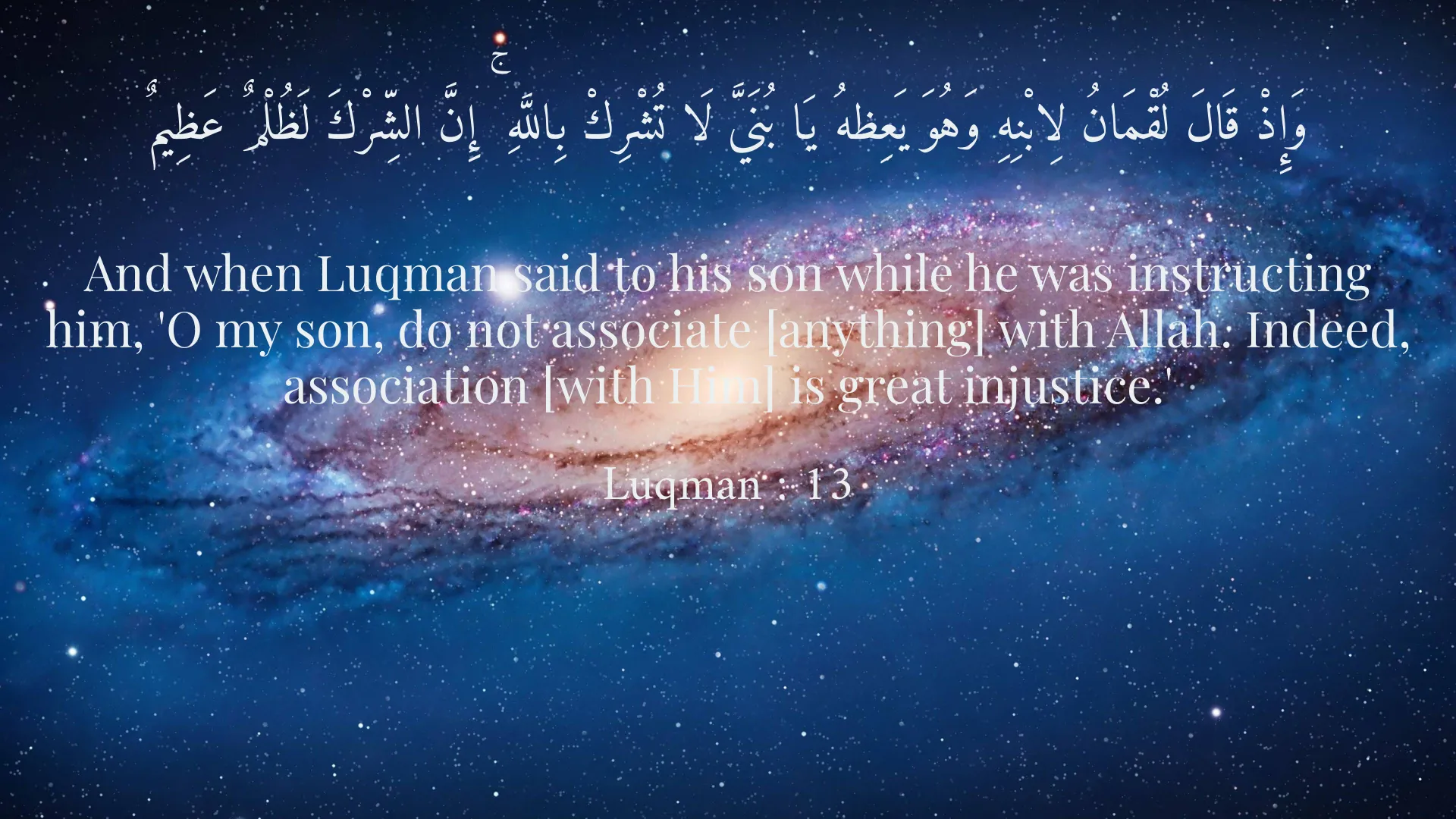
وَإِذْ قَالَ لُقْمَانُ لِابْنِهِ وَهُوَ يَعِظهُ يَا بُنَيَّ لَا تُشْرِكْ بِاللَّهِ ۚ إِنَّ الشِّرْكَ لَظُلْمٌ عَظِيمٌ
And when Luqman said to his son while he was instructing him, 'O my son, do not associate [anything] with Allah. Indeed, association [with Him] is great injustice.'
Luqman : 13
وَلا تَقْتُلُوا أَولَادَكُمْ خَشْيَةَ إِمْلاقٍ ۚ نَحْنُ نَرْزُقُهُمْ وَإِيَّاكُمْ ۚ إِنَّ قَتْلَهُمْ كَانَ خِطَئًا كَبِيرً
And do not kill your children for fear of poverty. We provide for them and for you. Indeed, killing them is a great sin.
Al-Isra : 31
Short Story
Once upon a time, there was a father and son who lived lovingly together. The father always reminded his son to be truthful and help others in every situation. Gradually, the son noticed that love and compassion in the home brought peace and happiness. This positive behavior made him a role model for his friends.