Quranic Answer
In the sublime teachings of the Holy Quran, one of the key concepts repeatedly emphasized is that truth (Haqq) is independent of the number of its followers or supporters. In other words, being alone or being in the minority never signifies that the path one is treading is wrong; rather, it can often be a sign of its purity and correctness. The Quran repeatedly warns us against following the majority of people, stating that many humans deviate from the path of truth unknowingly, due to following their desires, ancestral traditions, or worldly allurements. This is a fundamental principle: truth derives its criteria from a divine source, not from collective opinion or popular vote. Although companionship and solidarity on the path of truth provide strength and encouragement, their absence should by no means lead to doubt about the path itself. The history of prophets and divine saints is full of instances where they persevered in truth and righteousness despite having few followers, or even being in absolute solitude. Prophet Noah (peace be upon him), for instance, invited his people to monotheism for over nine hundred years, and ultimately, only a small number believed in him. He faced mockery and ridicule from his people throughout his mission, yet he never deviated from the path of truth and fulfilled his divine mandate. Building the ark on dry land, amidst the scoffing of the people, epitomizes the ultimate trust and steadfastness of a solitary believer on the path of truth. Similarly, Prophet Abraham (peace be upon him) stood alone against the idolatry and ignorance of his community and proclaimed the message of monotheism by destroying their idols. He was indeed a 'nation unto himself' (Ummah), because his heart and soul were filled with truth and monotheism, even if no one accompanied him. These stories teach us that truth sometimes gets lost amidst the clamor of falsehood, and only those endowed with divine insight are capable of recognizing and adhering to it. The Quran, in numerous verses, refers to the fact that truth-seekers and true believers might find themselves in the minority. For instance, in Surah Al-An'am (6:116), it states: “And if you obey most of those on earth, they will mislead you from the way of Allah.” This verse explicitly shows that the criterion for truth is not the majority, and indeed, the majority of people might be astray from the straight path. Similarly, in Surah Al-A'raf (7:187), it states: “...but most of the people do not know.” These are warnings from Allah for us to seek the signs of truth in the Divine Book and the Sunnah of the Messenger, instead of blindly following the prevailing trend. Steadfastness on the path of truth, even in solitude, requires immense patience, certainty, and reliance on Allah. This path does not indicate weakness; rather, it proves the depth of one's faith and the firmness of one's resolve. A true believer is one who considers Allah’s satisfaction and divine logic as the criterion for truth, not popular approval or likes. Sometimes, the test of faith lies precisely in this point: an individual must choose between the comfort of conforming with the majority and the hardship of standing firm on the path of truth (which might entail isolation). In such circumstances, the Quran reminds us that Allah is always with the patient and those who rely on Him. The feeling of loneliness on this path can transform into a driving force for deepening one's connection with Allah and relying on His inexhaustible power. This apparent solitude is, in reality, a profound communion with truth and the Lord, which makes a person stronger and more resilient. Ultimately, the mission of a believer is not to amass a maximum number of followers, but to persevere on the path of truth, propagate it in the best possible way, and act upon it with all their being, even if this path places them among a minority rejected by society. This is the path of the prophets and the truthful ones, who always preferred truth over desires and never succumbed to the pressures and temptations of their times. Therefore, being alone on the path of truth is not a sign that the path is wrong; rather, it is a testament to independent judgment, spiritual courage, and the authenticity of a path that originates from the inexhaustible divine source.
Related Verses
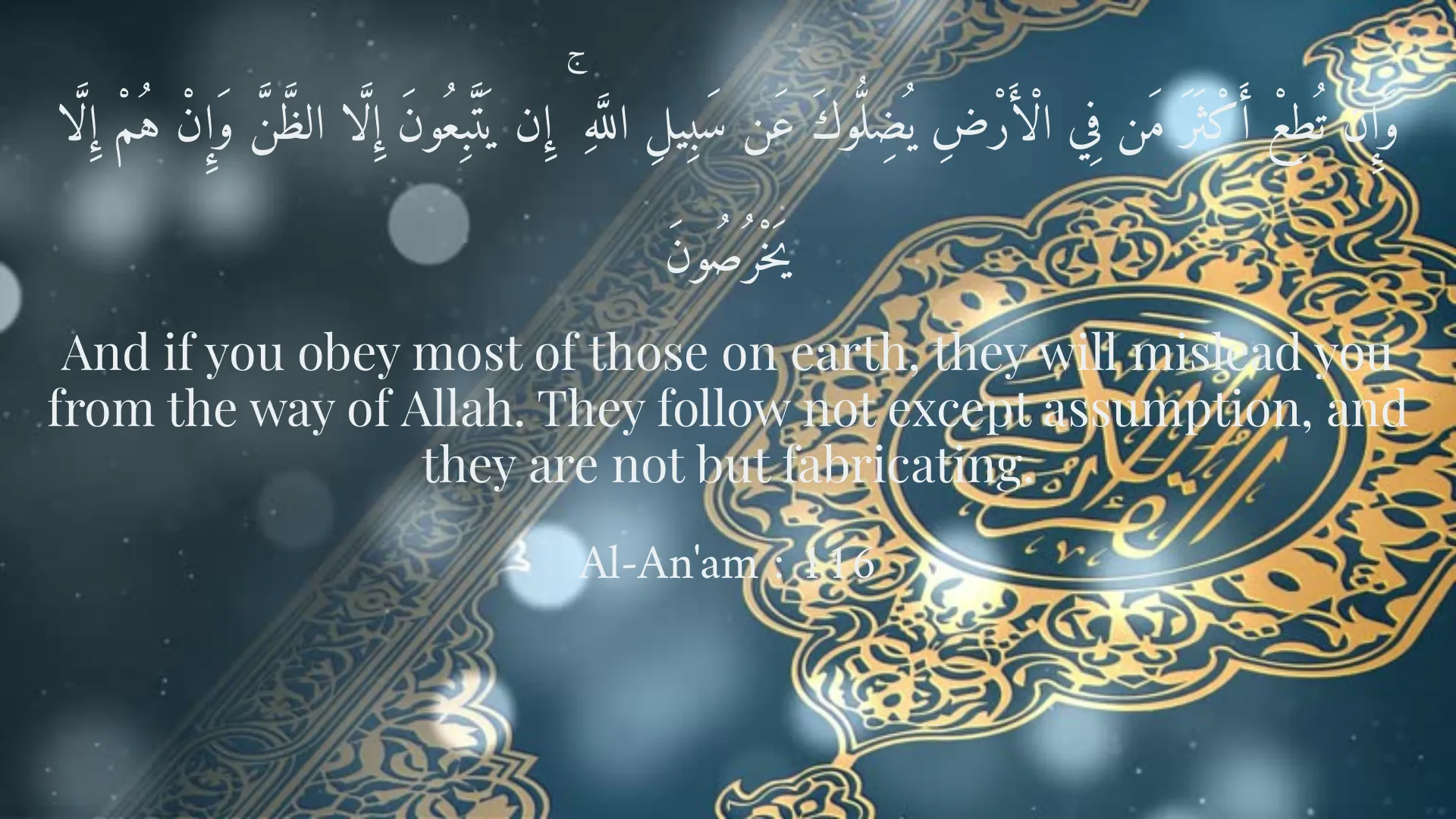
وَإِن تُطِعْ أَكْثَرَ مَن فِي الْأَرْضِ يُضِلُّوكَ عَن سَبِيلِ اللَّهِ ۚ إِن يَتَّبِعُونَ إِلَّا الظَّنَّ وَإِنْ هُمْ إِلَّا يَخْرُصُونَ
And if you obey most of those on earth, they will mislead you from the way of Allah. They follow not except assumption, and they are not but fabricating.
Al-An'am : 116
فَقَالَ الْمَلَأُ الَّذِينَ كَفَرُوا مِن قَوْمِهِ مَا نَرَاكَ إِلَّا بَشَرًا مِّثْلَنَا وَمَا نَرَاكَ اتَّبَعَكَ إِلَّا الَّذِينَ هُمْ أَرَاذِلُنَا بَادِيَ الرَّأْيِ وَمَا نَرَىٰ لَكُمْ عَلَيْنَا مِن فَضْلٍ بَلْ نَظُنُّكُمْ كَاذِبِينَ
So the eminent among those who disbelieved from his people said, "We do not see you but as a man like ourselves, and we do not see any follow you except the lowest among us, at first glance. And we do not see in you any superiority over us; rather, we think you are liars."
Hud : 27
قَالَ لَقَدْ ظَلَمَكَ بِسُؤَالِ نَعْجَتِكَ إِلَىٰ نِعَاجِهِ ۖ وَإِنَّ كَثِيرًا مِّنَ الْخُلَطَاءِ لَيَبْغِي بَعْضُهُمْ عَلَىٰ بَعْضٍ إِلَّا الَّذِينَ آمَنُوا وَعَمِلُوا الصَّالِحَاتِ وَقَلِيلٌ مَّا هُمْ ۗ وَظَنَّ دَاوُودُ أَنَّمَا فَتَنَّاهُ فَاسْتَغْفَرَ رَبَّهُ وَخَرَّ رَاكِعًا وَأَنَابَ ۩
He said, "He has certainly wronged you in demanding your ewe [to add] to his ewes. And indeed, many partners oppress one another, except for those who believe and do righteous deeds – and few are they." And David became certain that We had tried him, and he asked forgiveness of his Lord and fell down bowing [in prostration] and turned in repentance.
Sad : 24
Short Story
In Saadi's Gulistan, it is said: "One has a friend and another an enemy, and whoever is with truth, is an enemy to falsehood." One day, a wise man was walking through a crowded and bustling bazaar. He saw that everyone was running in one direction, following each other without any thought. The wise man stopped and looked around, asking his own wisdom: "Is the right path necessarily the one everyone takes?" At that moment, the advice of an old, sagacious man came to his mind, who used to say: "Many a time, there might be a well on the path, and a flock inevitably falls into it." So, the wise man changed his route and, instead of following the crowd, thoughtfully and insightfully chose another path, one less traveled. He knew that on the path of truth, sometimes solitude is better than accompanying a crowd whose destination is error and whose end is misguidedness. He listened to the call of his heart and mind, and with reliance on the One Lord, he took a path that, though less trodden, he knew would lead to righteousness and truth. This is how sometimes, being alone on the path of truth is itself a sign of courage and correctness of choice, not an error.