Quranic Answer
The concept of 'intuitive knowledge' or 'inner witnessing' (Ma'rifah Shuhudi), a term widely used in post-Quranic mystical and philosophical traditions, refers to a deep, direct, and non-sensory apprehension of the truths of existence and God. While the Holy Quran does not explicitly use the exact compound term 'Ma'rifah Shuhudi,' it unequivocally presents the foundations, allusions, and pathways for attaining such knowledge, which form the very essence of this type of gnosis. Instead of employing philosophical terminology, the Quran emphasizes concepts that lead to a direct and profound inner experience of truth. One of the most significant of these concepts is contemplation and reflection upon God's 'Ayat' (Signs). These divine signs encompass God's manifestations in the cosmos (Afaq) and within the human self (Anfus). In numerous verses, Allah invites humanity to ponder the creation of the heavens and the earth, the alternation of night and day, the movement of ships, the descent of rain, and the diverse forms of living beings. Through such contemplation, individuals are encouraged to recognize the Creator's grandeur, power, and wisdom. This type of reflection is not merely a dry intellectual process; rather, it is an invitation to a deeper insight that can culminate in spiritual witnessing and a presential knowledge of God. The 'heart' (Qalb) in the Quranic perspective is not merely a physical organ but the locus of understanding and apprehending truths. The Quran speaks of 'hearts with which they understand' (Surah Al-Hajj: 46), indicating that true insight emanates from the heart, not solely from physical vision. By purifying the self (Tazkiyah) and cleansing the inner being, a person can remove the veils of heedlessness from their heart and perceive the Divine Light. This is precisely the path that leads to the opening of the gateways of intuitive knowledge. In Surah An-Nur, Allah describes Himself as 'the Light of the heavens and the earth' and states that this Light is bestowed upon those who are worthy. This Divine Light is none other than deep insight and understanding that can lead to the witnessing of ultimate realities. Furthermore, Taqwa (God-consciousness and piety) plays a pivotal role in unlocking the doors to intuitive knowledge. The Quran states: 'And fear Allah, and Allah teaches you' (Surah Al-Baqarah: 282). This divine teaching is not limited to instruction through books or teachers but also encompasses direct divine guidance and spiritual inspirations. Additionally, the verse 'O you who have believed, if you fear Allah, He will grant you a criterion [to judge between right and wrong]' (Surah Al-Anfal: 29) indicates that practicing Taqwa leads to 'Furqan,' a faculty of discernment. This Furqan is a form of inner insight that enables individuals to navigate life's complexities, find the right path, and comprehend truths as they genuinely are. Another prominent example of intuitive knowledge in the Quran is the story of Prophet Musa (Moses) and Khidr (Al-Khidr). In Surah Al-Kahf, Khidr tells Musa that he possesses 'knowledge from Us' (Ilm Ladunni) of which Musa is unaware (Surah Al-Kahf: 65). This Ilm Ladunni is knowledge directly bestowed by God, without any apparent intermediaries, upon a special servant. This type of knowledge differs fundamentally from acquired knowledge and bears a strong resemblance to intuitive or experiential knowledge, as Khidr acted upon it by perceiving truths and performing actions that appeared illogical to conventional understanding, yet held profound inner wisdom. Therefore, it can be concluded that although the exact term 'Ma'rifah Shuhudi' is not directly mentioned in the Quran, its underlying concept and the pathways to its attainment are thoroughly described within the Quran. This form of knowledge is a result of divine piety, self-purification, contemplation of both cosmic and inner signs, and ultimately, the grace and mercy of Allah, which illuminates the believer's heart with the light of insight, revealing truths to them. This is an active journey that requires continuous effort and striving in devotion to God. This knowledge helps individuals gain an understanding beyond mere appearances and access the depths of universal truths, often termed in Islamic mysticism as 'seeing with the eye of the heart.'
Related Verses
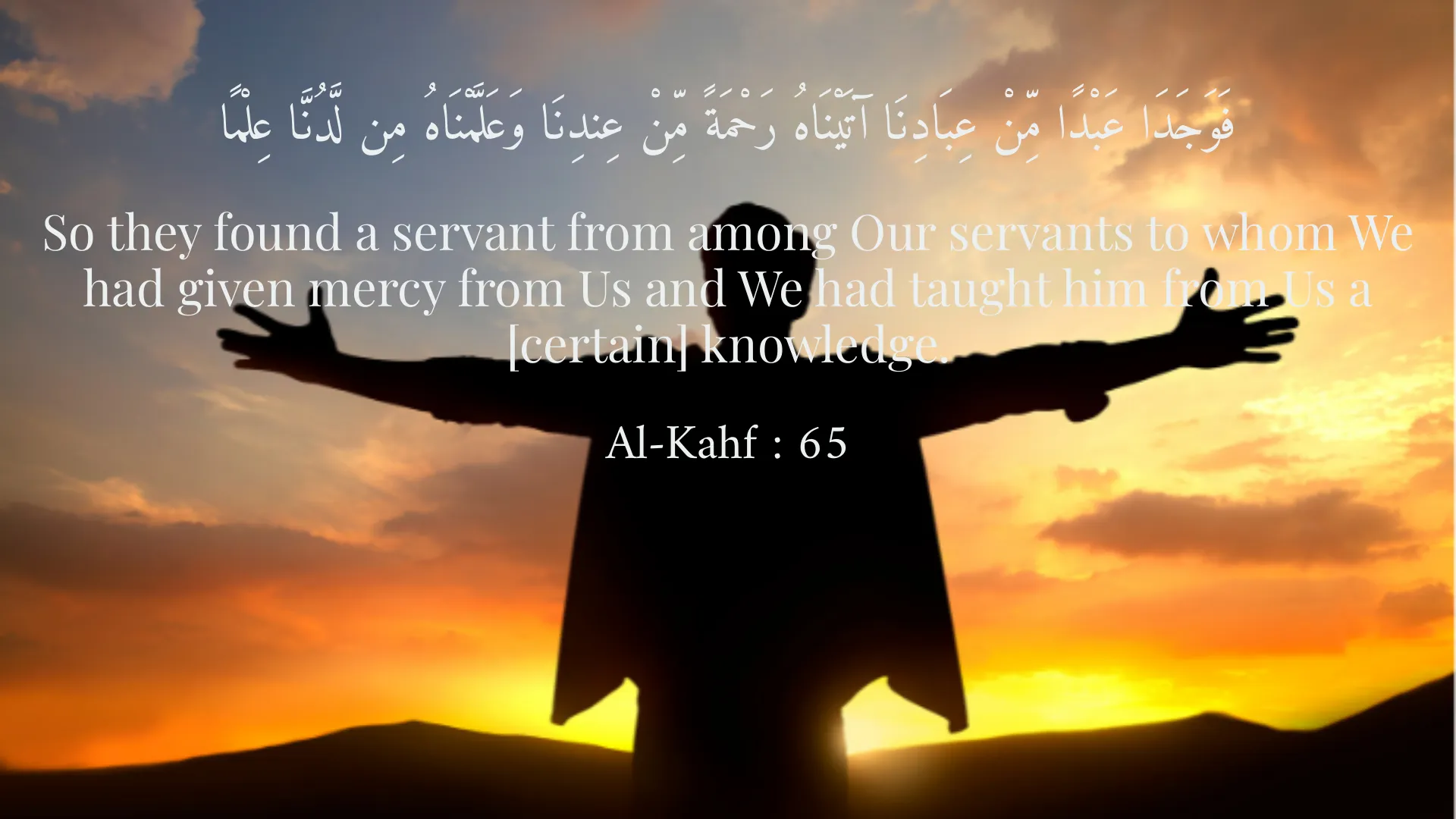
فَوَجَدَا عَبْدًا مِّنْ عِبَادِنَا آتَيْنَاهُ رَحْمَةً مِّنْ عِندِنَا وَعَلَّمْنَاهُ مِن لَّدُنَّا عِلْمًا
So they found a servant from among Our servants to whom We had given mercy from Us and We had taught him from Us a [certain] knowledge.
Al-Kahf : 65
أَفَلَمْ يَسِيرُوا فِي الْأَرْضِ فَتَكُونَ لَهُمْ قُلُوبٌ يَعْقِلُونَ بِهَا أَوْ آذَانٌ يَسْمَعُونَ بِهَا ۖ فَإِنَّهَا لَا تَعْمَى الْأَبْصَارُ وَلَٰكِن تَعْمَى الْقُلُوبُ الَّتِي فِي الصُّدُورِ
Have they not traveled through the earth, and have they hearts by which to reason and ears by which to hear? For indeed, it is not eyes that are blinded, but blinded are the hearts which are within the breasts.
Al-Hajj : 46
اللَّهُ نُورُ السَّمَاوَاتِ وَالْأَرْضِ ۚ مَثَلُ نُورِهِ كَمِشْكَاةٍ فِيهَا مِصْبَاحٌ ۖ الْمِصْبَاحُ فِي زُجَاجَةٍ ۖ الزُّجَاجَةُ كَأَنَّهَا كَوْكَبٌ دُرِّيٌّ يُوقَدُ مِن شَجَرَةٍ مُّبَارَكَةٍ زَيْتُونَةٍ لَّا شَرْقِيَّةٍ وَلَا غَرْبِيَّةٍ يَكَادُ زَيْتُهَا يُضِيءُ وَلَوْ لَمْ تَمْسَسْهُ نَارٌ ۚ نُّورٌ عَلَىٰ نُورٍ ۗ يَهْدِي اللَّهُ لِنُورِهِ مَن يَشَاءُ ۚ وَيَضْرِبُ اللَّهُ الْأَمْثَالَ لِلنَّاسِ ۗ وَاللَّهُ بِكُلِّ شَيْءٍ عَلِيمٌ
Allah is the Light of the heavens and the earth. The example of His light is like a niche within which is a lamp, the lamp is within [a casing of] glass, the glass as if it were a brilliant star, lit from [the oil of] a blessed olive tree, neither of the east nor of the west, whose oil would almost illuminate even if no fire touched it. Light upon light. Allah guides to His light whom He wills. And Allah presents examples for the people, and Allah is Knowing of all things.
An-Nur : 35
يَا أَيُّهَا الَّذِينَ آمَنُوا إِن تَتَّقُوا اللَّهَ يَجْعَل لَّكُمْ فُرْقَانًا وَيُكَفِّرْ عَنكُمْ سَيِّئَاتِكُمْ وَيَغْفِرْ لَكُمْ ۗ وَاللَّهُ ذُو الْفَضْلِ الْعَظِيمِ
O you who have believed, if you fear Allah, He will grant you a criterion [to judge between right and wrong] and remove from you your evil deeds and forgive you. And Allah is the possessor of great bounty.
Al-Anfal : 29
Short Story
It is said that in ancient times, there lived a recluse ascetic who spent his life seeking knowledge, reading countless books. But the more he knew, the thirstier he became, finding no peace in his heart. One day, he met a wise old man and asked, 'O Sage, for years I have sought gnosis, yet the eye of my heart remains blind. What is the secret?' The old man, with a gentle smile, replied, 'O noble youth, true knowledge is inscribed not on the pages of books, but on the tablet of a pure heart. Have you gazed upon the star-filled sky and the lush green plains? Have you pondered the mysteries of your own soul? God has placed His signs in every atom so that the eye of the heart may see. Go, cleanse your heart of the dust of the world, embrace piety, and look deeply into creation. Then you will see that innate knowledge and intuitive gnosis, like a light from the unseen, will shine upon your heart, and hidden secrets will be revealed to you. Just as a tree, without a gardener's effort, receives light and bears fruit, so too will the heart, once purified, directly attain truth.' The ascetic took the elder's advice to heart and, from then on, focused on increasing his sincerity and piety rather than merely adding to his books. After a while, he found that the veils before his eyes had lifted, and he began to perceive truths that he could not grasp through mere intellect and logic before, and his heart became filled with tranquility.