Quranic Answer
In response to the question of whether it is always possible to abandon bad habits, from the perspective of the Holy Quran and Islamic teachings, the unequivocal answer is yes. However, this 'possibility' is contingent upon certain conditions and diligent effort. The Holy Quran emphasizes the boundless capacity of human beings for change, repentance (Tawbah), self-purification, and attaining perfection. Although the path to abandoning bad habits can be difficult and challenging, it is never a dead end. Divine grace and guidance are always available for those who sincerely strive. Indeed, one of the most fundamental concepts in Islam is 'Tawbah,' which means returning from sin and error towards God. This concept also encompasses abandoning undesirable habits and behaviors. Allah repeatedly emphasizes His vast mercy in the Quran and invites His servants to repent and return. This invitation, in itself, indicates that change and liberation from the shackles of bad habits are possible. Surah At-Tahrim (66:8) states: “O you who have believed, repent to Allah with sincere repentance.” This verse not only affirms the possibility of repentance but also presents it as an achievable endeavor for believers, even specifying the quality of repentance (nasuha, meaning sincere and irreversible), which indicates the importance of perseverance in abandoning the habit. The Holy Quran also stresses human responsibility and the role of one's will in effecting change. Verse 11 of Surah Ar-Ra'd clearly states: “Indeed, Allah will not change the condition of a people until they change what is in themselves.” This pivotal verse lays the foundation for the possibility of change on human will and effort. Bad habits are considered part of “what is within ourselves” that must be altered through conscious decision, determination, and diligent effort. Therefore, if someone has a sincere intention and demonstrates initiative for change, divine grace will encompass them, and the path will be smoothed. This means that abandoning a bad habit is not merely confined to an instantaneous will but requires a continuous and serious process that begins with intention and continues with steadfastness. Another related concept is 'Jihad al-Nafs,' which is the inner struggle of a human being against their egoistic desires and inclinations, often manifesting as bad habits. The Holy Quran promises guidance to those who strive in the way of Allah. Verse 69 of Surah Al-Ankabut states: “And those who strive for Us - We will surely guide them to Our ways. And indeed, Allah is with the doers of good.” This verse clearly indicates that if a person sincerely strives to overcome their bad habits, considering this effort as part of Jihad for the sake of Allah, then Allah will assist and guide them on this path. This assistance can come in the form of creating favorable conditions, inspiring the heart, increasing patience and perseverance, or even through the help of others. This concept offers great hope to individuals who feel trapped by bad habits and see no way out. The Quran says that a way out exists, provided you take the first step and remain steadfast on this path. Furthermore, 'patience' (Sabr) and 'prayer' (Salat) are introduced as two powerful tools in overcoming difficulties and changing habits. Verse 153 of Surah Al-Baqarah states: “O you who have believed, seek help through patience and prayer. Indeed, Allah is with the patient.” Abandoning bad habits requires immense patience: patience in the face of temptations, patience in enduring the difficulties of quitting, and patience for the time required to solidify the change. Prayer, as the pillar of religion, strengthens one's connection with Allah, brings tranquility to the soul, and empowers the will. These two, together, form a strong support for anyone who intends to free themselves from the bondage of negative habits. Prayer reminds a person that they are not alone and that there is an ultimate power that can support them, and patience gives them the ability to resist pressures. Ultimately, the Holy Quran teaches us that no human being is so immersed in sin and bad habits that the path of return and salvation is closed to them. Even for Pharaoh, with all his defiance, the door of repentance was open if he had wished. This demonstrates the vastness of Allah's mercy and justice. Therefore, yes, abandoning bad habits is always possible; provided that the individual genuinely desires it, makes a pure intention, puts forth persistent and continuous effort, seeks help from Allah, and remains patient on this path. This journey is not completed overnight but requires steadfastness, continuous self-reflection, and reliance on the Lord. Every step taken towards abandoning a habit will be met with divine grace and reward, and with every sincere effort, the doors of mercy will open further. This Quranic perspective is a highly hopeful and empowering approach that enables every individual to change their life towards the best, no matter what stage they are in, and to become a better version of themselves. The ability to change and transcend is one of Allah's great gifts to humanity.
Related Verses
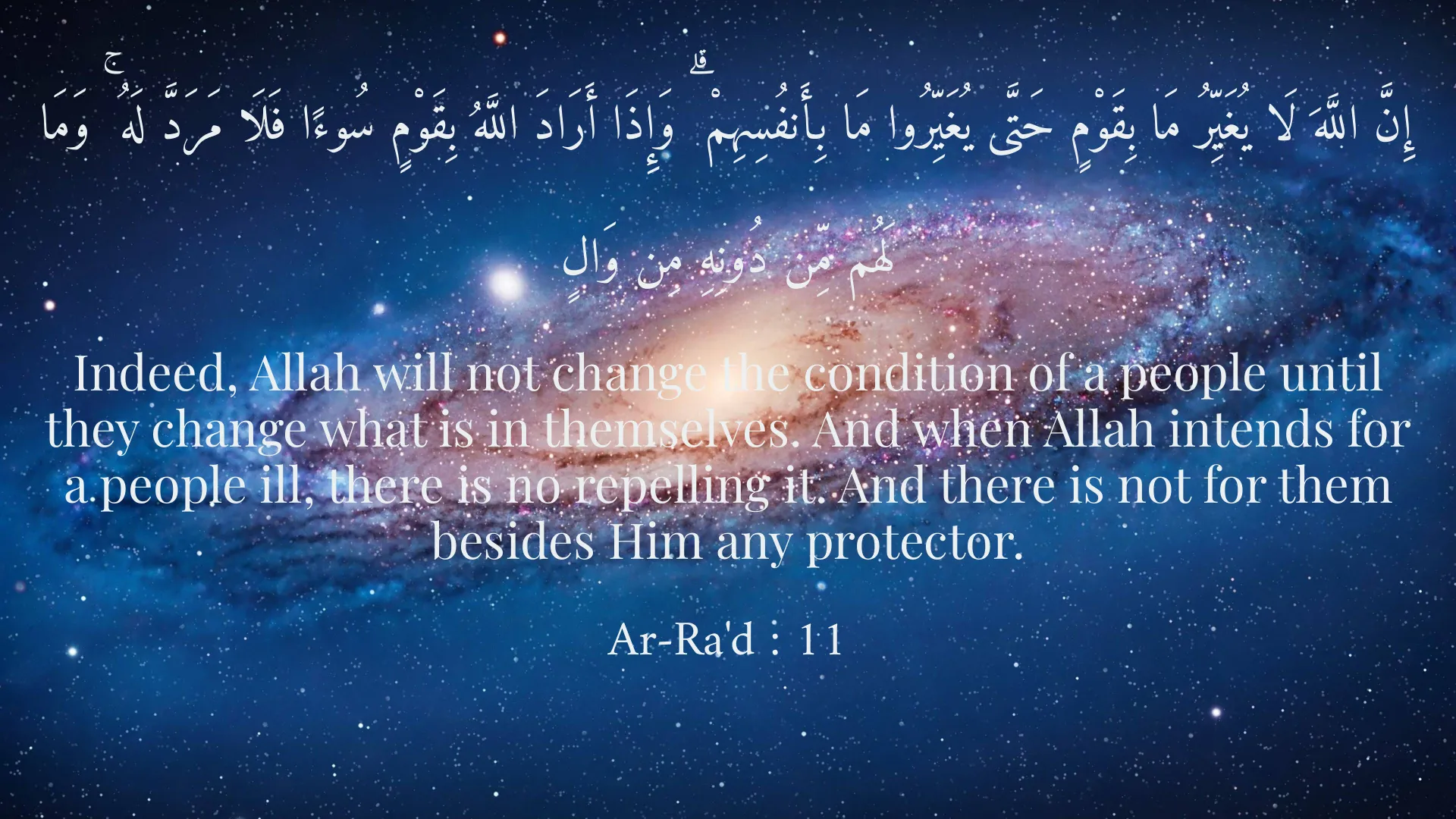
إِنَّ اللَّهَ لَا یُغَیِّرُ مَا بِقَوْمٍ حَتَّى یُغَیِّرُوا مَا بِأَنفُسِهِمْ ۗ وَإِذَا أَرَادَ اللَّهُ بِقَوْمٍ سُوءًا فَلَا مَرَدَّ لَهُ ۚ وَمَا لَهُم مِّن دُونِهِ مِن وَالٍ
Indeed, Allah will not change the condition of a people until they change what is in themselves. And when Allah intends for a people ill, there is no repelling it. And there is not for them besides Him any protector.
Ar-Ra'd : 11
یَا أَیُّهَا الَّذِینَ آمَنُوا تُوبُوا إِلَى اللَّهِ تَوْبَةً نَّصُوحًا عَسَى رَبُّکُمْ أَن یُکَفِّرَ عَنکُمْ سَیِّئَاتِکُمْ وَیُدْخِلَکُمْ جَنَّاتٍ تَجْرِی مِن تَحْتِهَا الْأَنْهَارُ یَوْمَ لَا یُخْزِی اللَّهُ النَّبِیَّ وَالَّذِینَ آمَنُوا مَعَهُ ۖ نُورُهُمْ یَسْعَى بَیْنَ أَیْدِیهِمْ وَبِأَیْمَانِهِمْ یَقُولُونَ رَبَّنَا أَتْمِمْ لَنَا نُورَنَا وَاغْفِرْ لَنَا ۖ إِنَّکَ عَلَى کُلِّ شَیْءٍ قَدِیرٌ
O you who have believed, repent to Allah with sincere repentance. Perhaps your Lord will remove from you your misdeeds and admit you into Gardens beneath which rivers flow [on] the Day when Allah will not disgrace the Prophet and those who believed with him. Their light will proceed before them and on their right; they will say, "Our Lord, perfect for us our light and forgive us. Indeed, You are over all things competent."
At-Tahrim : 8
وَالَّذِينَ جَاهَدُوا فِينَا لَنَهْدِيَنَّهُمْ سُبُلَنَا ۚ وَإِنَّ اللَّهَ لَمَعَ الْمُحْسِنِينَ
And those who strive for Us - We will surely guide them to Our ways. And indeed, Allah is with the doers of good.
Al-Ankabut : 69
Short Story
In Sa'di's Gulistan, it is narrated that a king had an unpleasant habit: every morning, he would begin his day and sour the mood of his courtiers with harsh and aggressive words. A wise man from the king's inner circle, through a clever strategy, sought to free him from this habit. One day, he asked the king's permission to tell a story. He said, 'O King, I have heard that in a city, there was a merchant who, upon waking every morning, would first, in the manner of the righteous, praise God and then, with a cheerful countenance, interact with his family and work. By virtue of this good disposition, his sustenance was abundant, and his affairs were always blessed.' The king, listening attentively, saw himself in the wise man's words. The wise man continued: 'And I have heard that there was another merchant who woke up every morning with anger and ill-temper, complaining. This bad habit stripped him of his wealth and reputation.' The king realized his flaw and asked the scholar, 'What is the remedy?' The wise man replied, 'O King, purify your heart from malice and accustom your tongue to gentleness, for habit is second nature. Every morning, before you utter a single word, take a deep breath, reflect on the Creator's greatness, and intend that today you will speak nothing but good words.' The king accepted this advice and, through self-discipline and perseverance, gradually abandoned his bad habit, and his tongue became accustomed to gentleness and good speech. After some time, people in the court remarked, 'This is not the same king as before; it is as if God has created him anew.' And thus, the king became known for his good disposition, and his life became sweet with the blessings of his pleasant words. This story illustrates that with sincere intention and continuous effort, even the most deeply rooted bad habits can be changed, and life can be made better.