Quranic Answer
### The Importance of Respecting Parents in Islam Respecting parents is a foundational teaching in Islam that permeates various aspects of a Muslim's life. The emphasis on the respect and kindness toward one's parents is clearly outlined in the Holy Quran. Islamic teachings place a vital importance on the family structure, and the reverence afforded to parents is a reflection of a person's character and moral standing in society. This article delves into the profound significance of respecting parents within the framework of Islamic teachings and how these virtues contribute to strong familial bonds, community cohesion, and societal harmony. #### Central Teachings in the Quran The significance of respecting parents is predominantly highlighted in numerous verses of the Quran. Among the key references is Surah Al-Isra, verse 23, where Allah states, "And your Lord has decreed that you not worship except Him, and to parents, good treatment." This verse elucidates two fundamental aspects of life: the worship of Allah and the treatment of parents. The verse underscores that honoring one’s parents is a commandment that holds equal weight to the worship of Allah. The emphasis on 'good treatment' transcends mere obedience; it is about fostering an environment of compassion, understanding, and dignity. Moreover, the verse continues to outline how children should behave if their parents reach old age. It states that even in such circumstances, children should treat their parents with utmost respect and avoid any form of derogatory remarks, including the utterance of 'uff,' a term used to express annoyance. This demonstrates that respect is not only a moral obligation but also a manifestation of gratitude for the sacrifices and efforts parents make throughout their lives. Similarly, in Surah Luqman, verse 14, it is emphasized that a person must show gratitude to their parents, even during times of disagreement or differing opinions. It highlights the idea that respect does not depend on conformity of beliefs or values but rather on a profound sense of duty and love that every child should have for their parents. It teaches that mutual respect, even in divergence, is vital for maintaining familial harmony. #### The Attributes of Respect The teachings regarding parents serve as a guide in fostering respect and understanding within families. In Islam, respect is reflected in various behaviors: acknowledging their opinions, listening to their advice, and approaching disagreements with humility. Respecting one's parents also includes maintaining a tone of kindness in conversations and actions, even when there are differences in views. This aligns with the broader Islamic principle of 'Ikhlas,' which emphasizes sincerity and the importance of good intentions. Additionally, the concept of respect extends beyond simple obedience; it embodies a deep appreciation for the sacrifices parents make and recognizes their pivotal role in education and moral upbringing. Islamic culture places significant importance on familial ties, and thus, the respect shown to parents reverberates through the clan and ultimately influences communal relationships. #### Parental Rights in Islamic Philosophy Islamic teachings further emphasize the concept of parental rights. In traditions and hadith literature, it is often narrated that the Prophet Muhammad (peace be upon him) had immense respect for his mother, highlighting the need to honor and obey her, simultaneously raising awareness of women's roles in upbringing. His life serves as a reminder that the responsibility of loving and supporting parents is a shared burden that extends through generations. Furthermore, numerous hadiths outline specific actions that reflect respect and kindness toward parents. These include speaking to them softly, never raising one’s voice, and ensuring their comfort, especially in old age. The adage, "He is not among us who does not honor his parents" from the Prophet Muhammad (peace be upon him) is a resounding call to action for all Muslims to integrate the respect of parents into their daily lives, regardless of their personal circumstances. #### The Impact of Disrespect and Its Consequences The consequences of failing to respect parents can ripple through society, causing strain not only in personal relations but also creating a foundation for broader societal issues. Disrespectful behavior towards parents is regarded as sinful in Islam; it is seen as a sign of moral decay and a potential path to larger societal disruptions. When children disregard parental authority, they disrupt the natural order of familial structure and inadvertently foster a culture of disrespect that extends to other relationships, such as with elders, authority figures, and community members. This loss of respect can lead to a breakdown of communication, understanding, and trust within families, ultimately fostering a cycle of conflict that could manifest in future generations. The Quran warns that such behavior can have dire consequences, not just in the afterlife but also in this world, affecting a child's own prosperity and happiness. #### The Role of Muslim Communities Given the Islamically mandated respect for parents, Muslim communities often play a significant role in nurturing and promoting this value among families. Many community programs aim to raise awareness on the importance of familial bonds and parental respect as pillars for a stable society. Workshops, lectures, and gatherings are frequently organized within mosque centers to discuss this topic and reinforce the teachings of Islam around honoring one's parents. Faith leaders often encourage the younger generation to actively participate in caring for their parents as a way of giving back to them for the sacrifices made during childhood. Such initiatives work to develop a community-wide ethos of respect and compassion that benefits everyone. #### Conclusion In summary, respecting parents is one of the most crucial teachings in Islam reinforced in the Quran and exemplified through the life of our beloved Prophet Muhammad (peace be upon him). The emphasis on parental respect illustrates broader principles that govern family life, nurture healthy relationships, and instill a sense of moral duty. By observing mutual respect and kindness between generations, we not only adhere to Islamic teachings but also reinforce the foundation of a thriving, harmonious society. Ultimately, the respect shown to parents significantly translates into how communities develop and sustain their values, paving the way for a generation that appreciates the meaning of respect, love, and compassion.
Related Verses
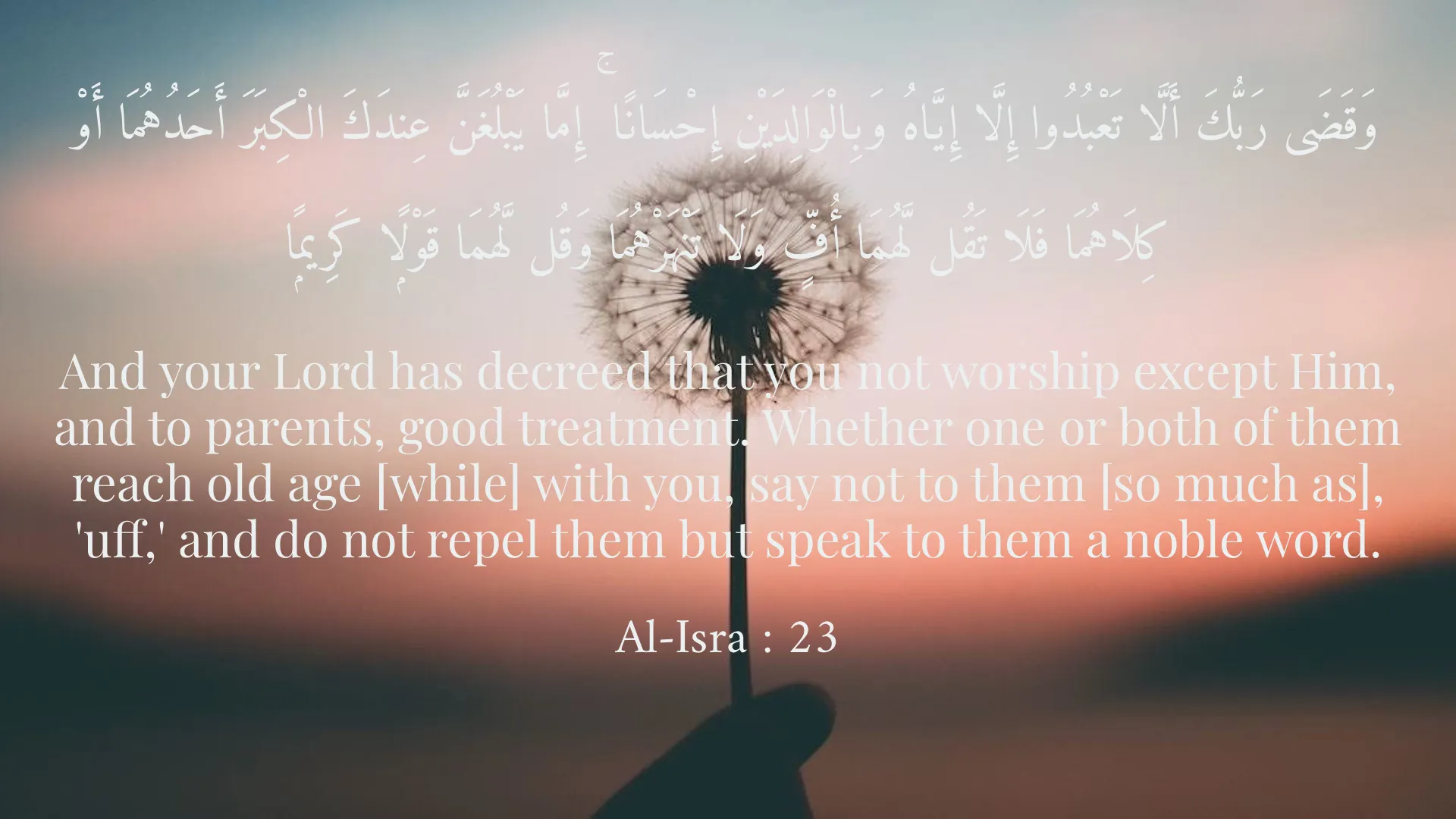
وَقَضَى رَبُّكَ أَلَّا تَعْبُدُوا إِلَّا إِيَّاهُ وَبِالْوَالِدَيْنِ إِحْسَانًا ۚ إِمَّا يَبْلُغَنَّ عِندَكَ الْكِبَرَ أَحَدُهُمَا أَوْ كِلَاهُمَا فَلَا تَقُل لَّهُمَا أُفٍّ وَلَا تَنْهَرْهُمَا وَقُل لَّهُمَا قَوْلًۭا كَرِيمًۭا
And your Lord has decreed that you not worship except Him, and to parents, good treatment. Whether one or both of them reach old age [while] with you, say not to them [so much as], 'uff,' and do not repel them but speak to them a noble word.
Al-Isra : 23
وَوَصَّيْنَا الْإِنْسَانَ بِوَالِدَيْهِ ۚ إِنْ شَكَرْتَ لِي وَلِوَالِدَيْكَ فَإِنَّ عَذَابِي شَدِيدٌ
And We have enjoined upon man [care] for his parents. But if they endeavor to make you associate with Me that of which you have no knowledge, do not obey them. To Me is your return, and I will inform you about what you used to do.
Luqman : 14
Short Story
On a beautiful spring day, Sara was having a conversation with her mother. They had different opinions on a topic, and Sara was quite upset. But she remembered that Allah commands respect for parents in the Quran. Sara said to her mother: 'I'm sorry for being disrespectful today; I want to honor your opinion.' Her mother hugged her with a smile and said, 'You will always be precious to me, even if our opinions differ!'