Quranic Answer
Understanding the concept of 'having everything' and 'feeling empty' from the perspective of the Holy Quran provides us with a profound and different insight than what might appear at first glance. In today's society, it is often believed that achieving boundless wealth, power, fame, beauty, career success, and perfect social relationships can guarantee absolute happiness and contentment. Media and prevailing culture also convey this message, implying that by attaining these material goals, one reaches perfection and bliss. However, the Quran, the book of divine guidance, teaches us that this 'everything' in its material and worldly definition is merely a transient adornment and a tool for testing, and can never replace the deep spiritual and emotional needs of a human being. In reality, someone might be at the peak of material splendor, yet feel empty and hollow due to a spiritual void and a lack of connection with the true source of tranquility. This phenomenon, widely observed in the modern world, testifies to the validity of Quranic teachings, which consider true happiness to be something beyond worldly achievements. time and again to the fleeting and transient nature of worldly life. Surah Al-Kahf, verse 46, states: "Wealth and children are [but] adornment of the worldly life. But the enduring good deeds are better to your Lord for reward and better for [one's] hope." This verse clearly indicates that what we call 'everything' (such as wealth and children) are merely external, ephemeral manifestations of life. While they may be appealing, they lack intrinsic value and permanence to provide inner peace and eternal satisfaction. Relying solely on these adornments diverts a person from the primary purpose of creation and the true path to happiness. Therefore, instead of absolute attachment to worldly life, the Quran emphasizes 'al-Baqiyat as-Salihat' (enduring righteous deeds); good actions that yield real and lasting fruits, and are beneficial in the Hereafter. Without this attention to eternity and righteous deeds, the human heart, even amidst abundant possessions, will always remain restless and anxious. Emptiness, in this context, means the absence of inner peace, a lack of meaning and purpose in life, and a feeling of deep dissatisfaction, even if all material needs are met. The human heart, according to Quranic teachings, finds tranquility only through the remembrance of Allah. Surah Ar-Ra'd, verse 28, states: "Those who have believed and whose hearts find satisfaction in the remembrance of Allah. Unquestionably, in the remembrance of Allah do hearts find satisfaction." This verse reveals the secret to true happiness and peace. If a person is materially at their peak, but their heart is heedless of the remembrance of Allah and distant from spirituality, they will never taste true tranquility. This heedlessness acts like a deep void within, consuming all material pleasures and leaving them with a constant feeling of emptiness and anxiety. This emptiness is essentially the result of a disconnection from the infinite source of existence and divine love, which is the sole means of true peace and contentment. In Surah Al-Hadid, verse 20, a clear picture of the nature of worldly life is also presented: "Know that the life of this world is only amusement and diversion and adornment and boasting among yourselves and competition in increase of wealth and children - like the example of a rain whose [resulting] plant growth pleases the tillers; then it dries and you see it turning yellow; then it becomes [scattered] debris. And in the Hereafter is severe punishment and forgiveness from Allah and approval. And what is the life of this world except the enjoyment of delusion." This verse explicitly shows that even 'competition in increase of wealth and children' (which can be considered 'having everything' from a worldly perspective) ultimately leads to destruction and emptiness, unless it is accompanied by a focus on the Hereafter and seeking Allah's pleasure. The constant competition to accumulate more and more diverts people from the true purpose of life and ultimately traps them in a prison of greed and avarice, leading to nothing but anxiety and restlessness. Therefore, from the Quranic perspective, possessing all material things does not necessarily mean spiritual satiety and inner peace. Rather, this abundance, if not accompanied by spirituality and the remembrance of Allah, may bring more burden and responsibility, distracting a person from their true existential reality. One who seemingly has everything, but is heedless of Allah, is in fact the emptiest person, because they are deprived of the only source of true peace and meaning in life. In contrast, an individual who might be materially poor, but whose heart is filled with faith, the remembrance of Allah, and righteous deeds, is the richest and most complete human being. This is the secret of contentment and peace that can be found on the faces of the poor and true seekers, while many of the world's wealthy and powerful, despite all their resources, are trapped in depression and anxiety. The Holy Quran teaches us that true happiness is not in 'what we have,' but in 'who we are' and 'how we behave with what we have,' and most importantly, in the quality of our connection with the Creator of existence. This perspective is not just a theoretical philosophy but a practical guide for achieving a life full of lasting meaning and tranquility.
Related Verses
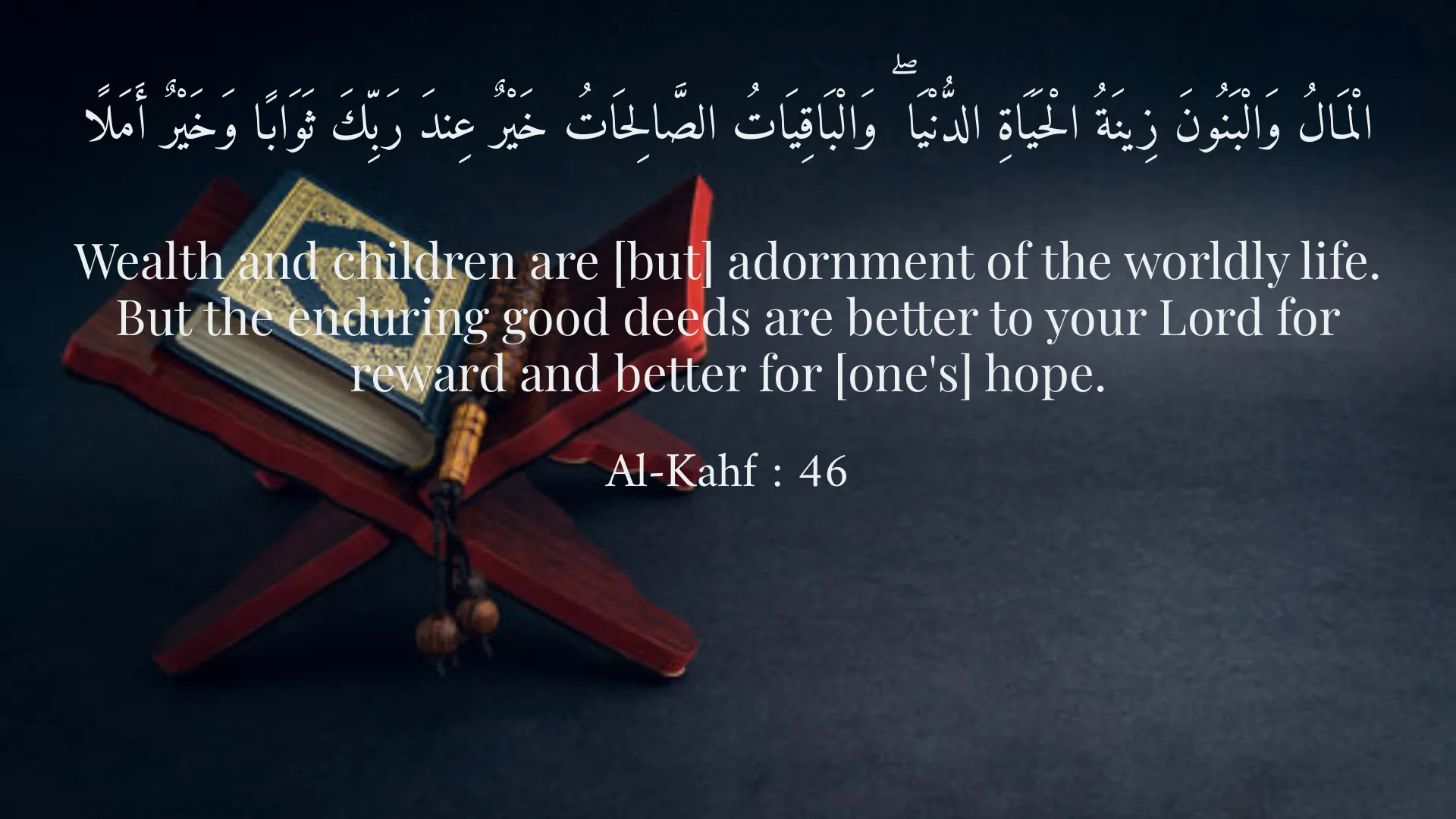
الْمَالُ وَالْبَنُونَ زِينَةُ الْحَيَاةِ الدُّنْيَا ۖ وَالْبَاقِيَاتُ الصَّالِحَاتُ خَيْرٌ عِندَ رَبِّكَ ثَوَابًا وَخَيْرٌ أَمَلًا
Wealth and children are [but] adornment of the worldly life. But the enduring good deeds are better to your Lord for reward and better for [one's] hope.
Al-Kahf : 46
الَّذِينَ آمَنُوا وَتَطْمَئِنُّ قُلُوبُهُم بِذِكْرِ اللَّهِ ۗ أَلَا بِذِكْرِ اللَّهِ تَطْمَئِنُّ الْقُلُوبُ
Those who have believed and whose hearts find satisfaction in the remembrance of Allah. Unquestionably, in the remembrance of Allah do hearts find satisfaction.
Ar-Ra'd : 28
اعْلَمُوا أَنَّمَا الْحَيَاةُ الدُّنْيَا لَعِبٌ وَلَهْوٌ وَزِينَةٌ وَتَفَاخُرٌ بَيْنَكُمْ وَتَكَاثُرٌ فِي الْأَمْوَالِ وَالْأَوْلَادِ ۖ كَمَثَلِ غَيْثٍ أَعْجَبَ الْكُفَّارَ نَبَاتُهُ ثُمَّ يَهِيجُ فَتَرَاهُ مُصْفَرًّا ثُمَّ يَكُونُ حُطَامًا ۖ وَفِي الْآخِرَةِ عَذَابٌ شَدِيدٌ وَمَغْفِرَةٌ مِّنَ اللَّهِ وَرِضْوَانٌ ۚ وَمَا الْحَيَاةُ الدُّنْيَا إِلَّا مَتَاعُ الْغُرُورِ
Know that the life of this world is only amusement and diversion and adornment and boasting among yourselves and competition in increase of wealth and children - like the example of a rain whose [resulting] plant growth pleases the tillers; then it dries and you see it turning yellow; then it becomes [scattered] debris. And in the Hereafter is severe punishment and forgiveness from Allah and approval. And what is the life of this world except the enjoyment of delusion.
Al-Hadid : 20
Short Story
One day, a wealthy and powerful king was deep in thought in his palace. Despite all his riches and retinues, he lacked peace and was always sad. He heard that in that city, a simple and poor dervish possessed a joyful heart and a soul full of tranquility. The king summoned the dervish and asked him: "O Dervish, I, who have everything, why do I lack peace, and you, with nothing, are so joyful and at ease?" The dervish, with a kind smile, replied: "O King, you have everything, but you are constantly in fear of losing it; whereas I have nothing to lose, and I have entrusted my heart to Him who owns everything. Comfort lies in having no worries or attachments, not in possessing more and more. A peaceful heart is a treasure whose price is not in gold and silver, but in the remembrance of Him." The king pondered and realized that emptiness from the remembrance of God and contentment, even with the world's possessions, deprives a person of the true treasure of peace.