Quranic Answer
The Holy Quran, in its profound and rich teachings, does not explicitly use the term 'simple living' (sadeh-zisti) to describe the path to true happiness. However, it presents numerous principles and values that clearly advocate for a balanced lifestyle, free from excess and extremism, and focused on spiritual values, which ultimately lead to genuine tranquility and well-being. These principles can be considered the foundational pillars of 'simple living' from a Quranic perspective, affirming that true happiness, in the sense of inner peace and contentment, is strongly linked to such an approach to life. The Quran repeatedly warns humanity against extravagance and wastefulness (israf and tabdhir). In several verses, it is emphasized that Allah does not love the extravagant. This prohibition extends beyond merely wasting money; it encompasses any form of excessive consumption, uncontrolled pursuit of luxury, and excessive attachment to worldly adornments. A life in which a person is constantly striving for more and accumulating possessions does not lead to peace; instead, it amplifies worries, greed, and anxiety. In Surah Al-Furqan, verse 67, Allah describes His true servants as those who, "when they spend, do not spend extravagantly nor stingily but are ever, between that, [justly] moderate." This verse clearly praises moderation and forbids extremism. This moderation can manifest in all aspects of life, including clothing, food, housing, and possessions, and can be seen as a logical and rational form of simple living. One of the most important keys to happiness in the Quran is the concept of 'qana'ah' (contentment) and 'rida' (satisfaction). While materialism and boasting about wealth and children are described as fleeting and deceptive matters, the heart of a believer finds peace through the remembrance of Allah. Surah Ar-Ra'd, verse 28, beautifully articulates this truth: "Those who have believed and whose hearts are assured by the remembrance of Allah. Unquestionably, by the remembrance of Allah hearts are assured." This verse indicates that the root of peace and happiness is not in the accumulation of wealth and luxuries, but in the spiritual connection with the Creator of the universe. In this regard, simple living helps individuals break free from material shackles and create more space for spiritual growth and attention to God. When a person has fewer worries about maintaining and increasing material possessions, they find more opportunities for contemplation, gratitude, helping others, and engaging in acts of worship; all of which lead to spiritual enrichment and lasting happiness. The Quran also emphasizes 'shukr' (gratitude) as a means to increase blessings and inner peace. Surah Ibrahim, verse 7, states: "If you are grateful, I will surely increase you [in favor]; but if you deny, indeed, My punishment is severe." This gratitude means not only uttering 'Alhamdulillah' but also recognizing and appreciating both small and large blessings, and avoiding regret over what one lacks. Simple living guides individuals to focus on what they possess and prevents them from engaging in comparisons with others, which is a significant source of dissatisfaction and unhappiness in modern society. Furthermore, the Quran reminds us that worldly life is transient and temporary, and the ultimate goal of a believer should be the Hereafter. In Surah Al-Kahf, verse 46, it is stated: "Wealth and children are the adornment of the worldly life; but the enduring good deeds are better with your Lord for reward and better for [one's] hope." This perspective encourages individuals to avoid excessive attachment to the world and its allurements and not to bind their hearts to what is fleeting. Simple living in this sense means detachment, not absence of possessions. That is, a person can have possessions, but their heart should not be enslaved by them, knowing that everything belongs to Allah and to Him is the return. This liberation from material bonds grants a lightness and freedom to the soul, which is itself a deep source of happiness. Therefore, it can be concluded that although the Quran does not directly address 'simple living' as a specific term, a collection of teachings including moderation, avoidance of extravagance, contentment, gratitude, and prioritizing the Hereafter over the worldly life, consistently guide humanity towards a life free from material complexities and filled with spiritual tranquility. This approach to life, which can be termed 'Quranic simple living,' not only lays the groundwork for happiness in this world but also ensures success in the Hereafter. True happiness is found not in the quantity of possessions but in the quality of one's relationship with the Creator and the way His blessings are utilized in seeking His pleasure, which is best achieved by adhering to the principles of simple living and moderation. A life in which one is free from excessive luxury and superfluities allows for greater focus on more significant aspects of life such as human relationships, self-improvement, and serving the community, each contributing to an increased sense of happiness and inner satisfaction. This lifestyle provides an opportunity for individuals to exit the endless cycle of consumerism and material competition, and to achieve a tranquility that is only possible through connection with the Originator of existence and adherence to His divine laws.
Related Verses
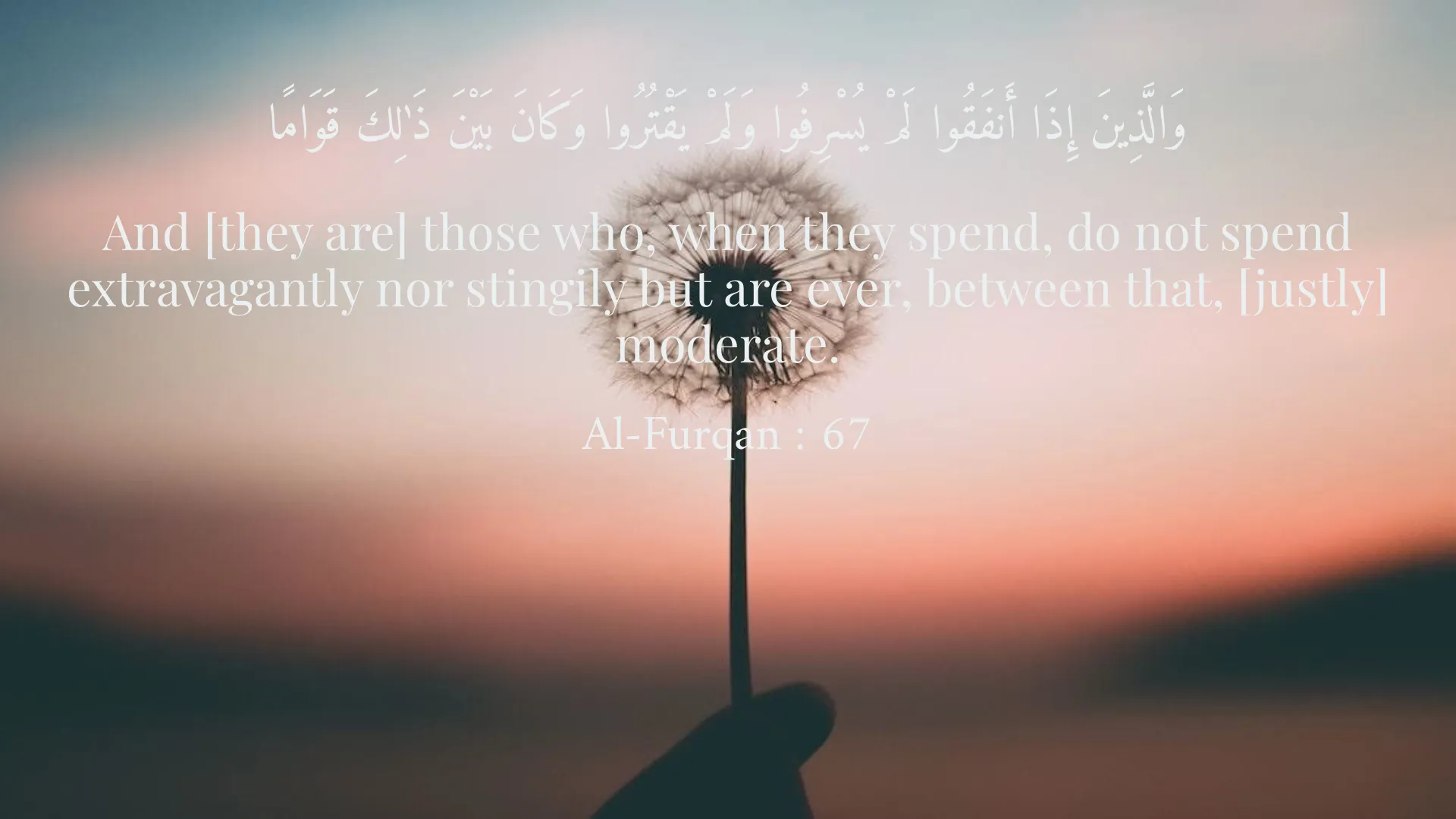
وَالَّذِينَ إِذَا أَنفَقُوا لَمْ يُسْرِفُوا وَلَمْ يَقْتُرُوا وَكَانَ بَيْنَ ذَٰلِكَ قَوَامًا
And [they are] those who, when they spend, do not spend extravagantly nor stingily but are ever, between that, [justly] moderate.
Al-Furqan : 67
وَآتِ ذَا الْقُرْبَىٰ حَقَّهُ وَالْمِسْكِينَ وَابْنَ السَّبِيلِ وَلَا تُبَذِّرْ تَبْذِيرًا
And give the relative his right, and [also] the poor and the traveler, and do not spend wastefully.
Al-Isra : 26
إِنَّ الْمُبَذِّرِينَ كَانُوا إِخْوَانَ الشَّيَاطِينِ ۖ وَكَانَ الشَّيْطَانُ لِرَبِّهِ كَفُورًا
Indeed, the wasteful are brothers of the devils, and ever has Satan been to his Lord ungrateful.
Al-Isra : 27
الَّذِينَ آمَنُوا وَتَطْمَئِنُّ قُلُوبُهُم بِذِكْرِ اللَّهِ ۗ أَلَا بِذِكْرِ اللَّهِ تَطْمَئِنُّ الْقُلُوبُ
Those who have believed and whose hearts are assured by the remembrance of Allah. Unquestionably, by the remembrance of Allah hearts are assured.
Ar-Ra'd : 28
Short Story
It is said there was a wealthy man who was constantly preoccupied with accumulating more wealth and protecting his assets. Every day his fortune grew, yet peace and sleep abandoned his eyes. One night, he lay restlessly in his bed, distressed by thoughts of potential losses. Just then, he heard the pleasant singing of a dervish in his neighborhood, who, with only a saddlebag and a pitcher, had laid his head down and was singing melodiously with a joyful heart. The wealthy man looked out his window and saw the dervish sleeping peacefully, free from worries. Enviously, he said to the dervish: "O dervish, how is it that you, with all this poverty, possess such tranquility, while I, with all this wealth, have no moment of rest?" The dervish smiled and replied: "My friend, the difference between us is that you are a prisoner of your possessions, while I am free from what I lack. My happiness lies in contentment, and your happiness is in the pursuit of more; and it never reaches an end." The wealthy man pondered for a while and realized that the heavy burden of wealth had kept him from true lightness and joy. This delightful story from Saadi's Bustan reminds us that sometimes, letting go of attachments and being content with what we have, brings true peace and happiness more than any fortune.