Quranic Answer
The relationship with God is the pulsating heart of every believer's spiritual life. This relationship is profound and multifaceted; it cannot be confined to a single dimension, such as the emotional aspect alone. While emotions play a very significant and vital role in drawing closer to God, and divine fervor and love can elevate an individual to the pinnacle of spiritual insight and sincerity, the Holy Quran and prophetic tradition demonstrate that this relationship transcends mere emotional fluctuations. It encompasses other dimensions such as intellectual, practical, and reliance-based aspects, each strengthening this bond in its own right and making it more enduring. The Emotional Dimensions of the Relationship: There is no doubt that love and affection for God are the foundation of faith and the highest emotional state in this relationship. The Quran, in Surah Al-Baqarah, verse 165, states: "But those who believe are stronger in love for Allah." This love is not a fleeting emotion but a deep, enduring affection built upon knowledge and understanding. This love propels an individual towards obedience, sacrifice, and devotion in the path of God. Fear of God (khashyah and taqwa) is another emotional dimension repeatedly emphasized in the Quran. This fear is not the dread of a tyrant but a reverence imbued with respect, awe, and majesty that restrains one from committing sins and motivates towards good deeds and responsibility. Hope in divine mercy and forgiveness (raja') and gratitude for His countless blessings are also crucial emotions in this relationship. These emotions give meaning and color to life and make an individual resilient in the face of hardships. However, can we expect these emotions to always be at their peak? No, human beings are creatures whose emotions fluctuate over time. Sometimes we might experience indescribable fervor and passion, while at other times we might feel sluggish, uninspired, or even doubtful. If the relationship with God were based solely on emotions, it could falter with every emotional fluctuation, which contradicts the nature of the "straight path" (Sirat al-Mustaqim) that the Quran refers to. The Intellectual and Cognitive Dimensions of the Relationship: The Holy Quran repeatedly invites human beings to ponder, reflect, and reason. The relationship with God is not merely a matter of the heart; it is also an intellectual and thoughtful matter. Knowing God through contemplating His cosmic signs (ayat in the universe) and His internal signs (ayat within one's own being) forms the deepest foundation of this relationship. Surah Ar-Rum, verse 24, states: "And of His signs is that He shows you the lightning [causing] fear and aspiration, and He sends down rain from the sky by which He revives the earth after its lifelessness. Indeed in that are signs for a people who use reason." This contemplation and reasoning transform faith from blind imitation into a heartfelt and rational certainty that is resilient against storms of doubt and ambiguity. Understanding divine names and attributes (Asma ul-Husna) and reflecting on His wisdom in creation enriches our relationship with God from a cognitive perspective and gives it stability. This dimension helps us to remain steadfast in our faith, relying on knowledge and understanding, even when our emotions have subsided. The Practical and Behavioral Dimensions of the Relationship: Faith in Islam is not merely an inward belief or an emotion; it is a combination of beliefs, words, and actions. The relationship with God manifests in practical deeds, fulfilling duties, and acts of worship. Prayer (Salat), fasting (Sawm), charity (Zakat), pilgrimage (Hajj), enjoining good and forbidding evil, and performing any good deed while abstaining from prohibitions are practical expressions of this relationship. Allah says in Surah Al-Ankabut, verse 45: "Recite what has been revealed to you of the Book and establish prayer. Indeed, prayer prohibits immorality and wrongdoing, and the remembrance of Allah is greater. And Allah knows that which you do." These acts of worship are the pillars of connection with God that preserve and strengthen this bond even in the absence of peak emotions. They are like anchors that keep the ship of faith steady in the turbulent sea of life. Even if we sometimes lack fervor in our prayers, the very act of fulfilling our duty and submitting to divine command demonstrates the steadfastness and depth of our relationship with Him. Steadfastness and Reliance (Tawakkul): The relationship with God must be strong and stable, remaining steadfast through the ups and downs of life. Patience (Sabr) and perseverance (Istiqaamah) in the path of God are among the most important characteristics of this relationship. Surah Al-Baqarah, verse 153, states: "O you who have believed, seek help through patience and prayer. Indeed, Allah is with the patient." This verse indicates that faith is not limited to moments of joy but also requires holding fast to the divine rope with patience and perseverance during hardships. Reliance on God (Tawakkul), which is a heartfelt and practical state of absolute trust in Him, also constitutes a significant dimension of this relationship. Tawakkul, beyond a mere emotion, is a profound conviction that enables every individual to resist life's challenges and entrust themselves to God in all stages of life. Conclusion: In conclusion, the relationship with God encompasses a wide spectrum of dimensions. While pure and spiritual emotions, such as love and fervor, are powerful driving forces for drawing closer to God and allow one to taste the sweet flavor of faith, this relationship should not be limited solely to the emotional dimension. A deep and mature relationship with God includes rational understanding, practical adherence, and reliance (Tawakkul) and steadfastness in all circumstances. It is this comprehensive combination that transforms the connection with God into an unbreakable and fruitful bond that remains firm and stable even in moments when emotional fervor is absent. A true believer is one who, in every situation—whether in joy or sorrow, at the peak of spirituality or during periods of spiritual lull—maintains their connection with God and remains true to their covenant with Him. This comprehensiveness and perfection bestow depth and richness upon humanity's relationship with its Creator.
Related Verses
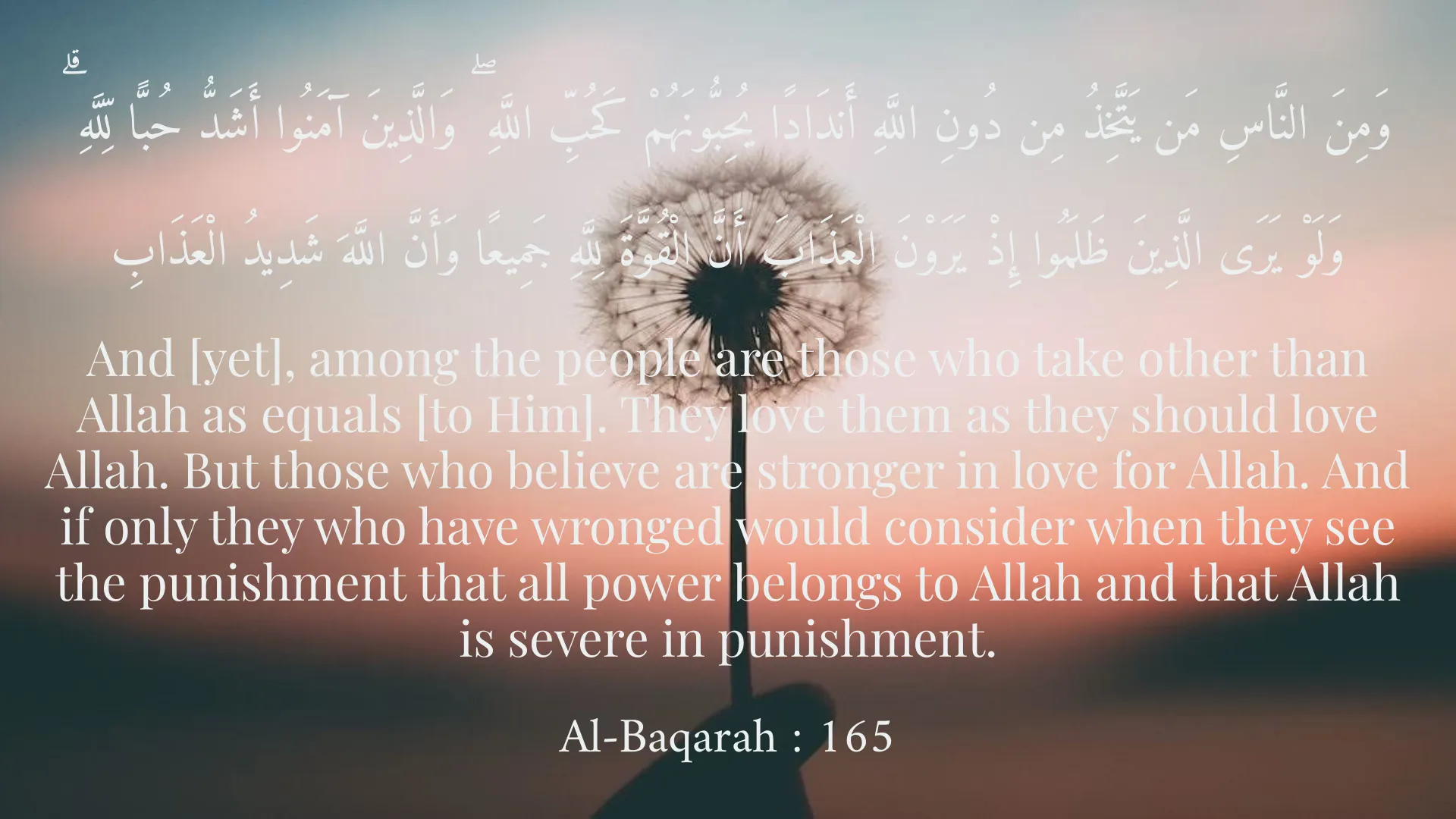
وَمِنَ النَّاسِ مَن يَتَّخِذُ مِن دُونِ اللَّهِ أَندَادًا يُحِبُّونَهُمْ كَحُبِّ اللَّهِ ۖ وَالَّذِينَ آمَنُوا أَشَدُّ حُبًّا لِّلَّهِ ۗ وَلَوْ يَرَى الَّذِينَ ظَلَمُوا إِذْ يَرَوْنَ الْعَذَابَ أَنَّ الْقُوَّةَ لِلَّهِ جَمِيعًا وَأَنَّ اللَّهَ شَدِيدُ الْعَذَابِ
And [yet], among the people are those who take other than Allah as equals [to Him]. They love them as they should love Allah. But those who believe are stronger in love for Allah. And if only they who have wronged would consider when they see the punishment that all power belongs to Allah and that Allah is severe in punishment.
Al-Baqarah : 165
اتْلُ مَا أُوحِيَ إِلَيْكَ مِنَ الْكِتَابِ وَأَقِمِ الصَّلَاةَ ۖ إِنَّ الصَّلَاةَ تَنْهَىٰ عَنِ الْفَحْشَاءِ وَالْمُنكَرِ ۗ وَلَذِكْرُ اللَّهِ أَكْبَرُ ۗ وَاللَّهُ يَعْلَمُ مَا تَصْنَعُونَ
Recite what has been revealed to you of the Book and establish prayer. Indeed, prayer prohibits immorality and wrongdoing, and the remembrance of Allah is greater. And Allah knows that which you do.
Al-Ankabut : 45
يَا أَيُّهَا الَّذِينَ آمَنُوا اسْتَعِينُوا بِالصَّبْرِ وَالصَّلَاةِ ۚ إِنَّ اللَّهَ مَعَ الصَّابِرِينَ
O you who have believed, seek help through patience and prayer. Indeed, Allah is with the patient.
Al-Baqarah : 153
Short Story
A devout worshiper, much occupied with prayer and remembrance, once asked his neighbor, who was less frequently seen in devotion: "Why do I see you less often in the mosque, while I am engaged in worshipping and remembering God day and night?" The neighbor replied with a smile: "I too converse constantly with my God, but not with shouts and display. It is as if my heart is with Him, whether I am in the market or at home. God looks not at the multitude of deeds, nor at the intensity of fleeting emotions, but rather at the sincerity of intention and steadfastness in His path." The worshiper pondered for a moment and understood that the relationship with God is not merely confined to fervent emotions or outward acts, but that true worth lies in inner steadfastness and sincerity, which strengthens it.