Quranic Answer
In the rich and comprehensive teachings of the Holy Quran, there is no command to abandon all lawful worldly pleasures and beauties. On the contrary, the Quran presents a balanced and realistic view of life, neither advocating for extreme asceticism and monasticism nor for complete immersion in materialism and forgetting the Hereafter. Islam views the world not as inherently evil nor as the ultimate goal, but rather as a bridge to the eternal abode and a field for cultivating good deeds. Allah, the Almighty, is the Creator of beauty and good things, and He encourages His servants to enjoy them in a lawful and moderate manner. In Surah Al-A'raf, verse 32, Allah explicitly addresses this matter, stating: "Say, 'Who has forbidden the adornment of Allah which He has produced for His servants and the good things of provision?' Say, 'They are for those who have believed in worldly life [while they are] pure and [will be exclusively] theirs on the Day of Resurrection.' Thus do We detail the verses for a people who know." This verse clearly indicates that enjoying lawful beauties and pure provisions is not only permissible but is sanctioned by the Lord and is even intended for believers in this world. This divine command is a direct refutation of any extremist ideology that seeks to prohibit the enjoyment of Allah's blessings. Furthermore, the Holy Quran places great emphasis on the necessity of striking a balance between this world and the Hereafter. Worldly life is an opportunity to prepare for the afterlife, but this does not mean neglecting all legitimate and positive aspects of temporal life. In Surah Al-Qasas, verse 77, Allah says: "But seek, through that which Allah has given you, the home of the Hereafter; and [yet], do not forget your share of the world. And do good as Allah has done good to you. And desire not corruption in the land. Indeed, Allah does not like corrupters." This unparalleled verse provides a complete roadmap for life: the primary goal should be the Hereafter, yet one should not neglect their legitimate share of the world's pleasures and blessings. "Share of the world" includes physical health, life's amenities, family, lawful earnings, and anything that facilitates and makes human life pleasant, aiding one on the path of devotion and service. This verse paints a picture of an active and dynamic Muslim who strives for spiritual perfection while also benefiting from worldly bounties within lawful and moderate bounds. However, the Quran also issues serious warnings against becoming overly absorbed in worldly pleasures and prioritizing this world over the Hereafter. Worldly pleasures are fleeting and temporary and should not become the ultimate goal for humans, lest they distract from the remembrance of Allah, moral responsibilities, and acts of worship. In Surah Al-Hadid, verse 20, it states: "Know that the worldly life is only amusement and diversion and adornment and boasting among yourselves and competition in [accumulating] wealth and children - like the example of a rainfall whose vegetation delights the disbelievers; then it dries and you see it turned yellow; then it becomes [scattered] debris. And in the Hereafter is severe punishment and forgiveness from Allah and approval. And what is the worldly life except the enjoyment of delusion." This verse describes the transient and deceptive nature of the world, but this does not imply absolute prohibition; rather, it is a warning not to be deceived by its appearances and to understand that the world is merely an enjoyment of delusion if one makes it their ultimate aspiration. In Surah At-Takathur, verses 1 and 2, the same theme is touched upon: "Competition in [worldly] increase diverts you until you visit the graveyards." These verses warn that rivalry in accumulating wealth, status, and children distracts a person from the primary purpose of life and the remembrance of Allah, and one only realizes it when it's too late. Therefore, it is important that worldly pleasures and bounties serve the greater purpose of worshipping Allah and earning His pleasure, rather than becoming ends in themselves. In summary, Islam recommends a middle path. On one hand, it neither encourages monasticism and extreme, undue ascetic practices nor prohibits Allah's blessings and good things. On the other hand, it strongly discourages getting lost in materialism and forgetting the primary purpose of creation. A Muslim should enjoy the lawful pleasures of this world as an expression of gratitude for Allah's blessings, but always be careful that these pleasures do not divert them from the path of truth and the remembrance of the Hereafter. A balanced life, grateful and responsible use of blessings, and making the Hereafter the ultimate goal are key Islamic principles in dealing with worldly pleasures. This perspective not only leads to a rich spiritual life but also allows a person to constructively and purposefully enjoy the beauties of the universe, ultimately achieving well-being in both this world and the Hereafter.
Related Verses
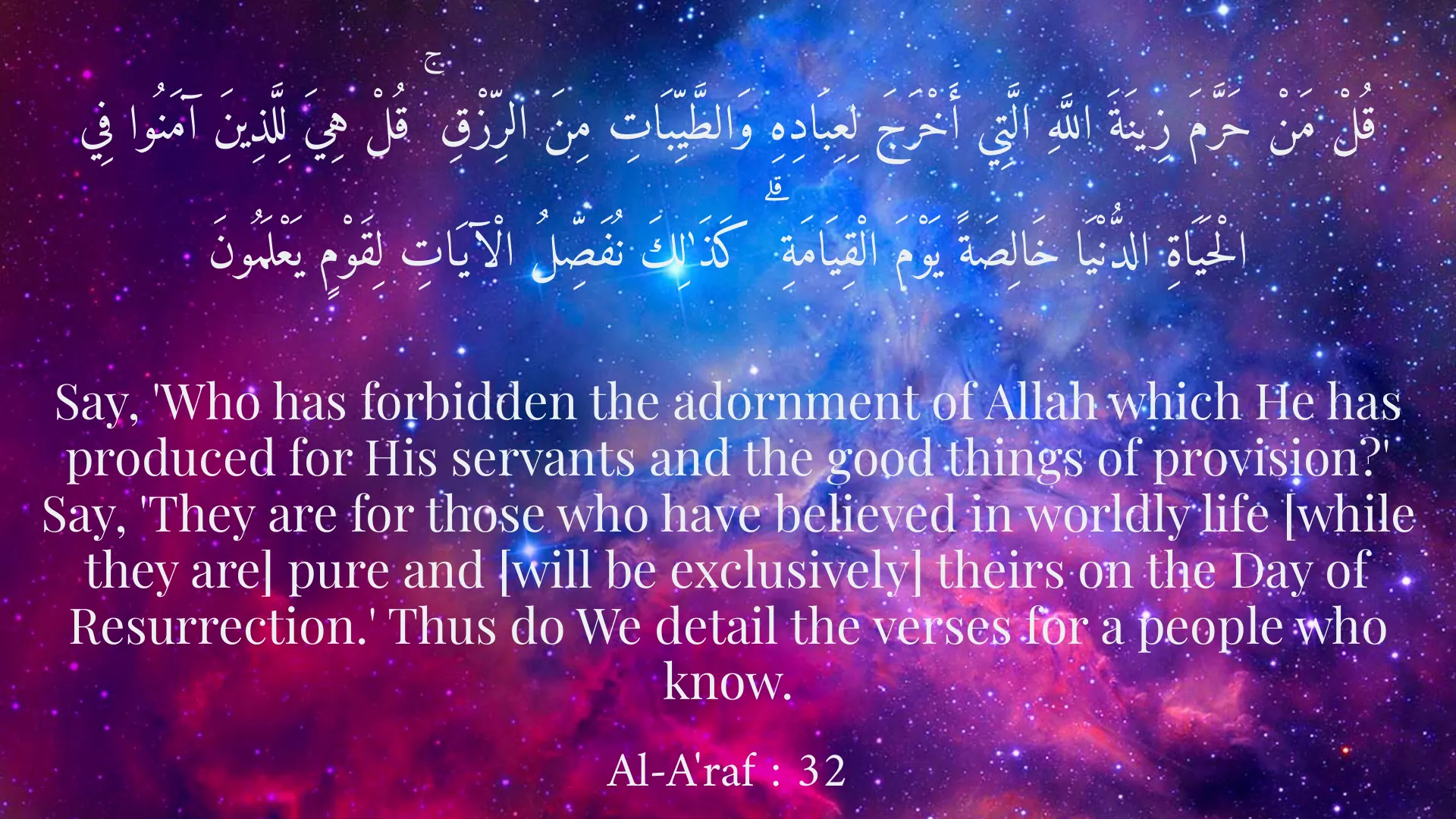
قُلْ مَنْ حَرَّمَ زِينَةَ اللَّهِ الَّتِي أَخْرَجَ لِعِبَادِهِ وَالطَّيِّبَاتِ مِنَ الرِّزْقِ ۚ قُلْ هِيَ لِلَّذِينَ آمَنُوا فِي الْحَيَاةِ الدُّنْيَا خَالِصَةً يَوْمَ الْقِيَامَةِ ۗ كَذَٰلِكَ نُفَصِّلُ الْآيَاتِ لِقَوْمٍ يَعْلَمُونَ
Say, 'Who has forbidden the adornment of Allah which He has produced for His servants and the good things of provision?' Say, 'They are for those who have believed in worldly life [while they are] pure and [will be exclusively] theirs on the Day of Resurrection.' Thus do We detail the verses for a people who know.
Al-A'raf : 32
وَابْتَغِ فِيمَا آتَاكَ اللَّهُ الدَّارَ الْآخِرَةَ ۖ وَلَا تَنسَ نَصِيبَكَ مِنَ الدُّنْيَا ۖ وَأَحْسِن كَمَا أَحْسَنَ اللَّهُ إِلَيْكَ ۖ وَلَا تَبْغِ الْفَسَادَ فِي الْأَرْضِ ۖ إِنَّ اللَّهَ لَا يُحِبُّ الْمُفْسِدِينَ
But seek, through that which Allah has given you, the home of the Hereafter; and [yet], do not forget your share of the world. And do good as Allah has done good to you. And desire not corruption in the land. Indeed, Allah does not like corrupters.
Al-Qasas : 77
اعْلَمُوا أَنَّمَا الْحَيَاةُ الدُّنْيَا لَعِبٌ وَلَهْوٌ وَزِينَةٌ وَتَفَاخُرٌ بَيْنَكُمْ وَتَكَاثُرٌ فِي الْأَمْوَالِ وَالْأَوْلَادِ ۖ كَمَثَلِ غَيْثٍ أَعْجَبَ الْكُفَّارَ نَبَاتُهُ ثُمَّ يَهِيجُ فَتَرَاهُ مُصْفَرًّا ثُمَّ يَكُونُ حُطَامًا ۖ وَفِي الْآخِرَةِ عَذَابٌ شَدِيدٌ وَمَغْفِرَةٌ مِنَ اللَّهِ وَرِضْوَانٌ ۗ وَمَا الْحَيَاةُ الدُّنْيَا إِلَّا مَتَاعُ الْغُرُورِ
Know that the worldly life is only amusement and diversion and adornment and boasting among yourselves and competition in [accumulating] wealth and children - like the example of a rainfall whose vegetation delights the disbelievers; then it dries and you see it turned yellow; then it becomes [scattered] debris. And in the Hereafter is severe punishment and forgiveness from Allah and approval. And what is the worldly life except the enjoyment of delusion.
Al-Hadid : 20
أَلْهَاكُمُ التَّكَاثُرُ
Competition in [worldly] increase diverts you,
At-Takathur : 1
حَتَّىٰ زُرْتُمُ الْمَقَابِرَ
Until you visit the graveyards.
At-Takathur : 2
Short Story
It is narrated in Saadi's Gulistan that a king, accompanied by a wise minister, passed by a dervish who sat contentedly eating dry bread in a corner. The king remarked to his minister, "This dervish is happier than I, for his state is good, and he has no worldly sorrow." The minister replied, "O King, though this dervish has detached himself from the world, you too can, with moderation and benevolence, enjoy the lawful pleasures of this world while keeping your heart focused on the Hereafter. True happiness lies neither in abandoning everything nor in boundless accumulation, but in balance and contentment."