Quranic Answer
The issue of forgiveness, or 'Afw' and 'Safh' in Quranic terminology, is one of the deepest and most challenging aspects of the human soul, repeatedly emphasized in the Holy Quran. The difficulty in forgiving with a comfortable heart often stems from various internal roots, many of which can be addressed by Quranic teachings and a proper understanding of faith. The Quran not only commands us to forgive but also offers pathways to achieve inner peace after forgiveness. In essence, the inability to forgive often arises from internal factors such as pride, fear of renewed vulnerability, an excessive desire for justice, and attachment to resentment and anger. These are obstacles that, if not illuminated by the light of the Quran, can harden the heart and strip it of peace. One primary reason for the difficulty in forgiving is 'self-love' and 'self-importance.' When someone wrongs us, we feel that our rights have been trampled upon and our pride wounded. In contrast to this feeling, the Quran emphasizes that all power and compensation rest solely with Allah. Forgiveness does not mean abandoning one's right, but rather entrusting that right to Allah so that He may compensate it in the best possible way. This understanding lifts an immense burden from the human being, freeing them from the endless cycle of resentment and revenge. Allah says in Surah An-Nur, verse 22: "...and let them pardon and overlook. Would you not like that Allah should forgive you? And Allah is Forgiving and Merciful." This verse directly addresses the human heart, inviting it to forgive, with the promise that if you forgive, Allah will forgive you. This is a transaction that no sensible person would turn away from. Another reason for the inability to forgive is the 'fear of repeated harm' or a feeling of 'weakness.' Some people believe that forgiveness signifies weakness and allows others to repeat their mistakes. However, the Quran considers forgiveness not a weakness, but rather 'strength' and 'magnanimity.' Forgiveness emanates from a position of power and nobility of soul, not from a stance of weakness or fear. In Surah Ash-Shura, verse 40, we read: "And the recompense of an evil is an evil like it. But whoever pardons and makes reconciliation – his reward is [due] from Allah. Indeed, He does not like wrongdoers." This verse clearly states that although the right to retaliation exists, forgiveness and reconciliation hold a higher value and a greater reward with Allah. This demonstrates that forgiveness is a conscious and powerful choice. Furthermore, 'clinging to the past' and 'non-acceptance of destiny' can be significant barriers to forgiveness. Humans sometimes, due to the pain and suffering they endured in the past, are unable to let go, which prevents forward movement and the attainment of peace. The Quran constantly invites believers to patience and perseverance, teaching them that every hardship and tribulation that befalls them is with the permission of Allah, and there is a good in it that may not be immediately understandable. Accepting the truth that whatever has happened is part of divine decree helps a person make peace with their past and pave the way for forgiveness. Imam Ali (A.S.) also said: "Whoever uproots resentment from their heart will find peace." This inner peace is achieved only by releasing the heavy burden of resentment and overlooking the faults of others. The Quranic solution to achieving forgiveness from the depths of the heart is 'reliance on Allah' and 'recalling His attributes.' When a person knows that Allah is Oft-Forgiving (Ghafoor), Most Merciful (Raheem), the Pardoner ('Afuww), and Kind, and that they themselves are in constant need of divine forgiveness, then forgiving others becomes easier for them. If we expect Allah to forgive our sins and shortcomings, then we too must be ready to forgive the shortcomings of others. This is a reciprocal relationship strongly emphasized in Islamic teachings. Additionally, controlling anger, which is one of the most significant obstacles to forgiveness, is heavily emphasized in the Quran. In Surah Al-Imran, verse 134, Allah describes the righteous as those "who restrain anger and pardon the people." This suppression of anger is the first step towards achieving heartfelt forgiveness. Ultimately, forgiveness brings unparalleled peace and liberation not only for the person who is forgiven but also for the forgiver. Resentment and dissatisfaction are like a heavy burden on the human soul that prevent it from soaring towards perfection. With forgiveness, this burden is lifted, and the heart becomes light and calm. Therefore, if we cannot forgive with a comfortable heart, we should look within ourselves and identify obstacles such as pride, fear, and attachment to the past, which are also mentioned in the Quran. Then, with the help of faith and reliance on Allah, we can overcome them. Forgiveness is a path to inner peace and closer proximity to Allah, a path that frees the heart from the bonds of suffering and transforms it into a sea of mercy and tranquility.
Related Verses
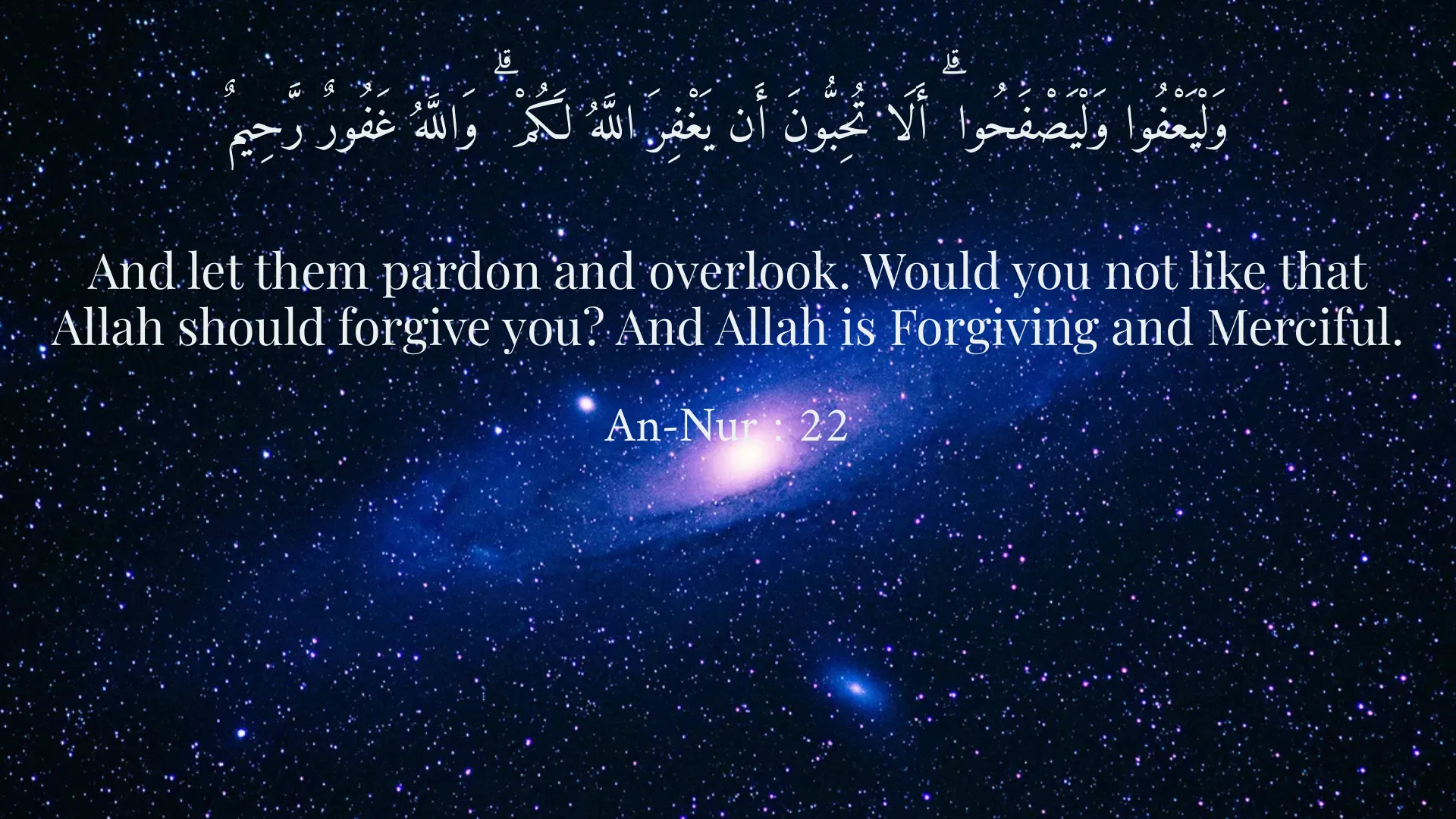
وَلْيَعْفُوا وَلْيَصْفَحُوا ۗ أَلَا تُحِبُّونَ أَن يَغْفِرَ اللَّهُ لَكُمْ ۗ وَاللَّهُ غَفُورٌ رَّحِيمٌ
And let them pardon and overlook. Would you not like that Allah should forgive you? And Allah is Forgiving and Merciful.
An-Nur : 22
وَجَزَاءُ سَيِّئَةٍ سَيِّئَةٌ مِّثْلُهَا ۖ فَمَنْ عَفَا وَأَصْلَحَ فَأَجْرُهُ عَلَى اللَّهِ ۚ إِنَّهُ لَا يُحِبُّ الظَّالِمِينَ
And the recompense of an evil is an evil like it. But whoever pardons and makes reconciliation – his reward is [due] from Allah. Indeed, He does not like wrongdoers.
Ash-Shura : 40
الَّذِينَ يُنفِقُونَ فِي السَّرَّاءِ وَالضَّرَّاءِ وَالْكَاظِمِينَ الْغَيْظَ وَالْعَافِينَ عَنِ النَّاسِ ۗ وَاللَّهُ يُحِبُّ الْمُحْسِنِينَ
Those who spend [in the cause of Allah] during ease and hardship and who restrain anger and who pardon the people - and Allah loves the doers of good.
Al-Imran : 134
Short Story
In Saadi's Gulistan, it is told that a just king had a servant who was negligent in his duties and made a mistake. The king grew angry and ordered his punishment. But one of the wise ministers present said to the king: "O King, this servant has served you faithfully for many years. Weigh his one day's mistake against his years of service. Your magnanimity lies in forgiving him, not in revenge and reprimand." Upon hearing these words, the king's heart softened, and he overlooked the servant's fault and pardoned him. Thereafter, the servant served with even greater loyalty and effort. This story shows that forgiveness, even in the face of error, not only signifies a noble soul but can also soften hearts and lead to goodness and reform, bringing deep peace to the forgiver.