Quranic Answer
The inherent human desire to always possess more is a deeply rooted trait, explicitly addressed in the Holy Quran. This insatiable yearning stems from various aspects of human nature, including natural inclinations, Satanic temptations, heedlessness of the Hereafter, and constant comparison with others. The Quran, with its profound wisdom, delicately addresses this facet of human existence and offers guidance on how to manage and redirect this pervasive inclination. Firstly, the Quran clearly states that humans are naturally drawn to wealth and the adornments of worldly life. Surah Al-Imran, verse 14, states: “Zainna li’n-naasi hubbush-shahawaati mina’n-nisaa’i wal-baneena wal-qanaateeril-muqantarati minaz-zahabi wal-fiddati wal-khaylil-musawwamati wal-an’aami wal-hars; dhaalika mataa’ul-hayaatid-dunyaa; wallaahu ‘indahu husnul-ma’aab.” This translates to: “Beautified for people is the love of desires – of women and sons, heaped-up sums of gold and silver, fine branded horses, and cattle and tillages. That is the enjoyment of worldly life, but Allah has with Him the best return.” This verse indicates that attachment to these matters is part of human psychological makeup. This inclination is not inherently evil; rather, it serves as a test for humanity to see how they interact with these attachments and whether they can utilize them in pursuit of truth and divine pleasure. One of the primary reasons for this boundless desire is what the Quran terms 'Takathur' (rivalry in worldly increase), as highlighted in Surah At-Takathur. “Alhaakumu’t-takaathur. Hattaa zurtumu’l-maqaabir.” This means: “Competition in [worldly] increase diverts you, until you visit the graveyards [i.e., until you die].” This Surah clearly illustrates that competition in accumulating wealth, or even boasting about family and social status, distracts humans from the fundamental purposes of life. It traps individuals in a perpetual cycle of seeking more until their very last breath. This state becomes detrimental when it replaces the true purpose of life, leading to heedlessness of Allah and the Day of Judgment. The inherent human tendency towards superiority and constant self-comparison with others fuels this desire. Seeing what others possess often creates a sense of inadequacy, driving individuals to accumulate more in an endless pursuit, oblivious to the fact that this competition has no end. Furthermore, the Quran repeatedly emphasizes the temporary and fleeting nature of worldly life to prevent humans from falling into the trap of insatiable desire. In Surah Al-Hadid, verse 20, it states: “I’lamoo annamal-hayaatud-dunyaa la’ibun wa lahvun wa zeenatun wa tafaakhurun baynakum wa takaathurun fil-amwaali wal-awlaadi kama-thali ghaythin a’jaba’l-kuffaara nabaatuhu thumma yaheej fa-taraahu musfarran thumma yakoonu hutaamaa; wa fil-aakhirati ‘azaabun shadeedun wa maghfiratum-minallaahi wa ridwaan; wa mal-hayaatud-dunyaa illaa mataa’ul-ghuroor.” This means: “Know that the life of this world is only play and amusement, pomp and mutual boasting among you, and rivalry in respect of wealth and children. [It is] like the example of a rain whose [resulting] plant growth pleases the tillers; then it dries and you see it turned yellow; then it becomes [scattered] fragments. And in the Hereafter is severe punishment and forgiveness from Allah and [His] approval. And what is the worldly life except the enjoyment of delusion.” This verse paints a vivid picture of the instability of worldly existence and the illusion created by excessive acquisition. Worldly life is likened to a plant that flourishes initially but ultimately withers and perishes. This reality should serve as a stark reminder for humans to abandon the pursuit of the mirage of “having more.” Another significant driver of this relentless desire is Satanic whispers. Satan perpetually entices humans with the allure of worldly glamour and instills fear of poverty, pushing them towards greed and covetousness. The Quran frequently mentions Satan's role in deceiving humanity. Moreover, heedlessness of Allah and the Hereafter creates fertile ground for material desires to take root. When the heart becomes empty of Allah's remembrance, worldly things fill that void, and the thirst for them becomes insatiable. The Quran offers the remembrance of Allah as the cure for this thirst. “Alladheena aamanoo wa tatma’innu quloobuhum bi-dhikrillaah; alaa bi-dhikrillaahi tatma’innul-quloob.” (Surah Ar-Ra’d, verse 28) This translates to: “Those who have believed and whose hearts are assured by the remembrance of Allah. Unquestionably, by the remembrance of Allah hearts are assured.” This verse outlines the fundamental path to inner peace and liberation from the bondage of endless desires. True tranquility is not found in accumulating possessions but in connecting with the infinite divine source. Therefore, to manage this natural yet potentially destructive inclination, the Quran provides practical guidance: contentment (qana'ah), gratitude (shukr), generosity (infaq), and a focus on the Hereafter (Akhira). Contentment does not mean ceasing effort but rather being satisfied with what Allah has provided and detaching one's heart from the pursuit of endless accumulation. Gratitude for existing blessings instills a sense of richness and sufficiency. Giving charity from what one possesses not only lessens attachment to worldly life but also fosters spiritual growth and blessings. Most importantly, constantly recalling the ultimate purpose of creation and life after death—the Hereafter—transforms one's perspective. With this outlook, this world becomes a field for cultivating good deeds whose fruits will be reaped in the eternal life, rather than merely a destination for unrestrained accumulation of assets. Ultimately, if this desire to 'have more' is not guided correctly, it can transform into a spiritual ailment that disrupts individual inner peace and societal harmony. However, when viewed with Quranic wisdom and insight, it can be transmuted into a powerful motivation for growth and elevation; a striving to acquire 'more' of divine pleasure, more good deeds, more knowledge, and more piety. The Quran invites us to redirect this internal thirst towards truth and enduring values, away from the deceptive mirages of this world, which are endless and bring nothing but regret and remorse. A life lived with such an approach will be truly rich and filled with a profound tranquility that no amount of wealth or status can provide.
Related Verses
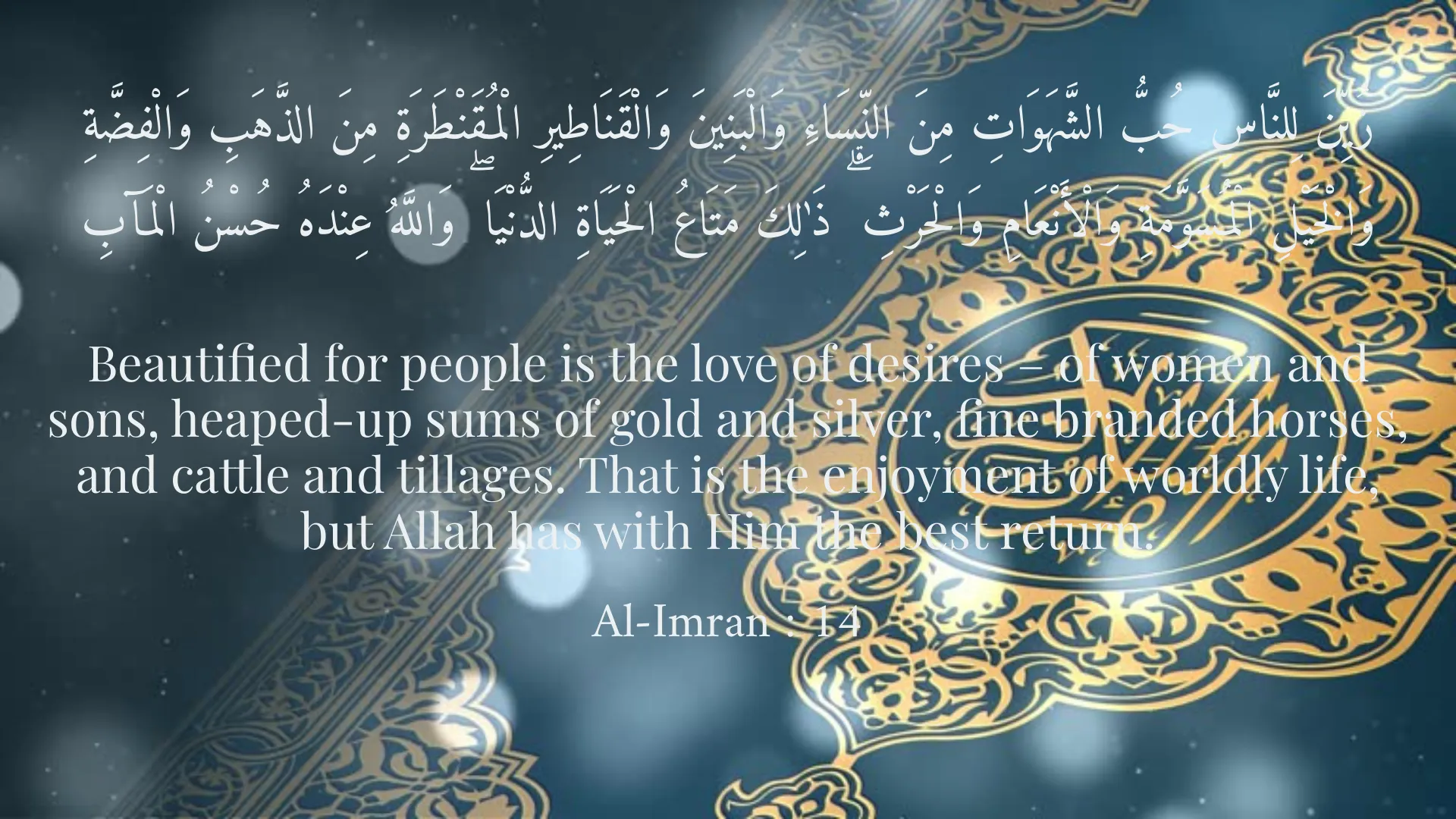
زُيِّنَ لِلنَّاسِ حُبُّ الشَّهَوَاتِ مِنَ النِّسَاءِ وَالْبَنِينَ وَالْقَنَاطِيرِ الْمُقَنْطَرَةِ مِنَ الذَّهَبِ وَالْفِضَّةِ وَالْخَيْلِ الْمُسَوَّمَةِ وَالْأَنْعَامِ وَالْحَرْثِ ۗ ذَٰلِكَ مَتَاعُ الْحَيَاةِ الدُّنْيَا ۖ وَاللَّهُ عِنْدَهُ حُسْنُ الْمَآبِ
Beautified for people is the love of desires – of women and sons, heaped-up sums of gold and silver, fine branded horses, and cattle and tillages. That is the enjoyment of worldly life, but Allah has with Him the best return.
Al-Imran : 14
أَلْهَاكُمُ التَّكَاثُرُ
Competition in [worldly] increase diverts you,
At-Takathur : 1
حَتَّىٰ زُرْتُمُ الْمَقَابِرَ
Until you visit the graveyards [i.e., until you die].
At-Takathur : 2
اعْلَمُوا أَنَّمَا الْحَيَاةُ الدُّنْيَا لَعِبٌ وَلَهْوٌ وَزِينَةٌ وَتَفَاخُرٌ بَيْنَكُمْ وَتَكَاثُرٌ فِي الْأَمْوَالِ وَالْأَوْلَادِ ۖ كَمَثَلِ غَيْثٍ أَعْجَبَ الْكُفَّارَ نَبَاتُهُ ثُمَّ يَهِيجُ فَتَرَاهُ مُصْفَرًّا ثُمَّ يَكُونُ حُطَامًا ۖ وَفِي الْآخِرَةِ عَذَابٌ شَدِيدٌ وَمَغْفِرَةٌ مِنَ اللَّهِ وَرِضْوَانٌ ۚ وَمَا الْحَيَاةُ الدُّنْيَا إِلَّا مَتَاعُ الْغُرُورِ
Know that the life of this world is only play and amusement, pomp and mutual boasting among you, and rivalry in respect of wealth and children. [It is] like the example of a rain whose [resulting] plant growth pleases the tillers; then it dries and you see it turned yellow; then it becomes [scattered] fragments. And in the Hereafter is severe punishment and forgiveness from Allah and [His] approval. And what is the worldly life except the enjoyment of delusion.
Al-Hadid : 20
الَّذِينَ آمَنُوا وَتَطْمَئِنُّ قُلُوبُهُمْ بِذِكْرِ اللَّهِ ۗ أَلَا بِذِكْرِ اللَّهِ تَطْمَئِنُّ الْقُلُوبُ
Those who have believed and whose hearts are assured by the remembrance of Allah. Unquestionably, by the remembrance of Allah hearts are assured.
Ar-Ra'd : 28
Short Story
One day, a wealthy merchant, constantly striving to expand his trade and accumulate more wealth, encountered a contented dervish. The merchant boastfully declared, “The more I acquire, the more my heart desires. This insatiable hunger drives me towards greater achievements!” The dervish replied with a serene smile, “My friend, the true treasure lies not in mountains of gold, but in a contented heart. The greedy man’s belly is filled only by the dust of the grave, but a heart satisfied with little is always full and at peace.” The merchant pondered this, and for the first time, understood that tranquility lies not in 'having more,' but in 'being content.'