Quranic Answer
The feeling of being left behind, despite personal and social achievements and progress, is a common experience in today's world. In an age of constant connectivity and incessant displays of seemingly perfect lives, comparison feels inevitable and can lead to a sense of inadequacy. But do these feelings have deeper roots that the Holy Quran addresses? Is our criterion for 'progress' and 'being left behind' a divine one, or merely worldly? The Holy Quran, with its profound insight into human nature and the purpose of life, can help us understand and overcome this feeling. One of the primary teachings of the Quran is the distinction between apparent worldly success and true, eternal salvation. Many of us unconsciously measure progress by common material and social standards: a better job, higher income, luxurious possessions, wider social networks, and fame. While these may be parts of life, the Quran warns us that they are not the ultimate goal, and clinging to them can lead to disappointment and a feeling of emptiness. Allah beautifully states this in Surah Al-Hadid, verse 20: "Know that the life of this world is only play and amusement, pomp and mutual boasting in the multiplication of wealth and children - like the example of a downpour whose vegetation delights the tillers; then it dries and you see it withered; then it becomes debris. And in the Hereafter is severe punishment and forgiveness from Allah and approval. And what is the worldly life except the enjoyment of delusion." This verse clearly indicates that the primary criteria of this world are boasting and accumulation, which can lead to a sense of competition and feeling left behind, even when we are seemingly progressing. The root of many of these feelings is comparison. In a world where we are constantly exposed to the highlight reels of others' lives, we unconsciously compare ourselves to them, and this comparison is often unfair. We only see the superficial aspects of others' lives, oblivious to their hidden struggles and difficulties. The Quran explicitly warns us against such comparisons in Surah An-Nisa, verse 32: "And do not wish for that by which Allah has preferred some of you over others. For men is a share of what they have earned, and for women is a share of what they have earned. And ask Allah of His bounty. Indeed, Allah is ever, of all things, Knowing." This verse teaches us that everyone has their unique provisions and blessings, and we should not covet what others have. Focusing on Allah's bounty and striving to earn a lawful livelihood, without envy or comparison, is the key to inner peace. The Quranic solution to overcome this feeling is to change our perspective on life and prioritize our goals. If our primary goal is the pleasure of Allah, spiritual growth, and gathering provisions for the Hereafter, then we will see true progress in righteous deeds, good character, beneficial knowledge, and service to humanity. In Surah Al-A'la, verses 16 and 17, it is stated: "But you prefer the worldly life, while the Hereafter is better and more enduring." These verses emphasize that excessive attachment to this world and forgetting the Hereafter prevent us from achieving true success. When our focus is on eternity and divine pleasure, worldly achievements, however important, take a secondary position, and their loss or lesser possession no longer leads to a feeling of being left behind. Furthermore, inner tranquility and reassurance, which are the antithesis of the feeling of being left behind, are only achieved through the remembrance of Allah. Surah Ar-Ra'd, verse 28, states: "Those who have believed and whose hearts are assured by the remembrance of Allah. Unquestionably, by the remembrance of Allah hearts are assured." This verse offers a definitive cure for anxiety, worry, and any feeling of inadequacy. When the heart finds peace in the remembrance of Allah, external values diminish in importance, and an individual attains a sense of inner richness that no material progress can replace. Remembering Allah, showing gratitude for existing blessings, and being content with what we have can be a great barrier against the trap of comparison and the feeling of being left behind. Ultimately, the feeling of being left behind despite worldly progress is a warning sign that invites us to re-evaluate our values and goals. The Quran teaches us that the true measure of success is not in competing with others over worldly possessions, but in competing with ourselves to draw closer to Allah and earn His pleasure. Every day in which we take a step towards greater knowledge, better character, and righteous deeds is true progress, even if no one sees it or praises it. This path is one of peace, contentment, and inner satisfaction that transcends any superficial progress and is achieved only by relying on divine teachings.
Related Verses
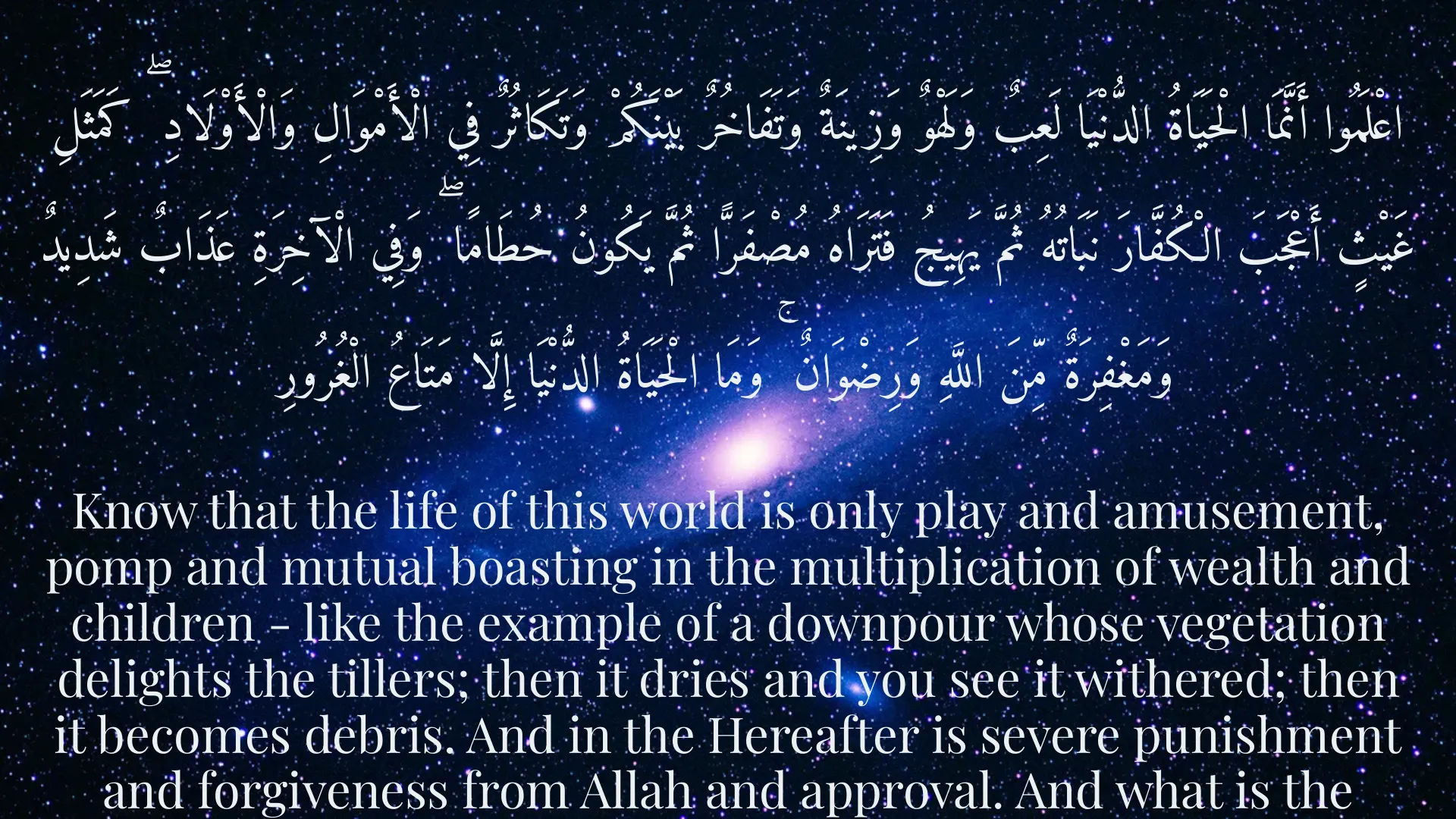
اعْلَمُوا أَنَّمَا الْحَيَاةُ الدُّنْيَا لَعِبٌ وَلَهْوٌ وَزِينَةٌ وَتَفَاخُرٌ بَيْنَكُمْ وَتَكَاثُرٌ فِي الْأَمْوَالِ وَالْأَوْلَادِ ۖ كَمَثَلِ غَيْثٍ أَعْجَبَ الْكُفَّارَ نَبَاتُهُ ثُمَّ يَهِيجُ فَتَرَاهُ مُصْفَرًّا ثُمَّ يَكُونُ حُطَامًا ۖ وَفِي الْآخِرَةِ عَذَابٌ شَدِيدٌ وَمَغْفِرَةٌ مِّنَ اللَّهِ وَرِضْوَانٌ ۚ وَمَا الْحَيَاةُ الدُّنْيَا إِلَّا مَتَاعُ الْغُرُورِ
Know that the life of this world is only play and amusement, pomp and mutual boasting in the multiplication of wealth and children - like the example of a downpour whose vegetation delights the tillers; then it dries and you see it withered; then it becomes debris. And in the Hereafter is severe punishment and forgiveness from Allah and approval. And what is the worldly life except the enjoyment of delusion.
Al-Hadid : 20
وَلَا تَتَمَنَّوْا مَا فَضَّلَ اللَّهُ بِهِ بَعْضَكُمْ عَلَىٰ بَعْضٍ ۚ لِّلرِّجَالِ نَصِيبٌ مِّمَّا اكْتَسَبُوا ۖ وَلِلنِّسَاءِ نَصِيبٌ مِّمَّا اكْتَسَبْنَ ۚ وَاسْأَلُوا اللَّهَ مِن فَضْلِهِ ۗ إِنَّ اللَّهَ كَانَ بِكُلِّ شَيْءٍ عَلِيمًا
And do not wish for that by which Allah has preferred some of you over others. For men is a share of what they have earned, and for women is a share of what they have earned. And ask Allah of His bounty. Indeed, Allah is ever, of all things, Knowing.
An-Nisa : 32
الَّذِينَ آمَنُوا وَتَطْمَئِنُّ قُلُوبُهُم بِذِكْرِ اللَّهِ ۗ أَلَا بِذِكْرِ اللَّهِ تَطْمَئِنُّ الْقُلُوبُ
Those who have believed and whose hearts are assured by the remembrance of Allah. Unquestionably, by the remembrance of Allah hearts are assured.
Ar-Ra'd : 28
بَلْ تُؤْثِرُونَ الْحَيَاةَ الدُّنْيَا
But you prefer the worldly life,
Al-A'la : 16
وَالْآخِرَةُ خَيْرٌ وَأَبْقَىٰ
While the Hereafter is better and more enduring.
Al-A'la : 17
Short Story
It is narrated that a man was passing through a humble neighborhood in a state of distress. He was saying to himself, 'Alas, why do I not have wealth and possessions like so-and-so? Why is my life so simple and devoid of luxuries?' Lost in these thoughts, he encountered an old woman who, despite her poverty and infirmity, had a smile on her face and was quietly remembering God. The man asked her, 'Mother, with all this poverty and old age, how are you so calm and happy?' The old woman replied, 'My son, happiness and peace are not in what you have, but in what you are not and what you do not desire. I am content with what God has given me, and I do not attach my heart to what He has not given. Is it not better that my heart be empty of the love of this world, so it does not suffer from not having it?' The man realized from this saying that true progress is the peace of heart and contentment with divine decree, not the accumulation of worldly possessions.