Quranic Answer
The feeling of reluctance or aversion towards certain religious rulings is a deeply human experience, and it's essential to approach this question with profound empathy and understanding, recognizing that such struggles are often an intrinsic part of a believer's spiritual journey. The Holy Quran, with its unparalleled wisdom, illuminates various reasons why an individual might feel a disconnect or resistance to divine commandments. It is paramount to remember that Islam, by its very essence, is a religion of ease and facilitation, not one of undue hardship. As Allah unequivocally states in Surah Al-Baqarah (2:185), “Allah intends for you ease and does not intend for you hardship.” Therefore, when feelings of aversion emerge, they typically signify underlying internal or external factors that obscure the intrinsic beauty, wisdom, and profound benefits embedded within these divine laws. One of the foremost reasons for this reluctance can be attributed to a weakness in one's faith (Iman) or a lack of deep-seated conviction in the ultimate wisdom, benevolence, and justice of Allah’s commands. If an individual’s belief is superficial, merely lip service, or not deeply rooted in the heart, then fulfilling duties that demand sustained effort, rigorous self-discipline, or the sacrifice of immediate worldly gratifications can indeed appear burdensome and unappealing. The Quran consistently and powerfully emphasizes the cultivation of a firm, unwavering, and sincere faith. When faith is robust, the commandments of Allah are perceived not as restrictive chains, but as luminous guidelines for living a truly meaningful and fulfilling life, a clear path towards spiritual purity, and the most certain means to earn divine pleasure and, ultimately, eternal reward. Conversely, without this profound conviction, the fleeting allure of worldly desires and temporary gains often overshadows eternal considerations, rendering religious obligations as inconvenient obstacles rather than invaluable opportunities for growth. A heart not fully submitted to the Divine will may naturally recoil from what it perceives as limitations or arduous demands. Another crucial contributing factor is the overwhelming allure of worldly life (Dunya) and its transient, often deceptive, pleasures. The Quran repeatedly issues stern warnings against becoming excessively attached to the material realm, constantly reminding believers that the life of this world is merely a fleeting enjoyment when contrasted with the boundless and eternal bliss of the Hereafter. In a poignant revelation in Surah At-Tawbah (9:24), Allah directly challenges the priorities of believers: “Say, [O Muhammad], 'If your fathers, your sons, your brothers, your wives, your relatives, the wealth which you have gained, commerce wherein you fear decline, and dwellings with which you are pleased are dearer to you than Allah and His Messenger and striving in His cause, then wait until Allah executes His command. And Allah does not guide the defiantly disobedient people.'” This verse serves as a powerful mirror, reflecting how an overwhelming prioritization of worldly attachments—be it family, wealth, or comfort—can inexorably lead one astray from the path of divine obedience. When the human heart is consumed by the love of material possessions, social status, or personal comfort, then commands that might necessitate giving up some of these, or enduring a degree of discomfort for the sake of Allah, become exceedingly difficult to embrace and practice. Furthermore, the insidious whispers of Satan (Waswasa) play an undeniable and potent role in fostering reluctance. Shaytan (Satan) is explicitly identified as a sworn enemy of humanity, relentlessly striving to deviate individuals from the straight path. He masterfully plants seeds of doubt, exaggerates the perceived difficulty of religious acts, diminishes their immense rewards, and cunningly beautifies worldly temptations. He makes acts of disobedience appear attractive, easy, or even justifiable, while simultaneously making acts of obedience seem arduous, irrelevant, or excessively restrictive. The Quran unequivocally describes Shaytan’s tireless efforts to misguide humankind. For instance, in Surah Al-A'raf (7:27), Allah forewarns us, “Indeed, he sees you, he and his tribe, from where you do not see them.” Actively seeking refuge in Allah from Shaytan’s subtle insinuations and fortifying one’s spiritual defenses through consistent remembrance of Allah (Dhikr), regular prayer, and recitation of the Quran are indispensable strategies in countering his pervasive influence. A significant, yet often overlooked, reason is a lack of genuine knowledge and profound understanding. When individuals do not fully comprehend the deep wisdom, multifarious benefits, and underlying spiritual and social philosophies that underpin specific religious rulings, they might mistakenly perceive them as arbitrary dictates, irrelevant traditions, or even oppressive burdens. Islam is inherently a rational and comprehensive way of life, and its commandments are never without a profound purpose. They are meticulously designed for the holistic well-being of individuals and the flourishing of society at large, promoting justice, spiritual purity, boundless compassion, and continuous personal growth. Consider, for example, the prohibition of intoxicants: it is not merely a restriction but a comprehensive safeguard against countless social ills, personal degradation, and severe physical and mental harm. If one genuinely grasps the overarching benefits and profound wisdom embedded within a particular command, the intrinsic willingness to obey it naturally escalates. Diligently seeking authentic religious knowledge, deeply pondering over the verses of the Quran, and learning from knowledgeable and righteous scholars can effectively bridge this gap in understanding and transform perception. Finally, inherent human weakness and the innate desire for ease and comfort are integral aspects of our creation. Allah Himself acknowledges this fundamental truth in the Quran, stating in Surah An-Nisa (4:28), “And Allah wants to lighten for you [your difficulties]; and mankind was created weak.” At times, the sheer and sustained effort required for consistent adherence to religious duties—such as performing regular prayers with devotion, fasting during Ramadan, or maintaining modesty in attire and conduct—can feel overwhelming, particularly in a contemporary world that incessantly promotes instant gratification, effortless living, and unbridled personal freedom. The struggle against one’s own lower self (Nafs) is indeed a significant spiritual jihad, a continuous battle for self-mastery. However, it is paramount to reaffirm that Allah never burdens a soul beyond its capacity (Surah Al-Baqarah 2:286). He graciously provides strength, inner peace, and facilitation to those who sincerely strive in His way. Patience (Sabr), unwavering perseverance, and consistent, heartfelt supplication (Du'a) are indispensable virtues for overcoming these innate human vulnerabilities. The spiritual journey of faith is a continuous, dynamic process of purification, growth, and profound self-improvement. Occasional feelings of reluctance should not be seen as failures, but rather as powerful signposts inviting deeper introspection, renewed commitment, and a fresh surge of effort. By diligently nurturing one's faith, assiduously seeking knowledge, resolutely resisting temptations, and relying unequivocally on Allah’s infinite strength and guidance, one can transform initial reluctance into profound, joyful submission, discovering immense tranquility and spiritual fulfillment in sincere adherence to divine commands.
Related Verses
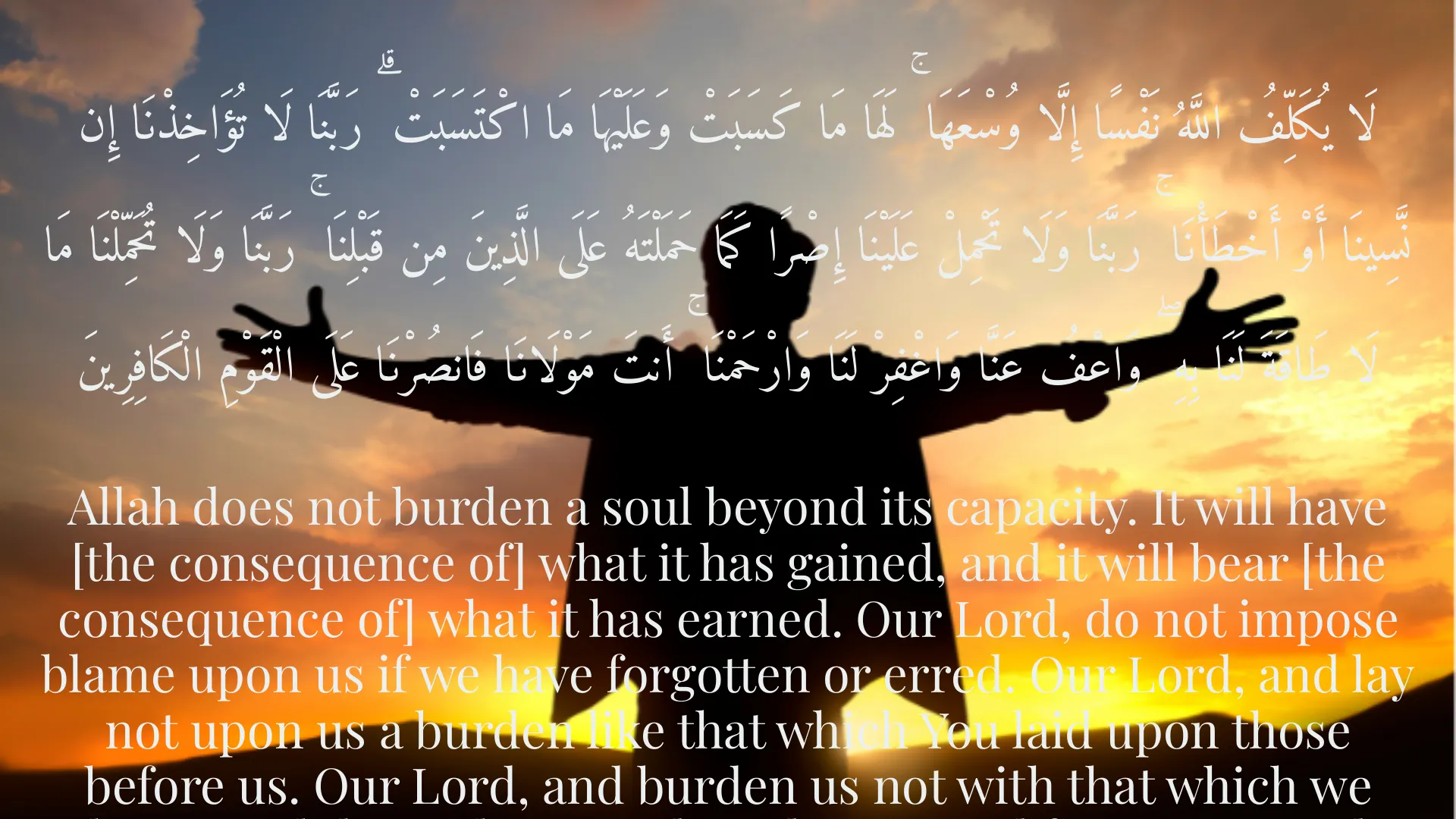
لَا يُكَلِّفُ اللَّهُ نَفْسًا إِلَّا وُسْعَهَا ۚ لَهَا مَا كَسَبَتْ وَعَلَيْهَا مَا اكْتَسَبَتْ ۗ رَبَّنَا لَا تُؤَاخِذْنَا إِن نَّسِينَا أَوْ أَخْطَأْنَا ۚ رَبَّنَا وَلَا تَحْمِلْ عَلَيْنَا إِصْرًا كَمَا حَمَلْتَهُ عَلَى الَّذِينَ مِن قَبْلِنَا ۚ رَبَّنَا وَلَا تُحَمِّلْنَا مَا لَا طَاقَةَ لَنَا بِهِ ۖ وَاعْفُ عَنَّا وَاغْفِرْ لَنَا وَارْحَمْنَا ۚ أَنتَ مَوْلَانَا فَانصُرْنَا عَلَى الْقَوْمِ الْكَافِرِينَ
Allah does not burden a soul beyond its capacity. It will have [the consequence of] what it has gained, and it will bear [the consequence of] what it has earned. Our Lord, do not impose blame upon us if we have forgotten or erred. Our Lord, and lay not upon us a burden like that which You laid upon those before us. Our Lord, and burden us not with that which we have no ability to bear. And pardon us; and forgive us; and have mercy upon us. You are our protector, so give us victory over the disbelieving people.
Al-Baqarah : 286
وَيُرِيدُ اللَّهُ أَن يُخَفِّفَ عَنكُمْ ۚ وَخُلِقَ الْإِنسَانُ ضَعِيفًا
And Allah wants to lighten for you [your difficulties]; and mankind was created weak.
An-Nisa : 28
قُلْ إِن كَانَ آبَاؤُكُمْ وَأَبْنَاؤُكُمْ وَإِخْوَانُكُمْ وَأَزْوَاجُكُمْ وَعَشِيرَتُكُمْ وَأَمْوَالٌ اقْتَرَفْتُمُوهَا وَتِجَارَةٌ تَخْشَوْنَ كَسَادَهَا وَمَسَاكِنُ تَرْضَوْنَهَا أَحَبَّ إِلَيْكُمْ مِّنَ اللَّهِ وَرَسُولِهِ وَجِهَادٍ فِي سَبِيلِهِ فَتَرَبَّصُوا حَتَّى يَأْتِيَ اللَّهُ بِأَمْرِهِ ۚ وَاللَّهُ لَا يَهْدِي الْقَوْمَ الْفَاسِقِينَ
Say, [O Muhammad], 'If your fathers, your sons, your brothers, your wives, your relatives, the wealth which you have gained, commerce wherein you fear decline, and dwellings with which you are pleased are dearer to you than Allah and His Messenger and striving in His cause, then wait until Allah executes His command. And Allah does not guide the defiantly disobedient people.'
At-Tawbah : 24
Short Story
It is said that a pious man was treading a difficult path and complaining about its hardship and adversities. A wise man saw him and, with a warm and fatherly tone, said: "O good man, do not imagine that the righteous and good path is always smooth. Sometimes one must pass through thorns to reach the roses, and one must overcome difficulties to attain true peace. If you empty your heart of doubt and firmly set your foot on the path of truth, you will see that however difficult it may seem, a greater ease and comfort are hidden behind it. Like a bitter medicine that cures the soul, religious rulings may appear difficult on the surface, but their inner essence is the healing of the spirit and eternal felicity." The pious man was heartened by these words and continued his journey with stronger resolve, soon tasting the sweetness of his destination and finding true peace in adherence to divine commands.