Quranic Answer
The question of why some individuals worship solely out of fear of Hell requires a profound understanding of the various dimensions of faith and human motivations as presented in the Holy Quran. The Quran explicitly warns against divine punishment and Hellfire, while also speaking of the rewards of Paradise and the boundless mercy of Allah. Both of these aspects—fear and hope—are legitimate and significant motivations for human beings to incline towards goodness and shun evil. However, what truly matters is the balance and depth of these motivations. Fear of Hell, as a potent deterrent, is frequently mentioned in numerous verses of the Quran. Allah Almighty repeatedly cautions humanity about the consequences of sins and disobedience to guide them towards righteousness. This fear is not a paralyzing one; rather, it is a constructive fear that compels individuals to reflect upon their actions and their worldly and otherworldly outcomes. For instance, in Surah At-Tahrim, verse 6, Allah states: “O you who have believed, protect yourselves and your families from a Fire whose fuel is people and stones...” This verse clearly illustrates the cautionary role of Hell, calling people to responsibility and righteous deeds. For many, this initial fear of punishment serves as a gateway to embark on the path of servitude to Allah and to observe His divine limits. This fear encourages individuals to abstain from major sins and fulfill the minimum requirements of their religious duties. Especially in the early stages of faith, when one's understanding has not yet reached a sufficient depth, the apprehension of dire consequences can play a very effective role in shaping correct worship practices and moral habits. The contemplation of the hardships and sufferings of Hell provides a clear understanding of the repercussions of transgressing divine commands and strengthens an individual against temptations and carnal desires. However, the Holy Quran does not rely solely on fear. Alongside warnings of punishment, it consistently speaks of Allah's vast mercy, His forgiveness, and the boundless rewards of Paradise. This hope in divine mercy and reward is the second wing of a human being's flight on the path of servitude. In Surah Az-Zumar, verse 53, we read: “Say, ‘O My servants who have transgressed against themselves [by sinning], do not despair of the mercy of Allah. Indeed, Allah forgives all sins. Indeed, it is He who is the Forgiving, the Merciful.’” This verse demonstrates how powerfully motivating the hope for divine forgiveness can be. Worship that is based purely on fear might become tiresome or even lead to despair in the long run; however, worship accompanied by hope in Allah's grace and generosity breathes new life into the soul and makes the path of servitude more enjoyable. Therefore, a true believer engages in balanced worship; they are both apprehensive of Allah's punishment and hopeful for His mercy. This balance prevents them from falling into extremes. Yet, the highest rank of worship, transcending fear of Hell and hope for Paradise, is worship motivated by love and affection for Allah Almighty. The Quran describes true believers as those who possess the most intense love for Allah. In Surah Al-Baqarah, verse 165, it states: “...But those who believe are stronger in love for Allah...” At this level of faith, a person loves and worships God not to escape punishment, nor solely to attain rewards, but because of His divine essence, His attributes of beauty and perfection, and the countless blessings He bestows. This worship is an act of passionate devotion and gratitude. At this stage, the individual becomes so immersed in the knowledge and understanding of their Lord that being in His presence and performing acts of servitude becomes the greatest pleasure. They understand that everything they possess comes from Him, and every breath they take is by His grace. This perspective transforms worship from a mere obligation into an intrinsic need and a manifestation of love. This type of worship is more enduring and profound because it originates from within and is not dependent on external factors such as fear or greed. When the heart is filled with divine love, worship is not only tireless but also becomes the greatest source of peace and joy. Such an individual, even if there were no Heaven or Hell, would still worship and draw closer to their Creator out of knowledge and love for Him. Thus, the answer to why some individuals worship only out of fear of Hell can have several dimensions: 1. Initial Stage of Faith: For many, the fear of the consequences of sin is the first spark that draws them towards religiosity. This is a valid starting point. Initially, due to insufficient knowledge or weakness of will, individuals might not be able to achieve higher motivations like love. 2. Focus on Deterrent Aspects of Religion: Some might predominantly perceive religion as a set of rules and restrictions meant to prevent wrongdoing. While this view is part of religious truth, it is not the entirety of it. Religion is a comprehensive guide for human growth and perfection. 3. Weakness in Divine Knowledge (Ma'rifah): The more a person's understanding of Allah's attributes (His Rahmaniyyah – all-encompassing mercy, Razzaqiyyah – sustainer, Ghafoor – most forgiving, etc.) deepens, the more varied and profound their motivations for worship become. Someone who knows God only as “the Punisher” will naturally only fear Him. But someone who knows Him as “the Most Gracious, the Most Merciful, the Forgiving, the Loving, the Appreciative” will become hopeful and loving towards Him. 4. Influence of Upbringing and Environment: The way religious education is imparted in families or societies can also play a role in shaping this motivation. If religiosity is taught solely through the lens of fear of punishment, the individual will naturally focus on this aspect. The Quran's purpose in mentioning Hell and Paradise is to create a strong incentive for people to follow the path of guidance and achieve perfection. A mature believer moves beyond mere fear and hope to achieve “Ikhlas” (sincerity) in worship. Surah Al-Bayyinah, verse 5, clearly states this sincerity: “And they were not commanded except to worship Allah, [being] sincerely obedient to Him in religion...” Sincere worship means worship that is neither out of fear of Hell nor greed for Paradise, but solely and purely for the pleasure of the Lord and drawing closer to His sacred essence. This type of worship is the pinnacle of servitude, free from any hint of hidden polytheism or ulterior motives. At this stage, a person understands that even if there were no Heaven or Hell, they would still worship their Lord out of gratitude and love, and adhere to His commands. This is because they comprehend that Allah alone is worthy of absolute worship, and human perfection lies precisely in this sincere servitude. Therefore, although fear of Hell can be an initial and important motivation for worship, it is only a small part of the broad spectrum of motivations introduced by the Quran for worship. The perfection of faith and spiritual growth lies in an individual's ability to transcend mere fear and hope, reaching the stages of love, sincerity, and gratitude. This path is a spiritual journey wherein one's knowledge of Allah deepens, and their acts of worship transform from dry obligations into a vibrant connection filled with love and peace. Ultimately, all these motivations should coexist to enable an individual to achieve balance in their servitude: apprehension of punishment, hope for reward, and above all, love and sincerity towards the Creator of existence.
Related Verses
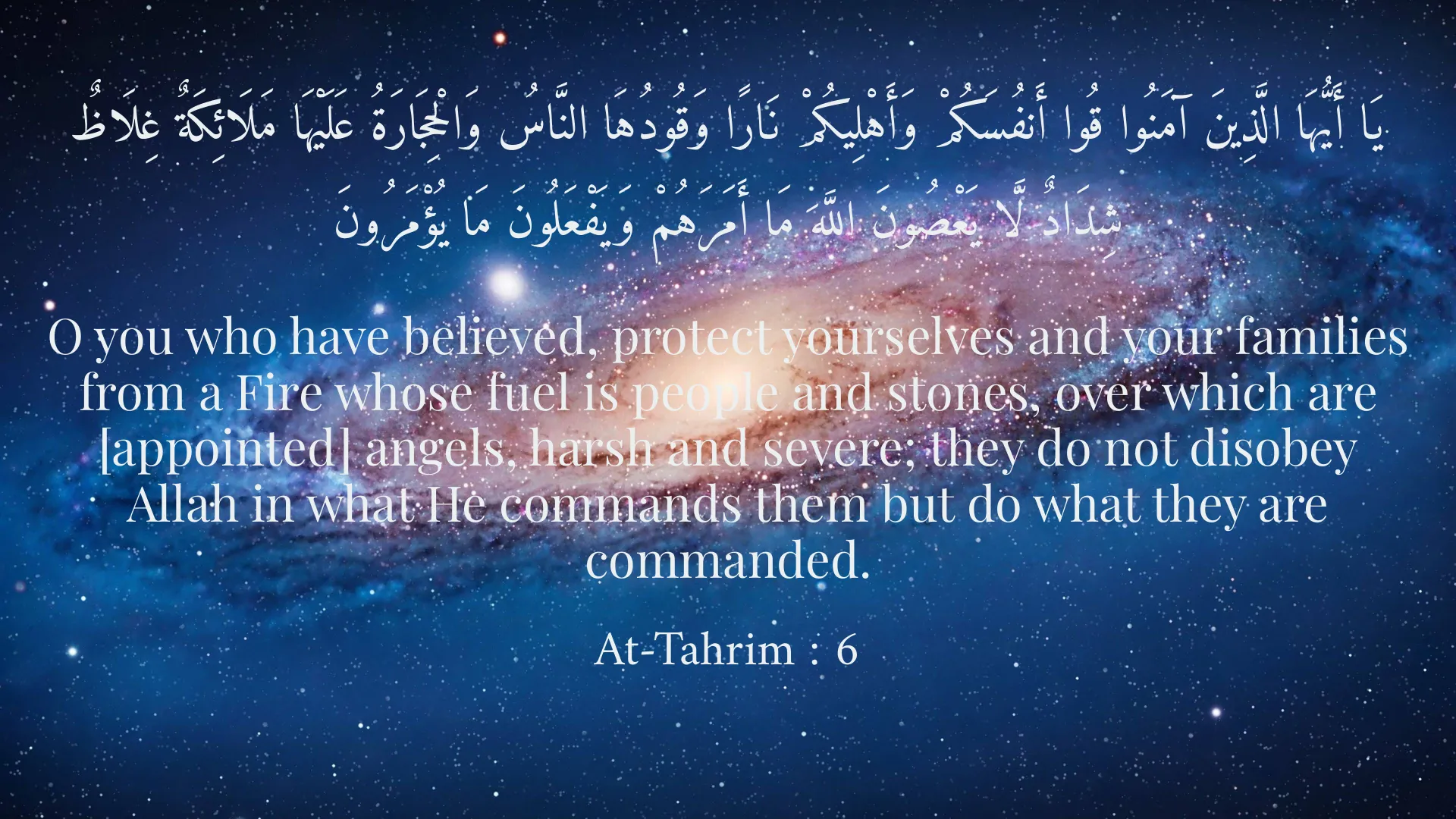
يَا أَيُّهَا الَّذِينَ آمَنُوا قُوا أَنفُسَكُمْ وَأَهْلِيكُمْ نَارًا وَقُودُهَا النَّاسُ وَالْحِجَارَةُ عَلَيْهَا مَلَائِكَةٌ غِلَاظٌ شِدَادٌ لَّا يَعْصُونَ اللَّهَ مَا أَمَرَهُمْ وَيَفْعَلُونَ مَا يُؤْمَرُونَ
O you who have believed, protect yourselves and your families from a Fire whose fuel is people and stones, over which are [appointed] angels, harsh and severe; they do not disobey Allah in what He commands them but do what they are commanded.
At-Tahrim : 6
وَمِنَ النَّاسِ مَن يَتَّخِذُ مِن دُونِ اللَّهِ أَندَادًا يُحِبُّونَهُمْ كَحُبِّ اللَّهِ ۖ وَالَّذِينَ آمَنُوا أَشَدُّ حُبًّا لِّلَّهِ ۗ وَلَوْ يَرَى الَّذِينَ ظَلَمُوا إِذْ يَرَوْنَ الْعَذَابَ أَنَّ الْقُوَّةَ لِلَّهِ جَمِيعًا وَأَنَّ اللَّهَ شَدِيدُ الْعَذَابِ
And [yet], among the people are those who take other than Allah as equals [to Him]. They love them as they should love Allah. But those who believe are stronger in love for Allah. And if only those who have wronged would consider [that] when they see the punishment, [they will be certain] that all power belongs to Allah and that Allah is severe in punishment.
Al-Baqarah : 165
وَمَا أُمِرُوا إِلَّا لِيَعْبُدُوا اللَّهَ مُخْلِصِينَ لَهُ الدِّينَ حُنَفَاءَ وَيُقِيمُوا الصَّلَاةَ وَيُؤْتُوا الزَّكَاةَ ۚ وَذَٰلِكَ دِينُ الْقَيِّمَةِ
And they were not commanded except to worship Allah, [being] sincerely obedient to Him in religion, inclining to truth, and to establish prayer and to give zakah. And that is the correct religion.
Al-Bayyinah : 5
Short Story
One day, a dervish in a humble monastery was engaged in ceaseless worship with immense asceticism. People marveled at his piety and considered him among the righteous. A wise elder, observing his state, approached him one day and kindly asked, "O virtuous man, what moves your heart to such fervent devotion?" The dervish humbly replied, "I dread the torment of Hellfire, and with the tears of my prayers, I strive to extinguish its flames." The elder smiled gently and said, "Indeed, fear is a bridle that keeps many from transgression. Yet, consider the nightingale that sings not for fear of the hunter's snare, but out of pure love for the rose. True worship, my dear friend, blossoms when the heart turns to God not merely from dread of His wrath, but from the joy of His presence and the immense grace He bestows. The path of fear leads to avoidance, but the path of love leads to embrace. Strive for the latter, and your worship shall be sweeter than honey and more enduring than mountains." From that day, the dervish pondered the elder's words, and gradually, his fear transformed into profound love and gratitude, making his worship a source of inner peace and joy.